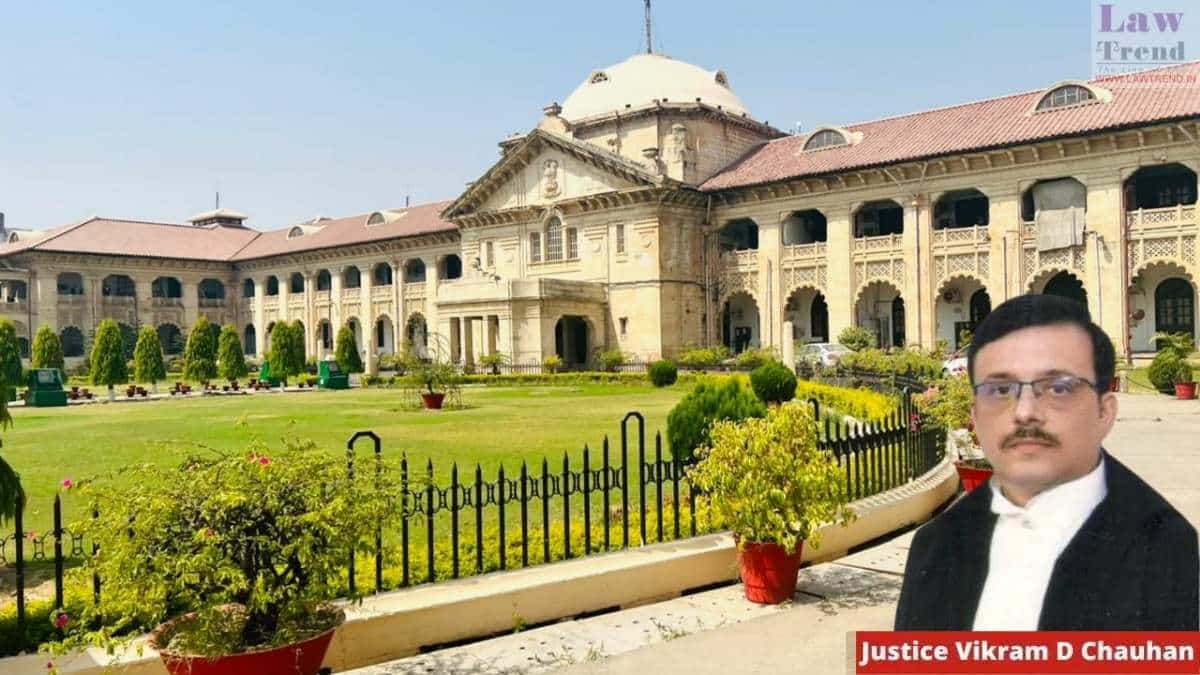
The Allahabad High Court has ruled that an internal circular of a bank prescribing a limitation period for submitting applications for ex-gratia payment cannot be enforced against the legal heirs of a deceased employee unless the document was communicated to them.
The bench of Justice Vikram D. Chauhan, while setting aside the orders passed by the Central Bank of India rejecting a claim for ex-gratia payment on the grounds of delay, observed that internal documents of a bank are “normally not within the knowledge of any person, who is not connected with the Bank unless the same is published and is widely circulated.”
Background of the Case
The writ petition was filed by Rajiv Mishra, challenging the orders dated September 19, 2013, and November 8, 2013, passed by the Central Bank of India. The petitioner sought a direction for the bank to consider the application for appointment under the Dying in Harness Rules or, alternatively, to provide ex-gratia payment in lieu of appointment.
The petitioner’s mother, an employee of the respondent-Bank, passed away on October 7, 2011. On February 8, 2013, the petitioner applied for a compassionate appointment. Responding to this request, the Bank issued a letter on February 23, 2013, stating that while compassionate appointment could not be awarded, ex-gratia payment could be made if the necessary papers were submitted.
Pursuant to the Bank’s letter, the petitioner’s brother, Sanjeev Mishra, applied for the ex-gratia payment on July 7, 2013. However, the Bank rejected the application on November 8, 2014, citing a circular dated April 9, 2008. The Bank contended that under this circular, an application for ex-gratia lump sum payment in lieu of compassionate appointment must be submitted within six months from the date of the employee’s death.
It was also noted that the petitioner’s brother, Sanjeev Mishra, who originally applied, passed away in 2017. Consequently, the present petition was pursued by Rajiv Mishra on the ground that ex-gratia payment is for the benefit of the entire family.
Arguments of the Parties
Counsel for the petitioner, Mr. B.P. Verma, argued that the limitation period relied upon by the Bank arose from an internal circular dated April 9, 2008, which was not within the knowledge of the legal heirs. He submitted that it was only after the Bank invited the application via its letter dated February 23, 2013, that the family became aware of the option. The application was filed by the brother on July 7, 2013, which was well within six months from the date the Bank invited the claim.
Learned counsel for the respondent-Bank, Mr. Gyan Prakash Srivastava and Mr. V.K. Shrivastava, defended the rejection, submitting that the claim was barred by limitation as per the Bank’s circular, which mandates filing the application within six months of the death. Since the employee died in 2011 and the application was made in 2013, it was beyond the prescribed time.
Court’s Analysis and Observations
The Court questioned the Bank’s counsel as to why the Bank issued the letter on February 23, 2013, inviting an application for ex-gratia payment if it was already aware that the limitation period had expired under its 2008 circular. The Court noted that the counsel for the Bank “could not give any satisfactory reply in this respect.”
Justice Chauhan emphasized that ex-gratia payment is granted in lieu of compassionate appointment and is intended for the sustenance of the deceased employee’s family. Regarding the binding nature of the limitation circular, the Court observed:
“The internal circular of Bank are normally not within the knowledge of any person, who is not connected with the Bank unless the same is published and is widely circulated. It is not the case of the Bank that petitioner was having knowledge of the circular dated 9.4.2008 at the time of death of employee. It is not shown by learned counsel for respondent-Bank that the legal heirs of deceased employee was communicated with the circular of the Bank dated 9.4.2008.”
The Court held that since the Bank itself invited the application in February 2013, the “date of knowledge” of the circular could, at best, be reckoned from that date. Since the application was filed in July 2013, it was within a reasonable period from the date of knowledge.
The Court further held:
“Internal circular cannot by itself cause a limitation on applying unless the internal document is communicated to legal heirs of deceased employee, which in the present case, Bank has not shown.”
Regarding the death of the original applicant (the petitioner’s brother), the Court clarified that “Ex-gratia payment is for the benefit of family members of the deceased employee and as such, each member of the family would be entitled to claim the same.”
Decision
The High Court allowed the writ petition and set aside the impugned orders dated September 19, 2013, and November 8, 2013.
The Court remanded the matter back to the respondent-Bank to consider the application for ex-gratia payment “without going into the question of limitation” within a period of three months. The Court further directed that if any formalities or documents are required, the Bank must communicate the same to the petitioner within 15 days, and the petitioner shall complete such formalities within one month thereafter.
Case Details:
- Case Title: Rajiv Mishra vs. Managing Director Central Bank Of India And 2 Others
- Case Number: WRIT – A No. 32433 of 2015
- Bench: Justice Vikram D. Chauhan
- Counsel for Petitioner: B.P. Verma
- Counsel for Respondents: Gyan Prakash Srivastava, V.K. Shrivastava, Standing Counsel