

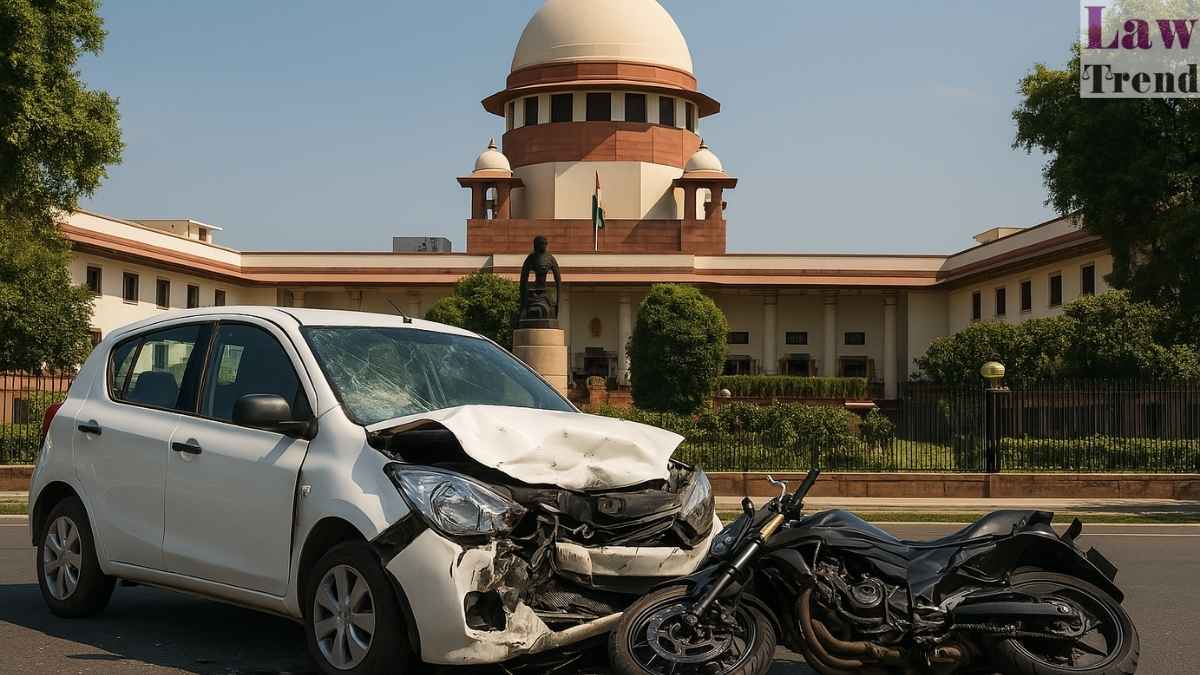
The Supreme Court of India has enhanced the compensation awarded to a motor accident victim to ₹97,73,011, setting aside a Madras High Court order that had significantly reduced the payout. A Bench comprising Justice Prashant Kumar Mishra and Justice Sandeep Mehta held that the appellant, a former manager, suffered 100% functional disability due to severe cognitive impairments and “Mild Intellectual Disability” resulting from a brain injury, rendering him unfit for his previous profession.
Background of the Case
The case pertains to an accident that occurred on the night of May 5, 2016. The appellant, R. Halle, then 30 years old and employed as a Manager at Flyjac Logistics Pvt. Ltd., was traveling on his motorcycle when another motorcycle, driven rashly by one R. Chinnadurai, collided head-on with him.
The impact resulted in grievous injuries, including a severe head injury, facial injuries, and a left femur fracture. Despite prolonged treatment, the appellant was left with permanent disabilities. He approached the Motor Accidents Claims Tribunal (MACT), Coimbatore, which awarded him ₹65,53,811 in compensation, assessing his permanent physical disability at 63%.
The High Court of Judicature at Madras, however, reduced this compensation to ₹35,61,000 in January 2022. While the Medical Board had certified 63% physical disability, the High Court “abruptly concluded” that the functional disability should only be reckoned at 30%, prompting the appellant to move the Supreme Court.
Arguments of the Parties
Senior Counsel Ms. Haripriya Padmanaban, appearing for the appellant, argued that the High Court failed to appreciate the severity of the neurological damage. She highlighted that a neuropsychological assessment revealed severe impairment of verbal and visual memory, frontal lobe dysfunction, and an IQ score of 65, categorizing him under “Mild Intellectual Disability.” She contended that for a managerial role, these deficits constituted 100% functional disability.
On the other hand, Ms. Prerna Mehta, counsel for Reliance General Insurance, supported the High Court’s judgment. She argued that physical disability cannot be equated with functional disability and that there was no evidence of total incapacitation to earn a livelihood in any form.
The Court’s Analysis and Observations
The Supreme Court criticized the High Court for reducing the disability percentage without providing “cogent reasons” or “independent analysis” of the medical evidence. The Bench observed:
“In our considered opinion, such conclusions, abruptly arrived at without proper reappreciation of the evidence and without recording adequate reasons, are in the nature of presumptions and assumptions and cannot be sustained in the eyes of law.”
The Court relied heavily on the medical reports, noting that the injuries led to partial blindness, cognitive impairment, and severe memory loss. Citing the landmark precedent in Raj Kumar v. Ajay Kumar (2011) 1 SCC 343, the Court reiterated that the assessment of functional disability must be grounded in a realistic appraisal of the injury’s impact on the claimant’s specific avocation.
Regarding the appellant’s role as a Manager, the Court remarked:
“The evidence does not indicate a mere diminution in efficiency, rather, it demonstrates a profound erosion of the faculties essential for gainful employment in his chosen field… the appellant-claimant would neither be considered suitable for the managerial post nor would he be capable of effectively discharging the onerous responsibilities attached to the said post.”
The Decision
The Supreme Court determined the functional disability to be 100% for the purpose of computing loss of earning capacity. The total compensation was recalculated as follows:
- Future Loss of Earning Power: ₹81,60,000 (at 100% disability)
- Medical Expenses: ₹5,88,011
- Pain and Sufferings: ₹5,00,000
- Loss of Amenities: ₹3,00,000
- Other Heads (Transportation, Marital Prospects, etc.): ₹2,25,000
- Total: ₹97,73,011
The Court directed the respondent-insurer to deposit the balance amount with 7.5% interest within six weeks.
Before concluding, the Bench issued a stern reminder to appellate courts, stating that when interfering with the findings of the MACT—a body operating under “beneficial and welfare-oriented legislation”—it is incumbent upon the court to provide clear and convincing reasons.
Case Details:
- Case Title: R. Halle vs. Reliance General Insurance Company Limited
- Case Number: Civil Appeal No(s). ___ of 2026 (Arising out of SLP (Civil) Diary No. 37186 of 2023)
- Bench: Justice Prashant Kumar Mishra and Justice Sandeep Mehta
- Date: March 18, 2026




