

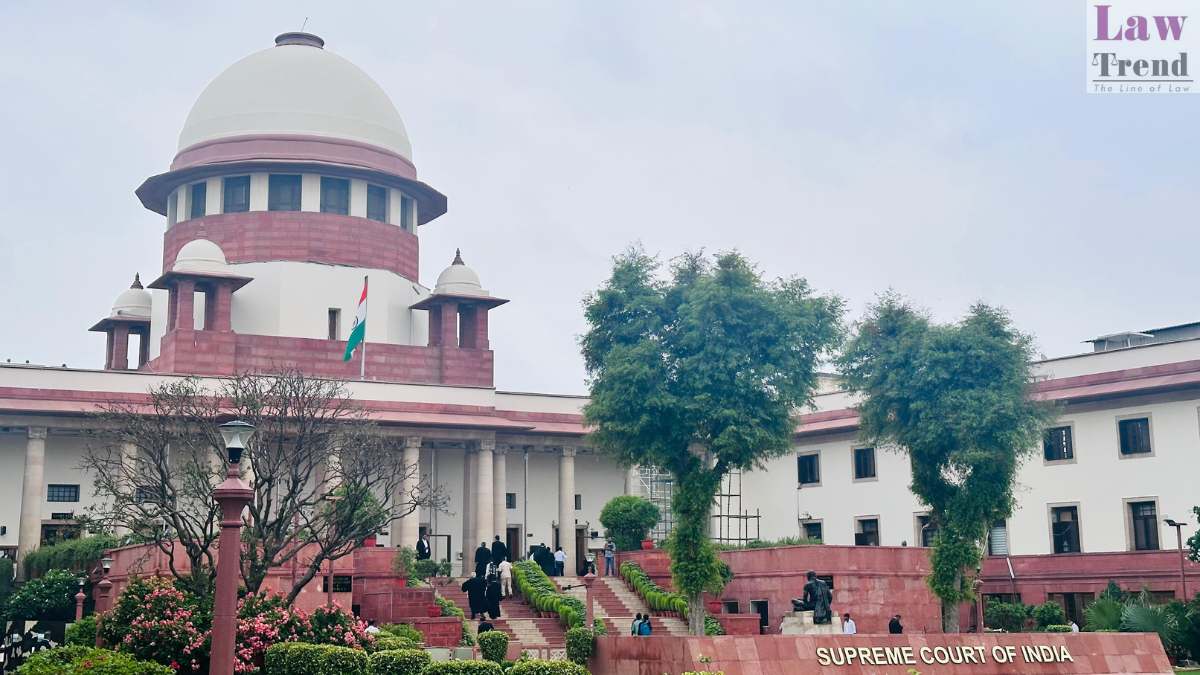
The Supreme Court of India has ruled that an Executing Court lacks the jurisdiction to modify the terms of a compromise decree, emphasizing that its role is strictly limited to giving effect to the decree as passed. The Court held that even if the exchange of specific portions of land as stipulated in a decree is considered “impracticable” due to existing constructions or third-party sales, the Executing Court cannot substitute its own view or alter the allotted portions.
A Bench comprising Justice Pankaj Mithal and Justice Prasanna B. Varale set aside orders from an Executing Court and the High Court that had modified a 2017 compromise decree concerning land in Panchgani, Maharashtra. The Court directed the Executing Court to execute the decree in its original “terms and tenor.”
Background of the Case
The dispute originated from Civil Suit No. 68 of 2012 regarding non-agricultural land in Plot No. 396(A), Village Panchgani, Satara. The appellant (plaintiff) had originally purchased 97.12R of land, eventually selling portions to the respondent (defendant) and retaining others. Following a dispute over 51R of land, the parties entered into a compromise on July 8, 2017.
A compromise decree was drawn on July 14, 2017, which provided:
- 10R of land would remain in common ownership for easementary rights (common road).
- The remaining 41R would be divided equally (20.5R each).
- Specific boundaries were described: the appellant was allotted an area including a residential bungalow and constructions to the western side, while the respondent was allotted the area on the western side of the appellant’s bungalow.
Execution petitions were filed by both parties. In the respondent’s execution petition (No. 21 of 2018), the Executing Court passed orders on July 19, 2021, and August 26, 2021, modifying the specific land areas allotted in the original decree. The Executing Court reasoned that certain constructions were not as per the sanctioned plan, making the original allotment “not practicable,” and noted that 10R of the plot had allegedly been sold to a third party. The High Court upheld these modifications on April 21, 2022.
Arguments of the Parties
Appellant’s Submissions: Senior Counsel Shri Shoeb Alam, appearing for the appellant, argued that it is a settled principle of law that an Executing Court cannot go behind the decree. He contended that the court must execute the decree exactly as it stands without making any modifications, and therefore, the orders varying the allotted portions were manifest errors of law.
Respondent’s Submissions: Counsel Shri Gopal Jha, representing the respondent, argued that the Executing Court correctly interpreted the decree to ensure it did not become “inexecutable.” Relying on the three-judge bench decision in Jai Narain Ram Lundia v. Kedar Nath Khetan and Ors. (1956), he argued that the Executing Court has the power to ensure parties receive what the decree directs and can resolve disputes to facilitate execution.
Court’s Analysis and Observations
The Supreme Court examined Section 47 of the Code of Civil Procedure (CPC), which governs questions to be determined by the Court executing a decree. The Court observed:
“A plain reading of the aforesaid provision makes it clear that the Executing Court is empowered to decide questions relating to execution, discharge or satisfaction of the decree and has no jurisdiction to go beyond the decree sought to be executed.”
The Court reiterated the principle established in Vasudev Dhanjibhai Modi v. Rajabhai Abdul Rehman (1970), noting that the Executing Court must take the decree according to its tenor and cannot entertain objections that the decree was incorrect in law or on facts.
Addressing the respondent’s reliance on Jai Narain Ram Lundia, the Court clarified that while an Executing Court can resolve disputes regarding the identity of land if it is unclear, it has no jurisdiction to vary the terms of the decree where the identity is already established.
The Bench noted:
“In the instant case, there is no dispute of identity of the land falling into the shares of both the parties. The compromise decree clearly describes the portions of land falling into the shares of the parties. Therefore, the Executing Court has to ensure that both the parties fulfil their obligations and exchange the land as per the decree…”
The Court further held that factors such as the “practicability” of exchanging portions due to construction issues or sales to third parties are “immaterial” to the Executing Court’s jurisdiction.
The Decision
The Supreme Court concluded that the Executing Court exceeded its jurisdiction by altering the terms of the compromise decree.
“Since the Executing Court in passing the orders dated 19.07.2021 and 26.08.2021 has gone beyond its jurisdiction and instead of directing for the execution of the decree as it stands, has altered its terms by changing certain portions of the land allotted to the parties, the same are unsustainable in law.”
The Court allowed the appeal, setting aside the orders dated July 19, 2021, August 26, 2021, and the consequential order dated October 11, 2021. The Executing Court was directed to execute the decree strictly according to its original terms and tenor.
Case Details:
- Case Title: Maurice W. Innis v. Lily Kazrooni @ Lily Arif Shaikh
- Case No.: Civil Appeal No. ___ of 2026 (Arising out of SLP (C) No. 8166 of 2022)
- Bench: Justice Pankaj Mithal and Justice Prasanna B. Varale
- Date: April 09, 2026




