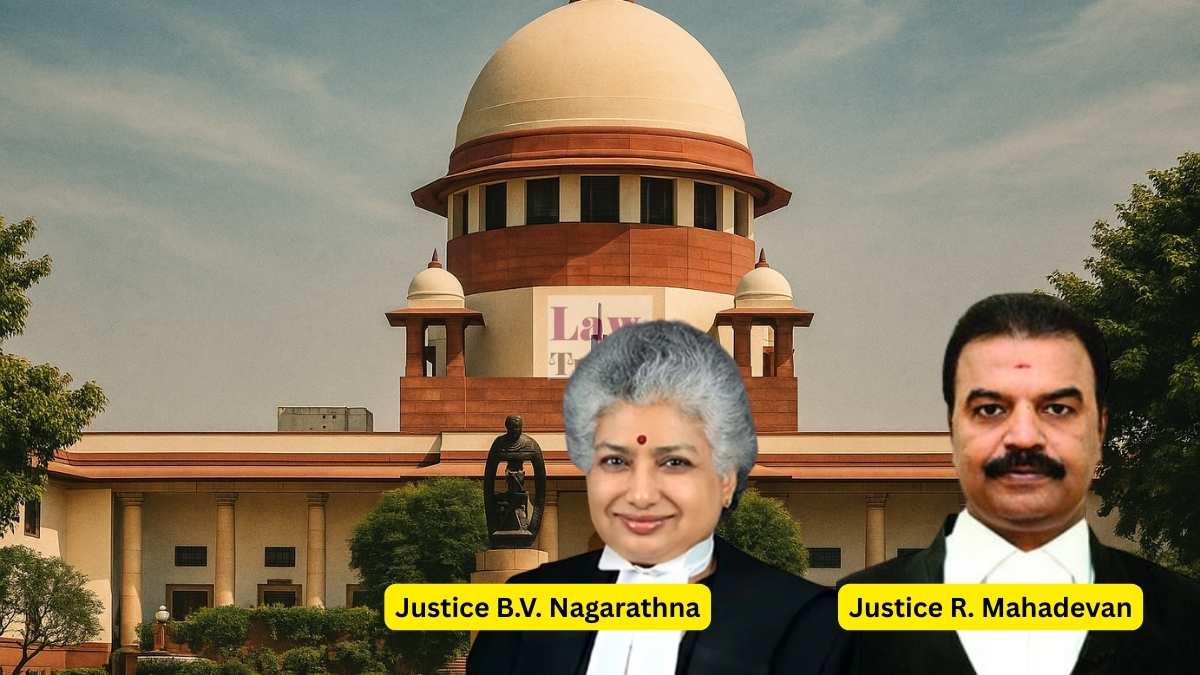
The Supreme Court has set aside a judgment of acquittal passed by the Himachal Pradesh High Court, thereby restoring the conviction and life imprisonment sentence of a man accused of setting his wife on fire.
The Bench, comprising Justice B.V. Nagarathna and Justice R. Mahadevan, observed that the High Court had erred in discarding the dying declaration of the deceased on “speculative and hyper-technical grounds.”
The central legal issue before the Supreme Court was whether the High Court was justified in reversing a conviction under Section 302 of the Indian Penal Code (IPC) by discarding a dying declaration due to minor discrepancies regarding the time of recording and the manner of its documentation. The Supreme Court held that the dying declaration was voluntary and trustworthy, and the High Court had committed a “manifest error” in acquitting the accused. Consequently, the acquittal was set aside, and the life sentence imposed by the trial court was restored.
Background of the Case
The case dates back to December 7, 2009, when the respondent, Chaman Lal, allegedly poured kerosene on his wife, Saro Devi, at their residence in Village Rampur, District Chamba, and set her on fire. The prosecution stated that the couple, who married in 2002, had strained relations, and the accused frequently doubted her character.
Following the incident, the victim was taken to the District Hospital, Chamba. On December 8, 2009, the Tehsildar-cum-Executive Magistrate (PW-1) recorded her statement, which was treated as the dying declaration. In her statement, Saro Devi categorically alleged that her husband had set her on fire after insulting her by calling her a “Kanjri” (woman of bad character). She succumbed to her burn injuries on January 15, 2010.
The Sessions Judge, Chamba, convicted Chaman Lal under Section 302 IPC on July 16, 2010, sentencing him to life imprisonment. However, the Himachal Pradesh High Court, in its judgment dated August 26, 2014, acquitted the accused, citing discrepancies regarding the time the Tehsildar arrived at the hospital and doubts over the manner in which the declaration was recorded. The State of Himachal Pradesh appealed this acquittal before the Supreme Court.
Arguments of the Parties
Arguments on behalf of the State (Appellant): Appearing for the State, counsel Mr. Vivek Kumar argued that the High Court committed a serious error by relying selectively on the testimony of the deceased’s brother (PW-2) to doubt the time of the Tehsildar’s arrival. The State contended that the Tehsildar (PW-1) and the Deputy Superintendent of Police (PW-10) consistently deposed that the statement was recorded around 11:00-11:15 a.m.
The State further submitted that the dying declaration was recorded by an independent public servant after obtaining medical fitness certification and was fully corroborated by ocular evidence. It was argued that the High Court erred in discarding the testimony of independent witnesses while placing undue reliance on hostile witnesses.
Arguments on behalf of the Respondent (Accused): On behalf of the respondent, Amicus Curiae Mr. Krishna Pal Singh argued that the earliest version of the incident, recorded in the FIR, did not name the accused. He relied on testimonies of hostile witnesses, including the Ward Member (PW-4) and the accused’s aunt (PW-5), who claimed the deceased had poured kerosene on herself.
The defence also pointed out that the accused sustained burn injuries (about 3% on his hand) while trying to save his wife, supporting the theory of self-immolation. It was further argued that the presence of police officers during the recording of the dying declaration cast doubt on its authenticity, suggesting possible manipulation.
Court’s Analysis
The Supreme Court examined the validity of the dying declaration under Section 32(1) of the Indian Evidence Act. Referring to precedents such as Khushal Rao v. State of Bombay and Laxman v. State of Maharashtra, the Court reiterated that a conviction can rest solely on a truthful and voluntary dying declaration without corroboration.
On the Reliability of the Dying Declaration The Bench found the dying declaration in the present case to be “voluntary, truthful and reliable.” It noted that the statement was recorded by a neutral public officer (PW-1) after the doctor certified the patient was fit.
Addressing the High Court’s reasoning regarding the time discrepancy and recording method, the Supreme Court observed:
“The High Court disbelieved the dying declaration primarily on two grounds: (i) an alleged inconsistency with respect to the time at which the statement was recorded; and (ii) a doubt as to whether PW-1 himself recorded the statement or merely dictated it. In our considered opinion, neither ground is sustainable.”
The Court clarified that the minor discrepancy regarding the time, which was explained by the witness, did not go to the root of the prosecution case. Regarding the procedure, the Bench noted:
“Recording a dying declaration under the supervision of a Magistrate does not render it invalid… The High Court thus discarded the dying declaration on conjectures not borne out by the evidence.”
On Hostile Witnesses and Defence Plea The Court rejected the defence’s reliance on hostile witnesses, terming their versions as hearsay unsupported by independent evidence. Regarding the plea of self-immolation and the injuries sustained by the accused, the Court stated:
“The alleged conduct of the respondent in attempting to extinguish the fire and sustaining minor burn injuries does not, by itself, exonerate him from culpability. Such conduct can equally be consistent with an attempt to create an appearance of innocence after the commission of the offence.”
On Motive On the issue of motive, the Court held that while the dying declaration itself referred to matrimonial discord, “failure to conclusively prove motive does not weaken an otherwise reliable and cogent case” when there is direct evidence in the form of a credible dying declaration.
Decision
The Supreme Court held that the High Court fell into “manifest error” by reversing the well-reasoned judgment of the trial court based on a re-appreciation of evidence contrary to settled principles.
The Bench ruled:
“The High Court erred in discarding this crucial piece of evidence on speculative and hyper-technical grounds… Accordingly, the criminal appeal filed by the appellant – State is allowed. The impugned judgement of acquittal passed by the High Court is set aside. Consequently, the judgement of conviction and order of sentence passed by the trial Court are restored.”
The respondent was directed to surrender forthwith to undergo the remaining sentence.
Case Details:
- Case Title: State of Himachal Pradesh vs. Chaman Lal
- Case No: Criminal Appeal No. 430 of 2018
- Coram: Justice B.V. Nagarathna and Justice R. Mahadevan