The Supreme Court has set aside the decision of the Allahabad High Court which had reinstated a candidate whose appointment was cancelled for suppressing information regarding pending criminal cases. Relying on the legal maxim dura lex sed lex (the law is harsh, but it is the law), the Apex Court held that providing false information in verification forms reflects “demonstrated mal-intent” and cannot be cured by a subsequent acquittal or grounds of sympathy.
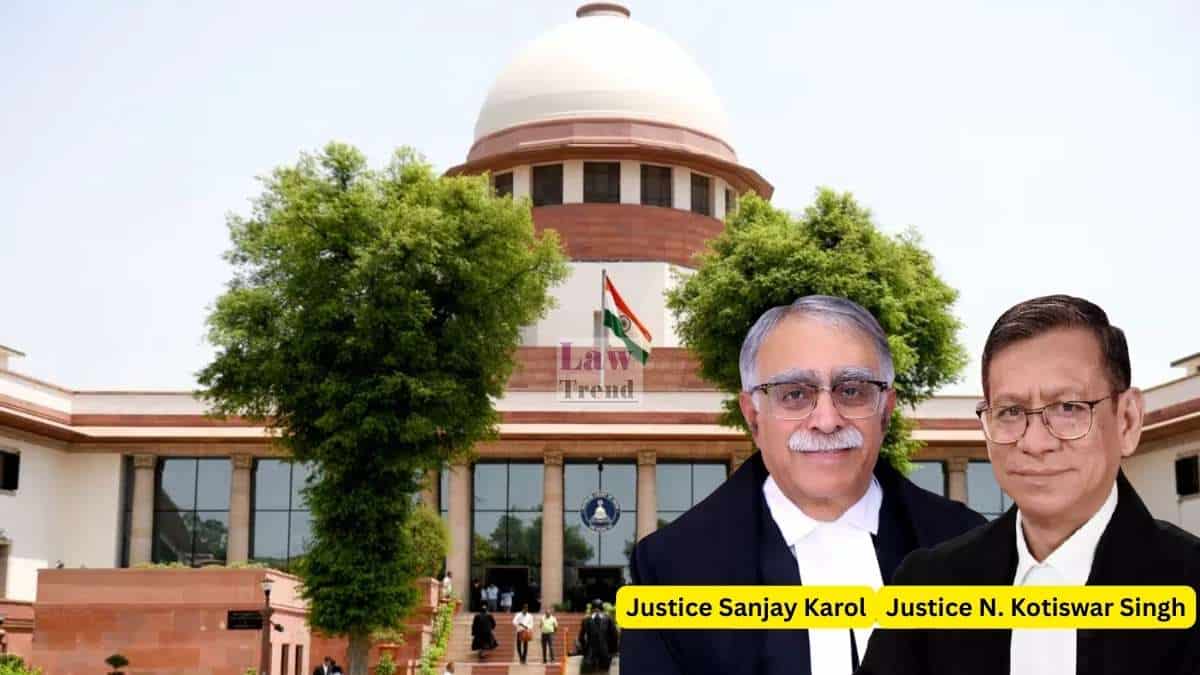
In the case of State of U.P. & Another v. Dinesh Kumar, the Supreme Court of India bench comprising Justice Sanjay Karol and Justice N. Kotiswar Singh delivered the judgment on January 12, 2026.
The Supreme Court allowed the appeal filed by the State of Uttar Pradesh against the judgment of the Division Bench of the Allahabad High Court. The High Court had affirmed the order of a Single Judge setting aside the cancellation of the respondent’s appointment as Sahayak Samiksha Adhikari. The Supreme Court ruled that the suppression of material information regarding pending criminal cases at the time of filling attestation forms is a serious lapse that justifies the cancellation of appointment.
Background of the Case
The controversy arose from a recruitment process initiated by the Uttar Pradesh Public Service Commission (UPPSC) via an advertisement dated March 5, 2021, for the post of Samiksha Adhikari/Sahayak Samiksha Adhikari. The respondent, Dinesh Kumar, was selected for the post.
Following his selection, the respondent was required to furnish an attestation form and a verification form. Both forms contained specific queries regarding pending criminal cases. In both instances, the respondent answered in the negative.
However, verification by the concerned Superintendent of Police revealed that two criminal cases were pending against the respondent:
- Case Crime No. 198 of 2019: Under Sections 147, 323, 504, 506, and 325 of the Indian Penal Code (IPC).
- Case Crime No. 215 of 2018: Under Section 354D of the IPC and Section 12 of the Protection of Children from Sexual Offences (POCSO) Act, 2012.
Despite the Superintendent of Police discovering these cases, the District Magistrate opined that the respondent was suitable for appointment. The respondent later filed an affidavit admitting the pendency of the cases, claiming he had done so on his own volition. The State subsequently cancelled his appointment.
The respondent challenged the cancellation before the High Court. The Single Judge allowed the writ petition on November 5, 2024, noting that the respondent had not been charge-sheeted, the non-disclosure was not fatal, and he had been acquitted in one case. The Division Bench upheld this view on May 22, 2025, characterizing the undisclosed information as being “of trivial nature.”
Arguments
The respondent urged the Supreme Court to consider the mitigating circumstances in his favor, relying on the precedents of Avtar Singh v. Union of India (2016) and Ravindra Kumar v. State of U.P. (2024).
The key arguments presented for the respondent included:
- Age: The respondent is approximately 45 years old.
- Voluntary Disclosure: He had filed an affidavit clarifying the position prior to the initiation of cancellation proceedings.
- Suitability: The District Magistrate had placed on record his fitness for appointment despite the cases.
- Acquittal: The subsequent dropping of proceedings/acquittal in the criminal cases.
Court’s Analysis
The Supreme Court rejected the reasoning of the High Court and the arguments of the respondent. The Bench emphasized that proper disclosure is a “basic requirement rooted in fairness, integrity, and public trust.”
On the Sanctity of Disclosure: The Court observed that government posts attract thousands of applicants, making scrupulous vetting essential.
“When an applicant withholds information about criminal antecedents, it undermines this process by depriving the appointing authority of the opportunity to make a fully informed assessment of suitability.”
On Deliberate Concealment The Court noted that the respondent had denied the existence of pending cases not once, but twice (in the attestation form and verification form).
“The gravity is significantly compounded when the non-disclosure is repeated, as it ceases to be accidental or inadvertent and instead reflects deliberate concealment.”
On the Effect of Disclaimers: The Court highlighted the specific disclaimers in the forms which stated that furnishing false information would render the candidate unfit for government service. The Court held that strict adherence to these stipulations was necessary.
“The factum that he said ‘no’ to pending proceedings against him not once but twice, shows demonstrated mal-intent and is in direct contravention of the disclaimer(s) given in the forms.”
On Subsequent Acquittal: The Bench clarified that the crucial point is the status of the cases at the time of filling the forms.
“Subsequent acquittal or the fact that he attempted to come clean about the suppression of facts cannot accrue to his benefit.”
Legal Maxim and Sympathy Invoking the legal maxim to underscore that the strictness of the law must prevail over personal hardships, the Court observed:
“There is a maxim in law to the effect that ‘juda lex sed lex’ which means the law may be harsh, but the law is law.”
“It is also settled position in law that sympathy cannot supplant law. As such, while we acknowledge that loss of a government job is not an easy loss to come to terms with, at the same time awareness of consequences is a necessary component of actions.”
Decision
The Supreme Court allowed the appeal and set aside the judgment of the High Court. The cancellation of the respondent’s appointment was upheld.
Case Details
- Case Name: State of U.P. & Another v. Dinesh Kumar
- Case Number: Civil Appeal No. 196 of 2026 (Arising out of SLP(C) No. 20292 of 2025)
- Bench: Justice Sanjay Karol and Justice N. Kotiswar Singh