

Dispute Over License Fee Arrears Arbitrable Where Possession Surrendered; Section 41 of Small Cause Courts Act No Bar: Supreme Court
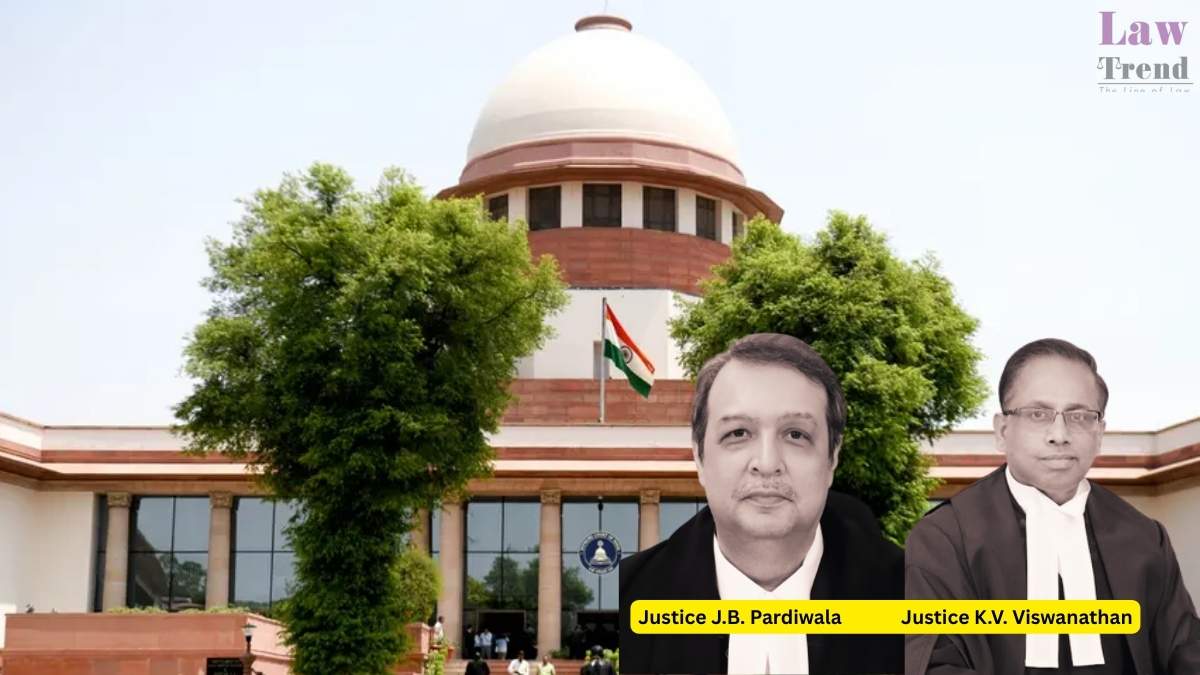

The Supreme Court has upheld the appointment of an arbitrator in a dispute between a licensor and licensee regarding arrears of license fee and security deposit refund, holding that the exclusive jurisdiction of the Small Causes Court under Section 41 of the Presidency Small Cause Courts Act, 1882, does not bar arbitration when the possession of the premises has already been handed over to the licensor.

A Bench comprising Justice J.B. Pardiwala and Justice K.V. Viswanathan dismissed the appeal filed by Motilal Oswal Financial Services Limited against the order of the Bombay High Court which had allowed the Section 11 application filed by the respondent, Santosh Cordeiro.

Background of the Case

The dispute originated from a Leave and License Agreement dated October 6, 2017, regarding a commercial premise at Unit No. 718, 7th Floor, Palm Spring Centre, Link Road, Malad (West), Mumbai. The agreement was for a period of 60 months from October 1, 2017, to October 30, 2022. Subsequently, an Addendum was signed on March 13, 2020, extending the period to 96 months with a lock-in period of 72 months.

The appellant, Motilal Oswal Financial Services Ltd., claimed that due to the COVID-19 pandemic, they could not continue the arrangement. Citing the force majeure clause, they handed over vacant peaceful possession of the premises to the respondent on September 9, 2020. They subsequently sought a refund of their security deposit of Rs. 10 lakhs.

Conversely, on June 28, 2023, the respondent demanded Rs. 94,40,152/- along with interest @ 24% towards alleged arrears of license fees for the balance lock-in period (September 1, 2020, to June 14, 2023). Following the denial of liability by the appellant, the respondent invoked Clause 33 of the agreement—the arbitration clause—and filed an application under Section 11 of the Arbitration and Conciliation Act, 1996 (A&C Act) before the Bombay High Court.

READ ALSO  सुप्रीम कोर्ट ने कर्नाटक के डिप्टी सीएम शिवकुमार के खिलाफ ईडी का मामला रद्द कर दिया

On May 2, 2024, the Single Judge of the Bombay High Court allowed the application and appointed an arbitrator, rejecting the appellant’s objection regarding the non-arbitrability of the dispute.

Arguments Before the Court

The appellant opposed the appointment of the arbitrator, contending that the dispute was non-arbitrable in view of Section 41 of the Presidency Small Cause Courts Act, 1882. The counsel for the appellant argued that Section 41 confers exclusive jurisdiction on the Court of Small Causes to entertain and try all suits and proceedings between a licensor and licensee relating to recovery of possession or recovery of license fee.

Reliance was placed on the Full Bench judgment of the Bombay High Court in Central Warehousing Corporation, Mumbai v. Fortpoint Automotive Pvt. Ltd., Mumbai (2009), which held that even if a license agreement contains an arbitration clause, the exclusive jurisdiction of the Small Causes Court is not ousted. The appellant argued that allowing arbitration would amount to contracting out of a special legislation.

The respondent contended that the claim was merely for compensation for the “balance lock-in period” and did not involve recovery of possession. They argued that the dispute was monetary in nature and supported by the judgment in Vidya Drolia and Others vs. Durga Trading Corporation (Vidya Drolia II), which clarified that mere conferral of jurisdiction on a specific court does not strictly bar arbitrability.

READ ALSO  SC Sets Aside Conviction for Dowry Death; Says No clear Mens rea proved.

Court’s Analysis

The Supreme Court confined its examination to the existence of an arbitration agreement as mandated by Section 11(6-A) of the A&C Act. Justice Viswanathan, writing for the Bench, observed that the Court’s jurisdiction at this stage is “only to inspect or scrutinize the dealings between the parties for determination about the existence of an Arbitration Agreement.”

Addressing the appellant’s reliance on the Central Warehousing judgment, the Court distinguished the facts. It noted that in Central Warehousing, the licensee was in possession of the premises and had sought a declaration against termination notices. In the present case, the Court observed:

“It is undisputed by both parties that possession had been handed over by the appellant to the respondents in September 2020. The dispute between the parties is with regard to a monetary claim with the appellant asserting that the security deposit should be repaid by the respondents and the respondents claiming sums of money towards alleged arrears of amounts payable for the balance lock-in period.”

The Bench referred to the principles laid down in Vidya Drolia II, emphasizing that:

“Conferment of jurisdiction on a specific court or creation of a public forum though eminently significant, may not be the decisive test to answer and decide whether arbitrability is impliedly barred.”

The Court further held that Section 41 of the 1882 Act cannot be interpreted to mean that “ex proprio vigore (by its own force), it neutralizes arbitration clauses in agreements.” The Bench also pointed to Section 28 of the Contract Act, 1872, noting that Exception 1 saves contracts to refer disputes to arbitration.

READ ALSO  Launching Criminal Prosecution Against Spouse Leading to Arrest Caused Mental Cruelty: HC Allows Divorce Under Special Marriage Act

The Court clarified regarding the Central Warehousing precedent:

“We have been constrained to deal with the judgement in Central Warehousing (supra) only to decipher whether on account of the said judgement, Clause 33 of the Leave and License Agreement dated 06.10.2017, in the present case, containing the arbitration clause is non-existent. We hold that it is not and that an examination under Section 11(6-A) indicates that there exists an arbitration agreement between the parties.”

Decision

The Supreme Court concluded that the arbitration agreement existed and was valid for the purpose of the Section 11 application. The Court clarified that it was not pronouncing on the correctness of the Central Warehousing judgment, as an appeal against it is pending, but held that based on the specific facts where possession was surrendered, the arbitration clause had not ceased to exist.

The Bench dismissed the appeal and directed the Arbitrator to conclude the proceedings within six months.

Case Details:

  • Case Title: Motilal Oswal Financial Services Limited vs. Santosh Cordeiro and Another
  • Case No.: Civil Appeal No. 36 of 2026
  • Bench: Justice J.B. Pardiwala and Justice K.V. Viswanathan

Law Trend
Law Trendhttps://lawtrend.in/
Legal News Website Providing Latest Judgments of Supreme Court and High Court

Related Articles

Latest Articles

