

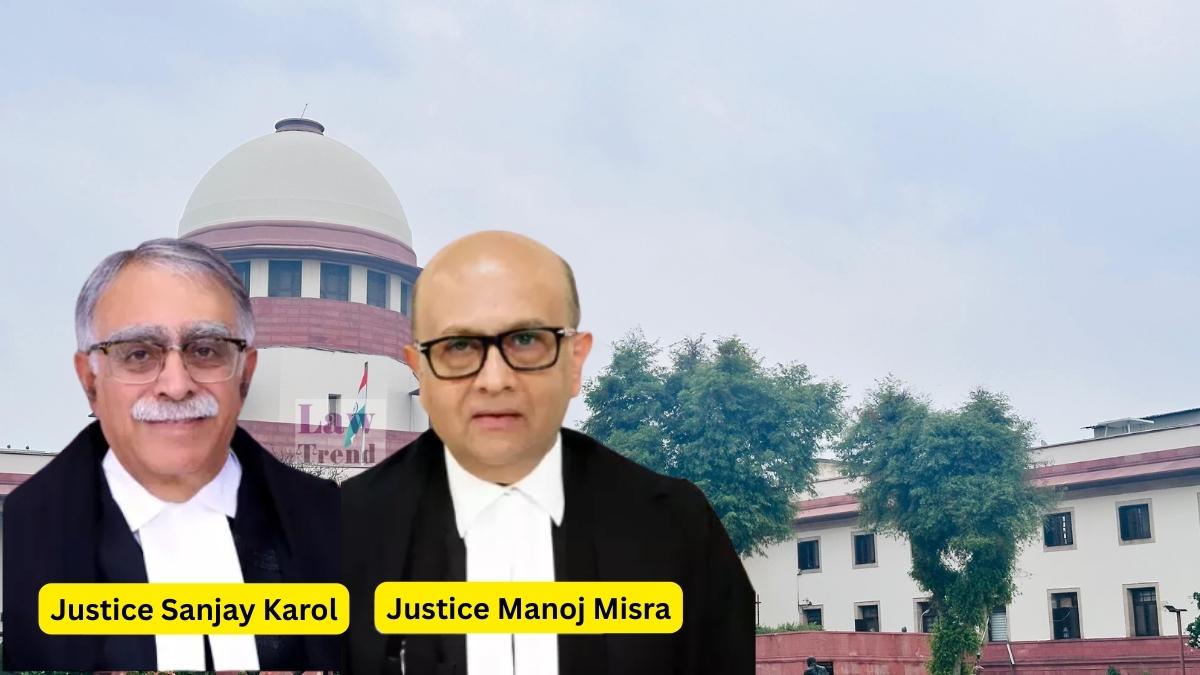
The Supreme Court of India has set aside a judgment of the Allahabad High Court and quashed the dismissal of an employee of the U.P. Cooperative Federation Limited, observing that a departmental enquiry stands vitiated if no oral enquiry is held and no witnesses are examined to prove the charges despite a denial by the delinquent employee.
A Bench comprising Justice Sanjay Karol and Justice Manoj Misra held that unless a charged employee admits their guilt in clear terms, the employer is duty-bound to lead evidence first and provide an opportunity for cross-examination.
Background of the Case
The appellant, Jai Prakash Saini, was employed as the in-charge of a paddy procurement centre at the U.P. Cooperative Federation Limited. He was served with a charge-sheet alleging a short delivery of 1093.60 quintals of paddy. A supplementary charge-sheet later alleged embezzlement of ₹2,00,850 involving 5000 sacks of de-husked paddy. Following an enquiry where the charges were found proved, Saini was dismissed from service on November 30, 2015, with a direction to recover ₹9,53,433.
The appellant challenged the dismissal before the High Court of Judicature at Allahabad (Lucknow Bench), contending that the enquiry violated the principles of natural justice as no oral enquiry was conducted, no date or time was fixed, and no witnesses were examined. The High Court dismissed the writ petition on April 12, 2019, concluding that the Enquiry Officer had followed prescribed procedures and that the appellant had not specifically requested to produce defence witnesses or cross-examine any person during the enquiry.
Arguments Presented
The appellant argued before the Supreme Court that since he had denied the charges, the burden of proof lay on the Federation. He contended that the failure to examine even a single witness rendered the enquiry a nullity under the extant service rules.
Conversely, the U.P. Cooperative Federation Limited submitted that the appellant’s reply was “evasive,” which they argued amounted to an admission of the charges under Section 58 of the Evidence Act, 1872. They maintained that the enquiry report was well-reasoned and based on available documentary material.
The Court’s Analysis
The Supreme Court rejected the Federation’s contention regarding “evasive replies.” Justice Manoj Misra, writing for the Bench, observed:
“A departmental charge-sheet is not a plaint that an evasive reply thereto may amount to an admission. In a departmental enquiry, unless the charge is admitted, the burden to prove the charge lies on the employer/ department.”
The Court examined Rule 84 of the Service Rules, 1980, and Regulation 85 of the 1975 Regulations, which mandate the observance of natural justice, including the opportunity to cross-examine witnesses. Referring to the precedent in Chamoli District Co-operative Bank Limited v. Raghunath Singh Rana (2016), the Court emphasized that holding an oral enquiry is a mandatory requirement when charges are refuted.
The Bench further cited Sur Enamel and Stamping Works Ltd. v. Workmen (1963) and State of Uttaranchal v. Kharak Singh (2008) to reiterate the settled legal principles:
“Even in a case based solely on documentary evidence, unless the relied upon documents are admitted by the charged employee, a witness would have to be examined to prove those documents and when so examined, the witness would have to be tendered for cross-examination.”
The Decision
The Supreme Court concluded that since the department produced no witnesses despite the appellant’s denial of charges, the enquiry was vitiated. Consequently, the order of punishment and recovery could not be sustained.
The Court allowed the appeal and set aside the High Court’s judgment. However, it granted the Federation liberty to conduct a de novo (fresh) enquiry within six months.
The Court directed:
- If the Federation chooses to hold a fresh enquiry, it must reinstate the appellant and place him under suspension, paying him the applicable suspension allowance.
- If no fresh enquiry is initiated within the stipulated period, the appellant shall be entitled to full reinstatement with continuity of service and arrears of salary.
Case Details:
- Case Title: Jai Prakash Saini v. Managing Director, U.P. Cooperative Federation Ltd. & Ors.
- Case No: Civil Appeal No. ___ of 2026 (Arising out of SLP (C) No. 2900/2020)
- Bench: Justice Sanjay Karol and Justice Manoj Misra
- Date: April 01, 2026




