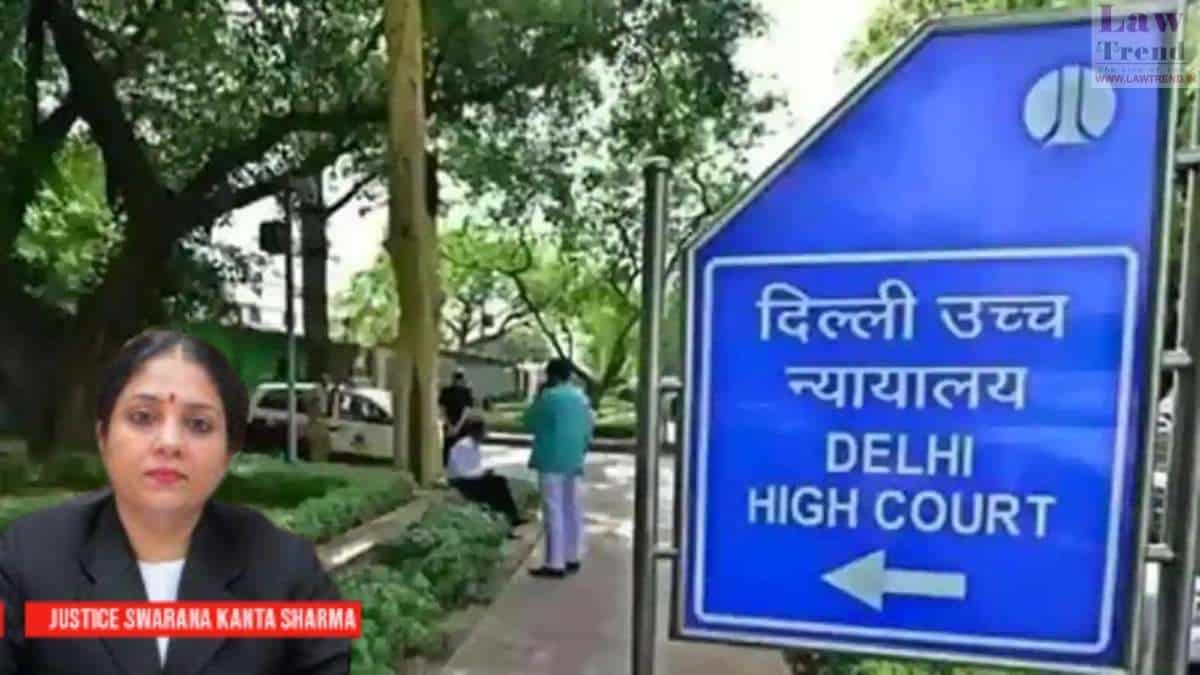
The Delhi High Court has upheld the conviction and 20-year rigorous imprisonment of a man for the aggravated penetrative sexual assault of his minor niece. While dismissing the appeal, the Court expressed serious concern over the loss of crucial DNA evidence due to the improper preservation of the “product of conception” (fetal tissue) in formalin by medical authorities, which rendered DNA profiling impossible.
The Single Bench of Justice Swarana Kanta Sharma dismissed the appeal filed by the convict, Darshan Mohar, challenging the judgment of the Trial Court dated December 12, 2024, and the order on sentence dated January 15, 2025. The Trial Court had convicted him under Sections 376(2)(f) and 506 of the Indian Penal Code (IPC) and Section 6 of the Protection of Children from Sexual Offences (POCSO) Act, sentencing him to 20 years of rigorous imprisonment.
The High Court held that the prosecution had proved its case beyond reasonable doubt based on the consistent and credible testimony of the victim, despite the absence of corroborative DNA evidence.
Factual Background
The case dates back to May 4, 2020, when the minor victim, aged approximately 17 years, was taken to Deep Chand Bandhu Hospital after complaining of abdominal pain and missing menstrual periods. An ultrasound revealed a pregnancy of approximately 15 weeks. The victim disclosed to the doctors and subsequently to the police that she had been sexually assaulted by her maternal uncle (the appellant), who had visited their home in January 2020.
According to the prosecution, the incident occurred when the victim was alone at home. The appellant allegedly overpowered her, threatened her, and forcibly established physical relations. The victim remained silent for months due to threats to her life and fear that the accused would inform her father. Following the registration of the FIR, the victim’s pregnancy was medically terminated, and the fetal tissue was seized for DNA profiling.
Arguments of the Parties
The counsel for the appellant argued that the conviction was based on a “perverse” appreciation of evidence. The defence contended that there was an unexplained delay of nearly five months in lodging the FIR and alleged material inconsistencies in the victim’s testimony. It was further argued that the victim had falsely implicated the appellant to shield a boy named “Amit” with whom she was allegedly in a relationship. The defence also highlighted the lack of medical or scientific evidence connecting the appellant to the crime.
Conversely, the Additional Public Prosecutor (APP) for the State argued that the delay was natural given the threats and the victim’s trauma. The State submitted that the statutory presumptions under Sections 29 and 30 of the POCSO Act operated against the accused, who failed to rebut them.
Court’s Analysis and Findings
Reliability of the Victim’s Testimony: The Court rejected the defence’s claim regarding inconsistencies in the victim’s statement. Justice Sharma noted that the victim, who had recently lost her mother and grandmother, was “emotionally fragile.” The Court referred to the Trial Court’s observations of the victim’s demeanour, noting she “cried inconsolably” during her deposition.
Referring to Section 280 of the Code of Criminal Procedure (Cr.P.C.), the Court observed:
“Judicial observation of demeanour, whether the witness shows hesitation, fear, emotional strain, or composure, is a way of assessing credibility… Courts must remember that case files are not merely documents, but represent the lives of individuals who seek justice through them.”
The Court held that minor discrepancies were natural for a traumatised child sexual abuse survivor and did not undermine the core prosecution case.
Failure of DNA Profiling due to Negligence: A significant portion of the judgment addressed the “unfortunate aspect” that crucial biological evidence was lost due to improper preservation. The Forensic Science Laboratory (FSL) and Central Forensic Science Laboratory (CFSL) reports indicated that no DNA profile could be generated from the fetal tissue because it was “degraded.”
Dr. Kamal Chauhan, Assistant Director, CFSL, explained to the Court that the sample was preserved in formalin, which causes DNA fragmentation and introduces inhibitors. He stated:
“As per research and publications, if any, biological sample is preserved in formalin for more than seven days, chance of recovery of DNA becomes negligible.”
The Court noted that existing guidelines by the Ministry of Health and Family Welfare and the Directorate of Forensic Science Services expressly prohibit the use of formalin for fetal tissue intended for DNA analysis, mandating instead the use of normal saline and cold-chain transportation.
Presumptions under POCSO Act: The Court ruled that the accused failed to rebut the presumptions under Sections 29 and 30 of the POCSO Act. The defence theories—ranging from a love affair with “Amit” to monetary disputes with the victim’s father—were termed “mutually contradictory,” “vague,” and “unsubstantiated.”
Decision and Directions
The High Court affirmed the conviction and sentence, stating that the victim’s testimony was “cogent, consistent, credible, and inspires confidence.”
Addressing the systemic lapses in evidence preservation, the Court cited the Supreme Court’s recent decision in Kattavellai v. State of Tamil Nadu (2025) regarding DNA collection protocols. Justice Sharma directed the FSL authorities, police administration, and the Delhi Government to “evolve a workable policy framework” to ensure strict compliance with guidelines.
“The use of saline, and the complete avoidance of formalin, is a non-negotiable scientific requirement,” the Court asserted.
The Court directed the judgment to be forwarded to the Secretary (Home), Secretary (Law), Directors of FSL and CFSL, and the Commissioner of Police, Delhi, to ensure such lapses do not recur.
Case Details:
- Case Title: Darshan Mohar v. State of NCT of Delhi and Anr.
- Case Number: CRL.A. 168/2025
- Coram: Justice Swarana Kanta Sharma
- Counsel for Appellant: Ms. Sakshi Sachdeva and Ms. Ritika Rajput
- Counsel for Respondents: Mr. Naresh Kumar Chahar (APP for State); Mr. Arvind Kumar (for Victim)