

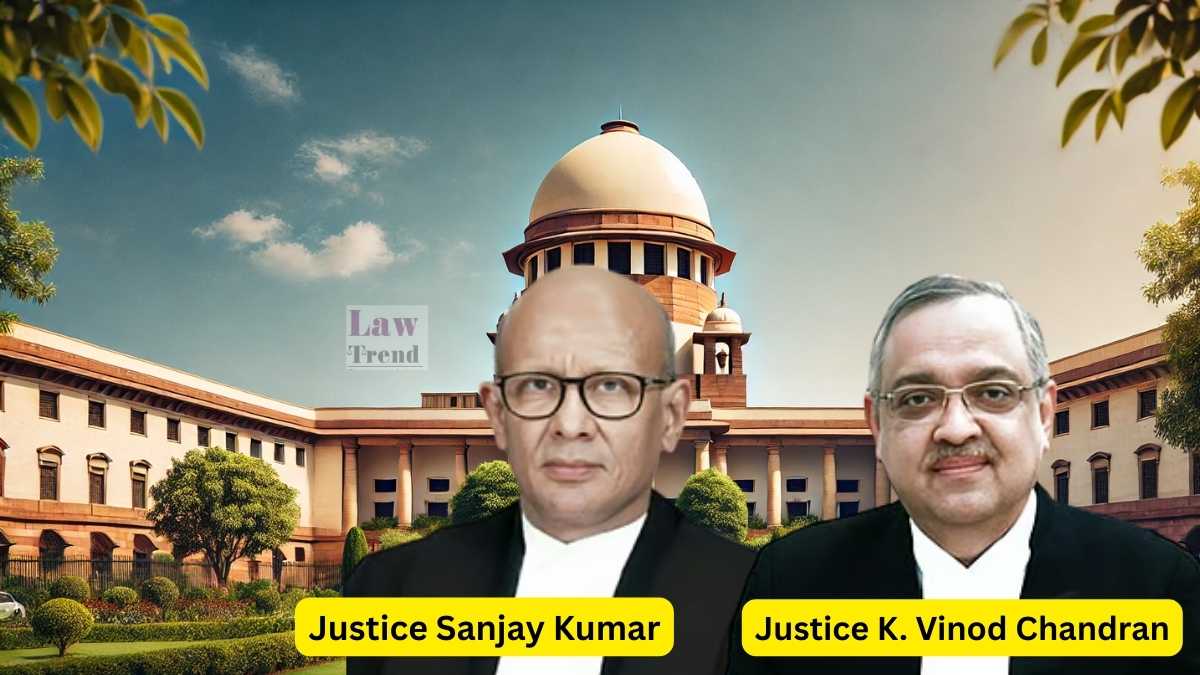
The Supreme Court has set aside a High Court-affirmed decision to remand a 1975 revenue suit, terming the 31-year delay in challenging the original decree as “gross.” A Bench comprising Justice Sanjay Kumar and Justice K. Vinod Chandran restored a 1975 order that declared the appellant’s ‘khatedari’ (tenant-occupant) rights over 158.3 bighas of land in Rajasthan, emphasizing that delay condonation must not defeat the cause of substantial justice.
Legal Issue
The primary legal issue before the Supreme Court was whether a 31-year delay in filing an appeal against a Trial Court decree could be condoned under the guise of “fraud” or “lack of notice,” especially when the judicial records demonstrated active participation by the defendant during the original trial. The Court also examined the validity of a property transfer involving a minor without requisite court permission under the Hindu Minority and Guardianship Act, 1956.
Background of the Case
The dispute pertains to 158.3 bighas of land in Rajasthan. The appellant, Hari Ram, filed a suit in 1965 through his mother (as he was then a minor) under Section 88 of the Rajasthan Tenancy Act, 1955. He sought a declaration of his ‘khatedari’ rights, claiming succession from his deceased father whose name was mutated in revenue records in 1961.
The appellant alleged that the defendants—Keshi, Bhura Ram, and Bhiya Ram—had unlawfully encroached upon half of the land based on a fabricated sale deed. The Trial Court decreed the suit in favor of the appellant on August 16, 1975. Although the first defendant (Keshi) appeared initially and filed a written statement, she was later declared ex-parte for non-appearance. In 2006—31 years after the decree—an appeal was filed by Keshi, which was initially rejected for delay but later remanded by the Board of Revenue. This remand was subsequently affirmed by the High Court.
Arguments of the Parties
For the Appellant: Senior Counsel Shri Vaibhav Gaggar argued that the 1st defendant had appeared through a lawyer and was present personally on many occasions, contrary to her claims of being unaware of the proceedings. He pointed out that defense evidence had been led through two witnesses and that there was no “satisfactory reason” for the 31-year delay. He further asserted that the appellant is in full possession of the property.
For the Respondents: Senior Counsel Shri Sadan Farasat argued that the sale deed was executed by the appellant’s mother and was known to her. He contended that under Rule 143 of the General Rules (Civil) 1986, signatures of parties should have been affixed to the proceedings, which was not done. He alleged fraud and maintained that the remand order was necessary to protect the interests of an illiterate widow.
The Court’s Analysis and Observations
The Supreme Court scrutinized the Trial Court records (Annexure P4) and found that the 1st defendant had indeed appeared through counsel and even filed an application for the production of documents, including the alleged sale deed. However, she failed to produce that deed before the Court.
On Delay and Condonation: The Court observed that the grounds for setting aside the 1975 decree were “belied by the proceedings in the suit.” Regarding the condonation of the three-decade delay, the Court held:
“As has been found in Jahangir Byramji Jeejeebhoy and the various decisions referred to therein, delay condonation cannot be an act of generosity defeating the cause of substantial justice and causing prejudice to the opposite party.”
On Adverse Inference: Citing Ajay Kumar D. Amin v. Air France and Gurnam Singh v. Surjit Singh, the Bench noted that the 1st defendant withheld the “best evidence” (the sale deed) despite seeking its production. The Court stated:
“…when a party in possession of the best evidence, which throws light on the issue in controversy, withholds it, the Court is entitled to draw an adverse inference…”
On the Legality of the Sale Deed: The Court noted that the alleged sale deed involved a 12-year-old minor (the appellant). Under Section 8(2) of the Hindu Minority and Guardianship Act, 1956, such a transfer requires court permission, which was absent. Additionally, citing K.S. Shivappa v. K. Neelamma, the Court clarified that a voidable transaction can be repudiated through “unequivocal conduct” (such as claiming rights in a suit) without a specific suit to set it aside.
Final Decision
The Supreme Court found the High Court’s affirmation of the remand order “illegal.” It held that there was no justification for remanding a case after 31 years, especially when the defendant had contested the suit for a decade (1965–1975) and examined witnesses but “refused to mount the box herself.”
The Bench set aside the orders of the High Court and the Board of Revenue, restoring the original order of the Revenue Court dated August 16, 1975.
Case Details:
Case Title: Hari Ram v. State of Rajasthan & Ors.
Case No.: Civil Appeal No. … of 2026 (@SLP(C) No. 4664 of 2025)
Bench: Justice Sanjay Kumar and Justice K. Vinod Chandran
Date: April 10, 2026




