

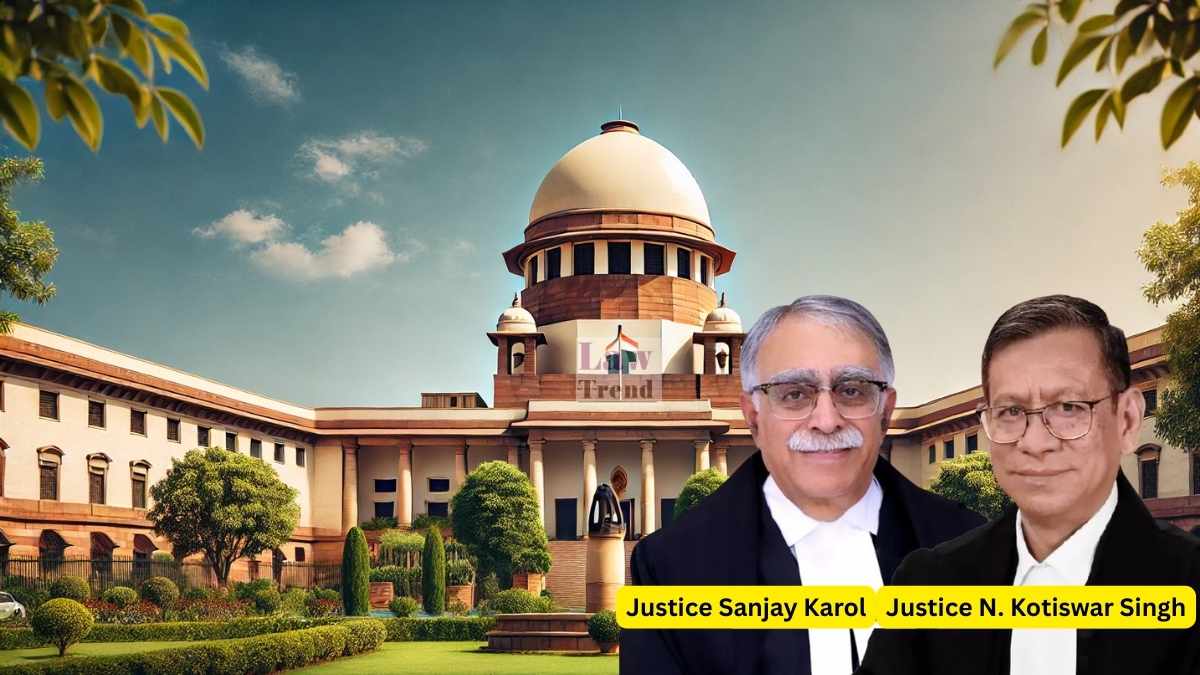
The Supreme Court of India has ruled that confiscation proceedings under the Bihar Special Courts Act, 2009 (BSCA) do not automatically abate or get set aside upon the death of the main accused public servant, especially when the properties are held by relatives or spouses who were also part of the proceedings.
A Bench of Justice Sanjay Karol and Justice Nongmeikapam Kotiswar Singh set aside a High Court judgment that had dropped confiscation proceedings against Sudha Singh, the wife of a deceased government officer, following her husband’s death during the pendency of the appeal. The Apex Court has restored the appeals to the High Court for a decision on merits.
Background of the Case
The case originated from two FIRs filed in 2009 against Ravindra Prasad Singh, a government servant, for allegedly amassing disproportionate assets worth ₹12,96,516 between 1975 and 2009. A chargesheet was filed on October 7, 2009, under the Prevention of Corruption (PC) Act, 1988.
On August 17, 2012, notices were issued to both the officer and his wife, Sudha Singh, under the BSCA. The Authorised Officer, in an order dated August 5, 2013, ordered the confiscation of various movable and immovable assets, noting that the wife failed to satisfactorily explain the source of income for properties acquired in her name in Patna and New Delhi.
Sudha Singh and her husband challenged this order before the High Court. However, Ravindra Prasad Singh passed away on January 18, 2018, while the appeal was pending. The High Court subsequently allowed the appeal and set aside the confiscation, holding that the BSCA had no provision to continue such proceedings after the death of the public servant.
Arguments of the Parties
The State of Bihar argued that the High Court’s conclusion was erroneous as it did not flow from the statute. The State contended that:
- Confiscation is distinct from attachment during trial; under the BSCA, property is confiscated if the owner cannot explain its source.
- Confiscation proceedings are not per se criminal proceedings, as held in Yogendra Kumar Jaiswal v. State of Bihar (2016), and thus the general principle of abatement of criminal proceedings upon death does not apply.
- The only statutory conditions for returning confiscated property are the acquittal of the accused or the annulment of the order by a High Court on merits.
The Respondent (Sudha Singh) argued that the procedure under the BSCA is not independent of the PC Act. She maintained that in the absence of a finding against her husband prior to his death, the presumption of innocence remains. She further argued that as a non-government servant, the proceedings under Section 13 of the BSCA could not continue against her alone.
Court’s Analysis and Observations
The Supreme Court clarified the distinction between “acquittal” and “abatement.” Referring to Gurmail Singh v. State of U.P. (2022), the Court noted:
“Abatement means ‘the discontinuation of criminal proceedings before they are concluded in the normal course of litigation, as when the defendant dies’… it is not a comment on the merits of the matter.”
The Court emphasized that the death of the officer would not let the respondent “off the hook” because she was proceeded against for holding allegedly illegally begotten property.
On the liability of non-public servants, the Court cited P. Nallammal v. State (1999), observing that a relative who keeps wealth in their name at the request of a public servant can be guilty of abetment. The Court noted that Section 15 of the BSCA specifically provides for hearing “any other person” through whom property is held.
Regarding the BSCA, the Court observed:
“The Act itself provides for the situations in which the money/property confiscated thereunder can be returned to the owner… They are: (a) modification or annulment of the confiscation order by the High Court or (b) acquittal by the Special Court. In other words, no other possibilities have been accounted for.”
The Bench found the argument regarding the lack of a “substitution of legal heirs” provision to be “entirely misconceived” because the respondent had been put to notice at the very inception of the proceedings.
Final Decision
The Supreme Court concluded that the High Court was required to decide the appeal on its merits rather than dismissing it due to the death of the public servant.
“The death of such a person does not extinguish the fact that confiscation order has been made after hearing the parties,” the Court held. Consequently, the impugned judgments in both the primary case and a connected matter (involving the death of officer Naresh Paswan) were set aside, and the appeals were restored to the High Court for fresh consideration.
Case Details Block
- Case Title: The State of Bihar Thr. Vigilance v. Sudha Singh (with connected matter)
- Case No.: Criminal Appeal No. [To be assigned] of 2026 (Arising out of SLP (Crl.) No. 7454 of 2025)
- Bench: Justice Sanjay Karol and Justice Nongmeikapam Kotiswar Singh
- Date: March 20, 2026




