

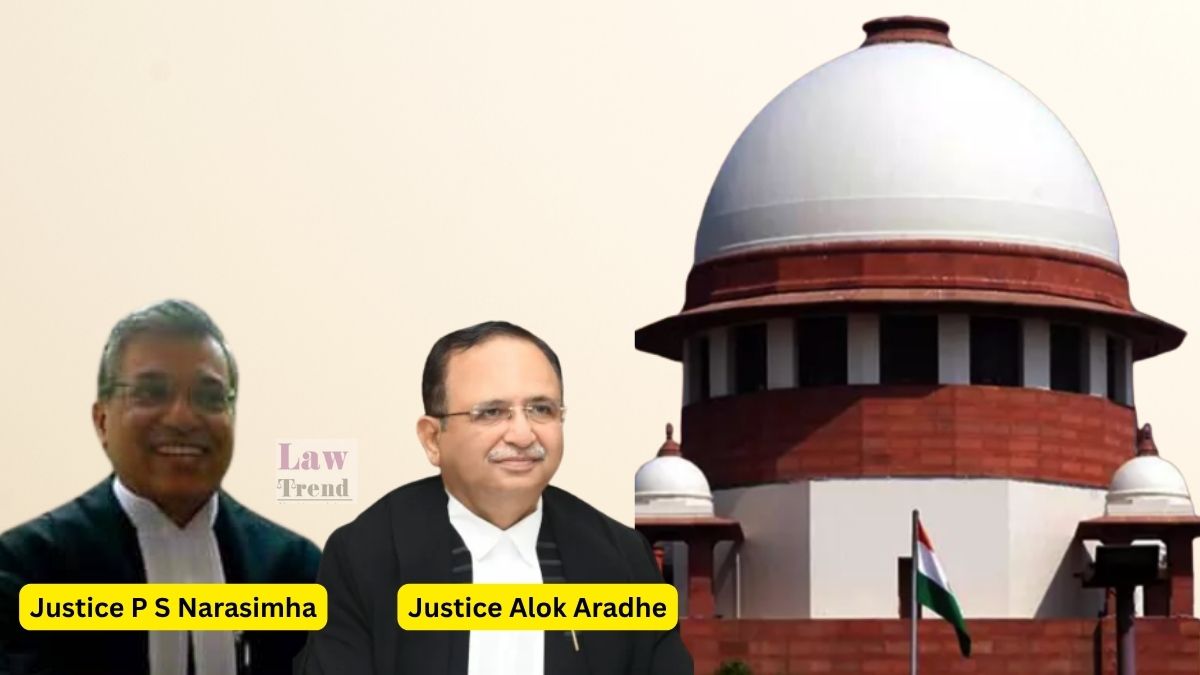
The Supreme Court of India has set aside a judgment of the Gujarat High Court that had quashed a Letter of Award (LOA) issued by GSPC Pipavav Power Company Ltd. (GPPC) for the operation and maintenance of its power plant. A Bench comprising Justice Pamidighantam Sri Narasimha and Justice Alok Aradhe emphasized that courts must exercise “nuanced discretion” and maintain judicial restraint in contractual matters, especially when the difference between competing bidders is “minuscule.”
The Court held that the final choice in a tender process rests with the owner, and judicial review should not be used to “pre-empt executive actions” or scrutinize technical bids with a “magnifying glass.”
Background
In January 2025, GPPC, which operates a 702.86 MW gas-based combined cycle power plant, invited public tenders for its operation and maintenance for five years. The tender followed the Quality and Cost Based System (QCBS), assigning a 70% weightage to technical evaluation and 30% to cost evaluation.
After a three-stage evaluation process, the appellant, M/S. Steag Energy Services (India) Pvt. Ltd. (“Steag”), was declared the successful bidder. GPPC issued the LOA on June 9, 2025. However, the second-placed bidder, O&M Solutions Pvt. Ltd. (“the writ petitioner”), challenged the evaluation process before the Gujarat High Court, alleging arbitrariness and seeking to quash the LOA.
The High Court Proceedings
During the writ proceedings, the High Court directed GPPC’s consultant, Fichtner Consulting Engineers India Private Limited, to re-evaluate the technical marks. Upon re-evaluation, Steag’s technical score was reduced from 10 to 8 marks for a specific parameter (technical experience) because one claimed experience fell outside the evaluation period.
This reduction resulted in a technical tie between Steag and the writ petitioner, both scoring 93. Consequently, the writ petitioner’s total combined score (S) became 95.09989831, while Steag’s score was 95.0978453. Finding the writ petitioner’s score “marginally higher” by a difference of 0.00205301, the High Court quashed Steag’s contract and directed GPPC to award the job to the writ petitioner.
Arguments of the Parties
Appellant (Steag): Senior Advocate Mr. D.V.S. Somayajulu argued that the High Court committed a serious error by interfering when the difference was so marginal. Relying on Afcons Infrastructure Ltd. v. Nagpur Metro Rail Corpn. Ltd., he contended that interference is permissible only if the decision is mala fide, perverse, or so arbitrary that no responsible authority could have reached it.
Respondents (GPPC & Others): Senior Advocate Ms. Meenakshi Arora, appearing for the writ petitioner, supported the High Court’s decision. She argued that since the tender mandates benchmarks, price differences will naturally be marginal. She contended the High Court simply applied the contractual condition (Clause 20.2 vi) which states that the bidder with the “highest total score” shall be considered for the award.
Court’s Analysis and Observations
The Supreme Court rejected the “mathematical precision” approach adopted by the High Court. Justice Narasimha, writing the judgment, observed:
“The judicial solution for such problems arising out of the fierce competition between competing bidders is not to be found in the mathematical precision or application of rigid formulae. … Judicial review must balance justice with flexibility, and this would require the courts to exercise a nuanced discretion between multiple outcomes and binary choices.”
The Bench highlighted that the High Court ignored the “needs and requirements of the Owner.” It noted that GPPC was anxious to execute the contract as the existing term was ending, and skilled personnel needed to be deployed for handover.
Citing Montecarlo Ltd. v. NTPC Ltd., the Court reiterated the principles of “restraint” and “free play in the joints.” The judgment noted:
“The courts should not use a magnifying glass while scanning the tenders and make every small mistake appear like a big blunder. … The final choice is of the owner, and it is for the owner to take the final decision with necessary flexibility and pragmatism.”
The Court also referenced Tata Motors Ltd. v. BEST (2023), stating that a writ court should refrain from imposing its decision unless something “very gross or palpable” is pointed out, as setting aside a contract well underway may not be in the public interest.
The Decision
The Supreme Court concluded that there was no justification for the High Court to interfere with the LOA dated June 9, 2025.
- Appeal Allowed: The Court allowed the appeal arising out of Special Civil Application No. 7289 of 2025, setting aside the High Court’s order.
- LOA Upheld: The LOA and the subsequent contract dated July 1, 2025, in favor of Steag Energy Services were upheld.
- Limited Rejection: The Court dismissed a separate appeal (No. 12328 of 2025) regarding Steag’s claim for additional marks for sea water system experience, agreeing with the High Court’s findings on that specific technical interpretation.
The Bench concluded that GPPC can now proceed with the performance of the contract “without any hindrance.”
Case Details:
- Case Title: M/S. Steag Energy Services (India) Pvt. Ltd. v. GSPC Pipavav Power Company Ltd. (GPPC) & Ors.
- Case Number: Civil Appeal arising out of SLP (C) No(S). 30209-30210 of 2025
- Bench: Justice Pamidighantam Sri Narasimha and Justice Alok Aradhe
- Date: March 25, 2026




