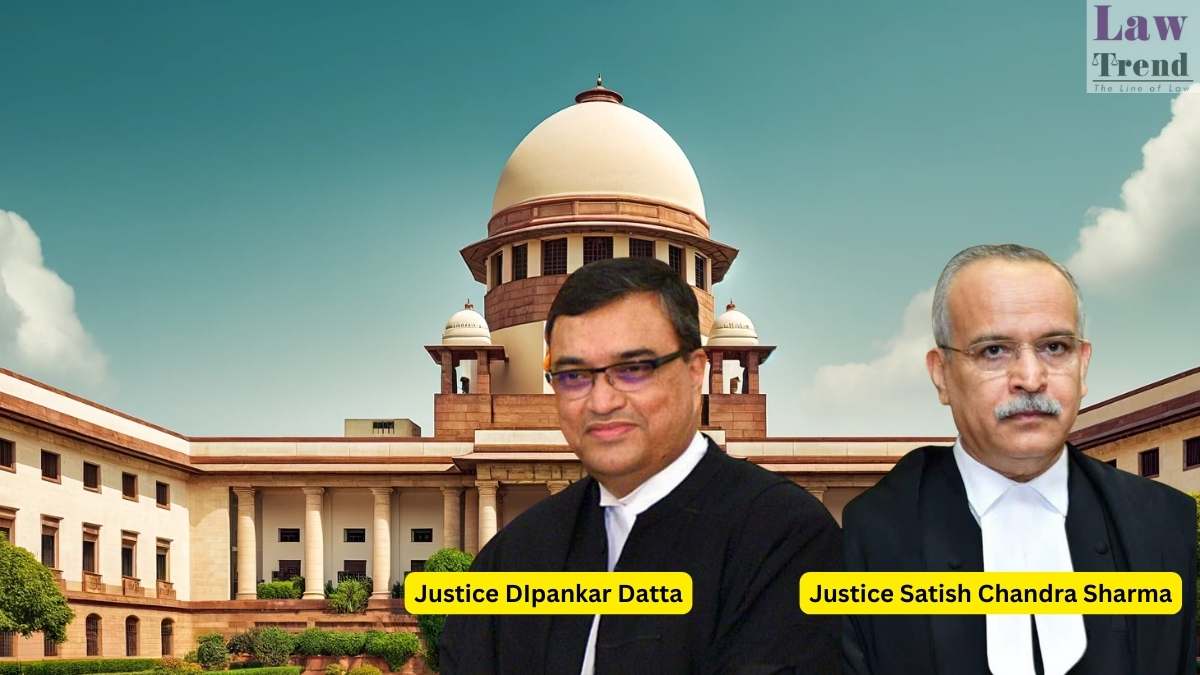
The Supreme Court of India has dismissed a Special Leave Petition filed by the State of Odisha, characterizing the government’s conduct in pursuing legal remedies as “utterly lethargic, tardy and indolent.” The Bench comprising Justice Dipankar Datta and Justice Satish Chandra Sharma refused to condone the delay in filing the petition, observing that the explanation offered by the State was not a valid legal explanation but merely a “lame excuse.”
The central issue before the Apex Court was whether to condone the delay of 123 days in filing the Special Leave Petition (and a further 96 days in re-filing) by the State of Odisha against an order of the Orissa High Court, which had itself refused to condone a significant delay in an appeal filed by the State.
The Supreme Court dismissed the Special Leave Petition as time-barred, holding that no “sufficient cause” was shown for the exercise of discretion and emphasizing that condonation of delay cannot be claimed as a matter of right.
Background of the Case
The legal proceedings originated from an order dated December 30, 2013, passed by the State Education Tribunal, Bhubaneswar. Upon an application filed by the Managing Committee of Namatara Girls’ High School under Section 24B of the Odisha Education Act, 1969, the Tribunal had directed the State of Odisha and the Director of Secondary Education to release grant-in-aid to the teaching and non-teaching staff of the school.
The State challenged this order before the High Court of Orissa on October 16, 2015. The appeal was filed after the limitation period had expired. Furthermore, the appeal was defective as it was not accompanied by the certified copy of the impugned Tribunal order.
For eight years, the State failed to cure this defect. Consequently, on April 26, 2023, the High Court dismissed the appeal citing the failure to file the certified copy of the Tribunal’s order.
Following this dismissal, the State obtained the certified copy on February 13, 2024, and filed an application seeking a recall of the order dated April 26, 2023, along with an application seeking condonation of a 291-day delay. On February 21, 2025, the High Court rejected the application for condonation of delay. The High Court observed that the appeal filed in 2015 was inherently defective and the delay in presenting the appeal effectively exceeded 11 years.
Arguments Before the Supreme Court
Aggrieved by the High Court’s order dated February 21, 2025, the State of Odisha approached the Supreme Court. The Special Leave Petition was filed with a delay of 123 days, with an additional delay of 96 days in re-filing after curing defects.
In its application for condonation of delay, the State pleaded:
“That the delay in filing the appeal was on account of procedural delay in obtaining approval from the higher authority. The delay caused is not deliberate and intentional.”
Ms. Sanjana Saddy, learned counsel appearing for the State of Odisha, submitted that the delay was not deliberate. She relied on a “long line of decisions” of the Supreme Court that advocate a liberal approach when an authority under Article 12 of the Constitution is the petitioner seeking condonation of delay. She urged the Court to condone the delay and direct the High Court to examine the challenge to the Tribunal’s order on merits.
Court’s Analysis and Observations
The Supreme Court rejected the State’s submissions, conducting a detailed analysis of the judicial approach toward government delays.
On “Sufficient Cause” and Government Latitude: The Court acknowledged earlier judgments such as Collector, Land Acquisition, Anantnag v. Mst Katiji (1987) and G. Ramegowda v. Land Acquisition Officer (1988), which held that a “justice oriented approach” is called for when the State seeks condonation of delay, as public interest suffers due to individual defaults.
However, the Bench noted that this liberal approach was based on the optimism that matters would improve. The Court referred to the subsequent decision in Commissioner of Wealth Tax, Bombay v. Amateur Riders Club, Bombay (1994), where the Court had expressed exasperation with “bureaucratic indifference.”
Quoting from Amateur Riders Club, the Bench reiterated:
“There is a point beyond which even the courts cannot help a litigant even if the litigant is Government which is itself under the shackles of bureaucratic indifference.”
On the State’s Conduct: Justice Dipankar Datta, authoring the judgment, observed that the State of Odisha had been “utterly lethargic, tardy and indolent” not only before the High Court but also before the Supreme Court.
The Court stated:
“Notwithstanding that its appeal was dismissed as time-barred by the High Court, this Court has been approached by the State of Odisha four months after expiry of the period of limitation.”
Rejection of the Explanation: Addressing the State’s reliance on procedural delays and the plea for a liberal approach, the Court held:
“Condonation of delay cannot be claimed as a matter of right. It is entirely the discretion of the Court whether or not to condone delay. Despite all the latitude that is shown to a ‘State’, we are of the clear opinion that the cause sought to be shown here by the State of Odisha is not an explanation but a lame excuse. No case for exercise of discretion has been set up.”
Decision
The Supreme Court dismissed the applications for condonation of delay in filing and re-filing the petition. Consequently, the Special Leave Petition was dismissed as time-barred.
Case Details
- Case Title: State of Odisha & Ors. v. Managing Committee of Namatara Girls High School
- Case Number: Special Leave Petition (C) Diary No. 54941/2025
- Coram: Justice Dipankar Datta and Justice Satish Chandra Sharma