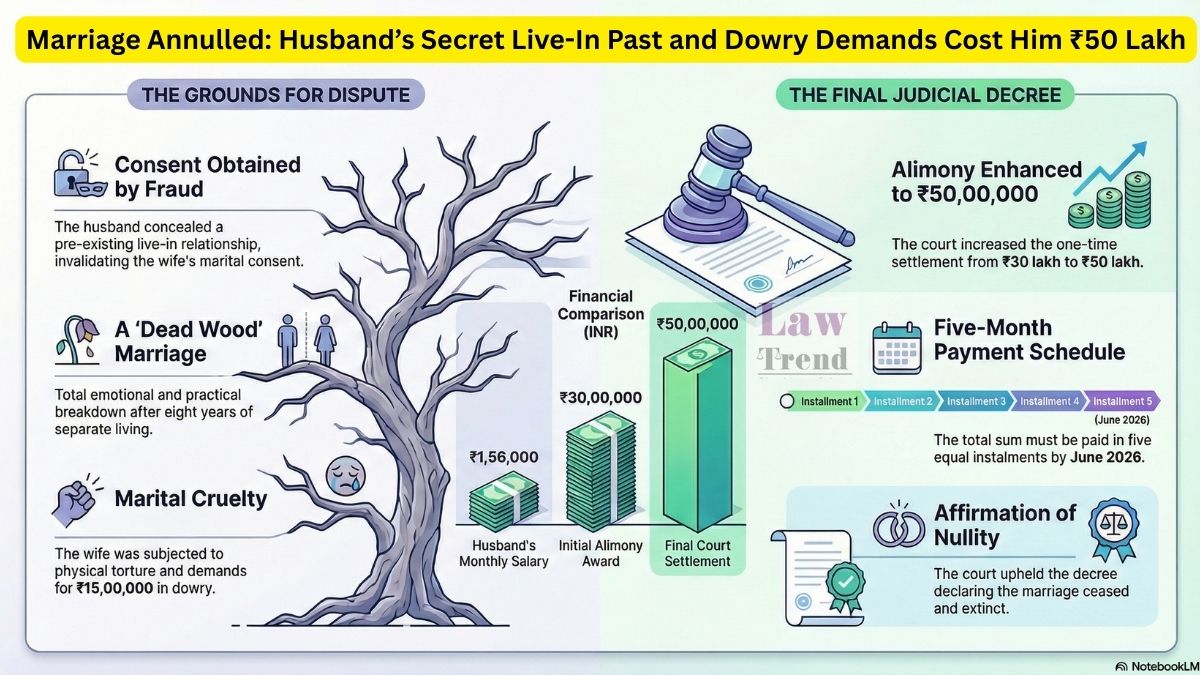
The Jharkhand High Court has upheld a decree of nullity of marriage on the ground that the husband concealed his prior live-in relationship, ruling that such concealment amounts to fraud under Section 12(1)(c) of the Hindu Marriage Act, 1955. While affirming the annulment, the Division Bench comprising Justice Sujit Narayan Prasad and Justice Gautam Kumar Choudhary enhanced the permanent alimony awarded to the wife from Rs. 30 Lakhs to Rs. 50 Lakhs, observing that the amount must reasonably secure her future.
Background of the Case
The appeals arose from a common judgment dated February 16, 2017, passed by the Principal Judge, Family Court, Garhwa. The marriage between the parties was solemnized on December 2, 2015. The wife (Appellant in F.A. No. 213 of 2019) alleged that after moving to her matrimonial home, she discovered that her husband (Respondent) had been in a live-in relationship with another woman prior to their marriage, a fact that was concealed from her.
She further alleged that the husband and his family demanded Rs. 15 Lakhs as additional dowry and subjected her to physical and mental torture. She claimed she was ousted from the matrimonial home on March 2, 2016. The wife filed a suit under Section 12(1)(c) of the Hindu Marriage Act, seeking annulment of the marriage on the ground of fraud, along with permanent alimony.
The Family Court, proceeding ex-parte as the husband failed to appear, allowed the petition, annulled the marriage, and directed the husband to pay Rs. 30 Lakhs as permanent alimony. The wife filed an appeal seeking enhancement of alimony, while the husband filed a separate appeal (F.A. No. 23 of 2018) challenging the ex-parte judgment and the decree of nullity.
Arguments of the Parties
The counsel for the Wife argued that the Family Court failed to follow a specific formula while fixing the permanent alimony and did not adequately consider the husband’s income and status. It was submitted that the husband held a high-ranking position with a handsome salary and possessed valuable assets. The wife sought alimony of Rs. 1 Crore.
The counsel for the Husband contended that the ex-parte judgment was bad in law as no summons or notices were properly served. He denied the allegations of infidelity and cruelty, arguing that the wife’s behaviour and false complaints amounted to cruelty against him. He further argued that the marriage had irretrievably broken down due to the wife’s actions.
Court’s Analysis and Observations
On Validity of Ex-Parte Order: The High Court rejected the husband’s contention regarding non-service of summons. Referring to the records, the Bench noted:
“It is evident from the record that despite summon and notices issued against the respondent… he neither appeared in this case nor filed any written statement… The Court was left no other option than to proceed ex-parte.”
On Annulment of Marriage (Fraud): The Court examined the evidence regarding the concealment of the husband’s prior relationship. The Bench observed that the wife and her mother deposed consistently that the husband was introduced as a man of good character, but the prior live-in relationship was concealed.
“Since the status of prior live-in-relationship of the respondent/husband with other lady has not been disclosed to the appellant wife, therefore, it may be inferred herein that consent of the petitioner/appellant/wife and her guardian was obtained by practicing fraud by the respondent/husband as required U/S 12(1)(C) of Hindu Marriage Act, 1955.”
The Court also invoked the concept of “dead wood marriage,” noting that the parties had been living separately since 2016.
“It is settled proposition of law that when a marriage is deemed a dead wood situation, Courts may consider it a valid reason to grant a divorce, recognizing that forcing a couple to remain in such a relationship only prolongs their suffering.”
On Permanent Alimony: The Court relied on the Supreme Court’s judgment in Rajnesh v. Neha & Anr. (2021) to determine the quantum of maintenance. The Court noted that the husband is employed as a Manager (Instrumentation) at Hindustan Zinc Ltd., earning approximately Rs. 1.56 Lakh per month. The wife, although holding an LL.B. degree, is currently unemployed and dependent on her father.
The Court observed:
“The respondent/husband’s income, financial disclosures, and past earnings establish that he is in a position to pay a higher amount. The appellant-wife… is entitled to a level of maintenance that is reflective of the standard of living she enjoyed during the marriage and which reasonably secures her future.”
Decision
The High Court affirmed the decree of nullity of marriage passed by the Family Court. However, regarding the alimony, the Bench modified the lower court’s order.
“Having considered the submissions and the evidence on record, we find it just and equitable to enhance the permanent alimony to Rs. 50,00,000/- as a one-time settlement. This amount will reasonably secure the appellant’s future and ensure a standard of living commensurate with her circumstances.”
The Court directed the husband to pay the amount of Rs. 50 Lakhs in five equal monthly installments between February 2026 and June 2026.