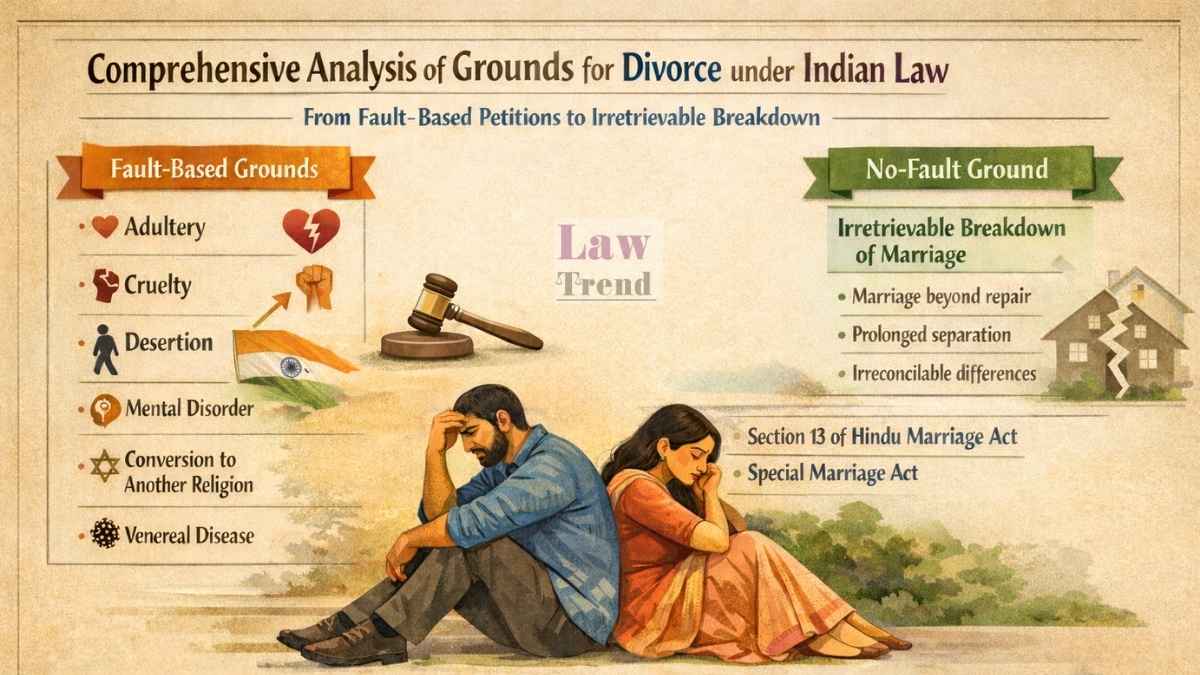
The matrimonial landscape in India is governed by a complex web of personal laws tailored to different religious communities. While statutes like the Hindu Marriage Act, 1955 (HMA) and the Special Marriage Act, 1954 (SMA) provide the primary framework for the majority of cases, the legal grounds for seeking a decree of divorce have evolved through both legislative action and judicial interpretation. This article provides a detailed breakdown of the existing grounds for divorce, categorized into fault-based grounds, objective breakdown grounds, special provisions for wives, and the emerging doctrine of irretrievable breakdown.
The Statutory Framework
Matrimonial relief in India is predominantly sought under the Hindu Marriage Act, 1955 (for Hindus, Buddhists, Jains, and Sikhs) and the Special Marriage Act, 1954 (a secular law for civil marriages). Other community-specific laws include the Indian Divorce Act, 1869 (Christians), the Parsi Marriage and Divorce Act, 1936, and the Dissolution of Muslim Marriages Act, 1939.
I. Fault-Based Grounds: Section 13(1) of the HMA
Under the “Fault Theory” of marriage, one party must prove a specific matrimonial offense committed by the other. Section 13(1) of the HMA outlines several grounds:
- Adultery: The respondent having voluntary sexual intercourse with any person other than the spouse after solemnization.
- Cruelty: Treatment of the petitioner with physical or mental cruelty. The Supreme Court has interpreted mental cruelty broadly to include conduct causing a reasonable apprehension that living together would be harmful.
- Desertion: Abandonment of the petitioner for a continuous period of at least two years without reasonable cause or consent.
- Conversion: The respondent ceasing to be a Hindu by converting to another religion.
- Mental Disorder: Incurable unsoundness of mind or a mental disorder of such nature that the petitioner cannot reasonably be expected to live with the respondent.
- Venereal Disease: Suffering from a virulent and incurable form of venereal disease.
- Renunciation of the World: Entering a religious order (Sanyasa).
- Presumption of Death: The respondent not being heard of as alive for seven years or more.
II. Objective Grounds: Breakdown of Marriage
Citing Section 13(1A) of the HMA, the law provides for divorce based on the failure of previous court decrees, regardless of original fault:
- Non-resumption of Cohabitation: If there is no cohabitation for one year or more after a decree of judicial separation. In Jethabhai Ratanshi Lodaya vs Manabai Jethabhai Lodaya (1973), the Bombay High Court observed that this section provides a purely objective test based on the failure of the relationship to resume.
- Non-compliance with Restitution of Conjugal Rights: If there is no restitution of conjugal rights for one year or more after such a decree has been passed. The Supreme Court in Ms. Jordan Diengdeh vs S.S. Chopra (1985) noted the consistency of this ground across various statutes.
III. Special Protections for the Wife: Section 13(2)
The HMA provides specific additional grounds available exclusively to the wife:
- Bigamy: Applicable to marriages before the HMA where another wife of the husband is alive.
- Criminal Offenses: If the husband is guilty of rape, sodomy, or bestiality since the solemnization of the marriage.
- Maintenance Decree: If cohabitation has not resumed for a year following a maintenance decree under the Hindu Adoptions and Maintenance Act, 1956, or Section 125 of the CrPC.
- Repudiation of Marriage: If the wife was married before the age of 15 and repudiated the marriage between the ages of 15 and 18. This ground was notably referenced by the Andhra High Court in Youth Welfare Federation vs Union of India (1996).
IV. Mutual Consent: Section 13B
Introduced to provide a smoother exit from failed marriages, Section 13B allows for divorce if both parties jointly petition the court, stating:
- They have been living separately for at least one year.
- They have not been able to live together.
- They have mutually agreed to dissolve the marriage.
V. The Doctrine of Irretrievable Breakdown
While not yet a statutory ground under the HMA or SMA, “Irretrievable Breakdown of Marriage” has gained significant legal traction. The Law Commission of India’s 71st Report recommended its introduction—a sentiment echoed by the Bombay High Court in Mrs. Pragati Varghese vs Cyril George Varghese (1997).
The legal pinnacle of this doctrine was reached in the landmark 2023 Supreme Court judgment, Shilpa Sailesh vs Varun Sreenivasan. The Court affirmed that it can invoke its extraordinary powers under Article 142 of the Constitution of India to grant a divorce on this ground.
The Court observed that it can dissolve a marriage if it is satisfied that the union is “completely unworkable, emotionally dead, and beyond salvage,” even if the statutory requirements for fault or waiting periods are not strictly met. This power is exercised to ensure “complete justice” between the parties when the matrimonial bond has broken down beyond repair.