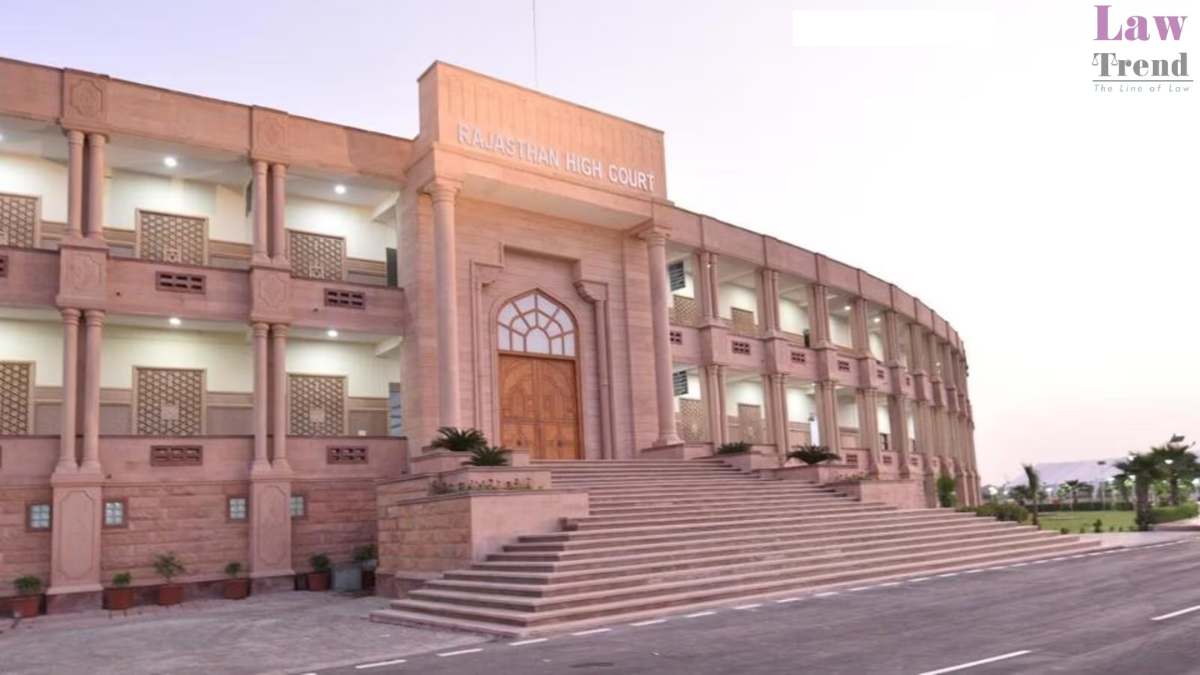
The Rajasthan High Court, Bench at Jaipur, has dismissed a writ petition seeking compassionate appointment, observing that such appointments are meant to provide immediate relief and cannot be claimed after an inordinate delay. The court held that if a family has managed to subsist for several years after the death of the employee, the immediate financial crisis justifying such an appointment no longer exists.
Background
The petitioner, Rahul Kumar Meena, is the son of Late Shri Babulal, who served as a Constable in the Rajasthan Police Department and died in harness on June 3, 2016. At the time of his father’s death, Rahul was a minor, aged 13 years and 17 days.
Initially, the petitioner’s mother applied for his appointment on compassionate grounds, requesting it be granted once he attained majority. Upon reaching 18, a second application was submitted on October 18, 2023. However, the respondents rejected this application on April 22, 2025, citing inordinate delay and state instructions that only matters with a delay of less than three years could be forwarded for consideration.
Arguments of the Parties
The petitioner’s counsel argued that the family suffered significant financial hardship following the breadwinner’s death. They contended that the denial of appointment was “unjustified, unwarranted and violative of Article 21 of the Constitution of India.” The counsel further stated that since the rules are intended to save the family from starvation, the delay should not be a ground for rejection.
The respondents maintained that the object of the compassionate appointment scheme is frustrated by such long delays. They relied on a State Government letter dated April 8, 2024, which limits the consideration of delayed cases.
Court’s Analysis
Justice Anand Sharma emphasized that compassionate appointment is not a “matter of right, nor an alternative mode of recruitment,” but an exception to the general rule of public employment under Articles 14 and 16.
The court cited several landmark Supreme Court judgments to clarify the jurisprudence:
- Sushma Gosain vs. Union of India (1989): Held that appointment must be provided without delay to relieve the family from immediate destitution.
- Umesh Kumar Nagpal vs. State of Haryana (1994): Clarified that it is not a source of permanent recruitment or a vested right.
- State of West Bengal v. Debabrata Tiwari (2025): Reaffirmed that prolonged delay creates a strong presumption that the family has overcome the initial financial hardship.
Justice Sharma observed:
“The very fact that the family has managed to subsist for several years after the death of the employee clearly indicates that the immediate financial crisis, which alone justifies compassionate appointment, no longer subsists.”
The court further noted that granting relief in such cases would violate the constitutional mandate of equal opportunity.
“This Court cannot lose sight of the fact that granting compassionate appointment after such a prolonged delay would amount to converting a welfare-oriented exception into a regular source of employment… compassionate appointment must not be allowed to become a parallel mode of recruitment.”
Regarding the petitioner’s claim of arbitrariness, the court remarked that “adherence to the settled legal principles… is neither arbitrary, nor unreasonable.”
Decision
The court concluded that the claim was barred by “inordinate and unexplained delay” and was “wholly unsustainable in law.” Finding no illegality in the respondents’ decision, the High Court dismissed the writ petition.
Case Details:
- Case Title: Rahul Kumar Meena vs. State of Rajasthan & Ors.
- Case Number: S.B. Civil Writ Petition No. 15227/2025
- Bench: Justice Anand Sharma