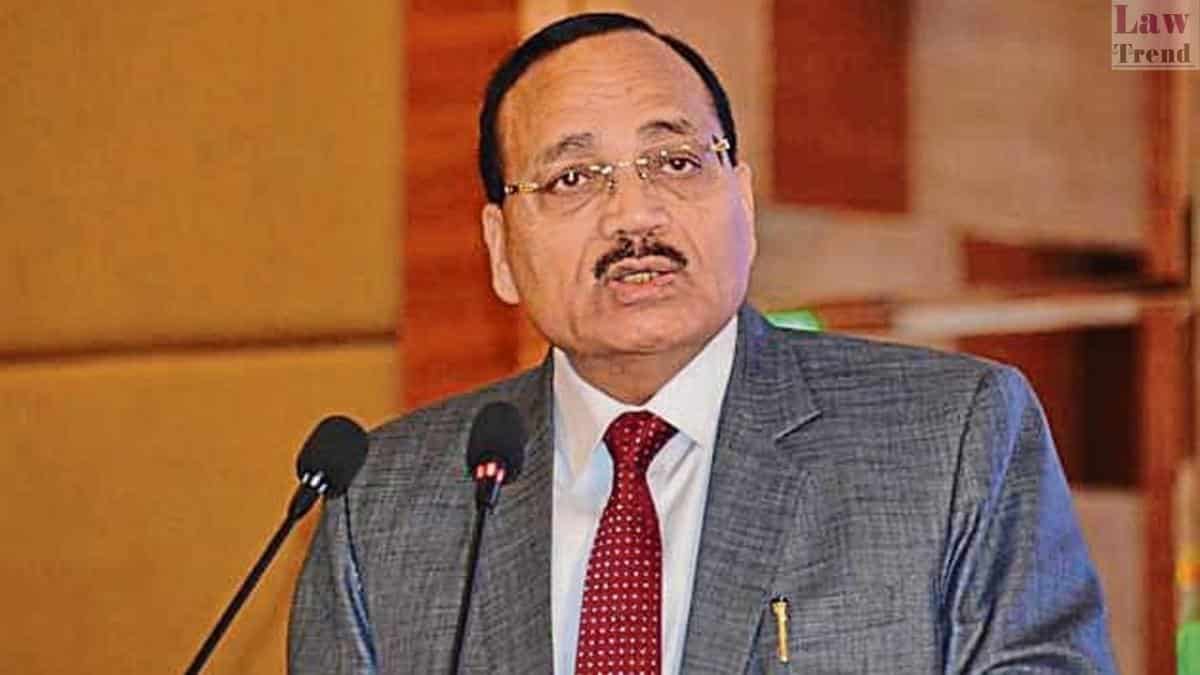
Chief Justice of India (CJI) Justice Surya Kant on Monday made a strong pitch for revitalising the district judiciary, asserting that “true justice” resides not in appellate courts but at the grassroots, where ordinary citizens first encounter the legal system.
Speaking at a felicitation event organised by the Bar Council of Delhi at the Delhi High Court premises, CJI Surya Kant urged both the Supreme Court and high courts to actively “incentivise” young lawyers to begin their legal careers in district courts rather than limiting their ambitions to the higher judiciary.
“Justice does not primarily reside in the appellate forums only. True justice resides only at the grassroots-level courts because the ordinary citizen will have the first encounter for the enforcement of his right only in the district courts,” the Chief Justice said.
He criticised the persistent use of the term “lower courts” to describe district courts, calling it a “misbranding” that undermines their pivotal role. “Being an important organ of an independent judiciary, these courts play a more important role than the appellate fora,” he emphasised.
Justice Kant, who took over as the 53rd Chief Justice of India in November 2025, reflected on his own beginnings as a young lawyer in the district courts, describing them as “centres of cultivating professional culture.”
“If a litigant, a consumer of justice, is satisfactorily dealt with in this primary health centre [the district court], I am quite sure he will not be required to be shifted to bigger hospitals. Definitely, he will not be required to go to a trauma centre,” he said, drawing an analogy between courts and healthcare infrastructure.
The event was attended by sitting judges of the Supreme Court and the Delhi High Court, senior advocates, office-bearers of the Bar Council of Delhi, and members of the legal fraternity.
CJI Kant also flagged what he called a misconception among graduates of premier law schools, including National Law Universities, who often bypass district courts and head straight to high courts or the Supreme Court for their legal practice.
“There is somehow a misconception among law graduates from national law universities or other ‘important’ universities that leads them to consider either a high court or the Supreme Court for their legal practice, and not the district courts,” he said.
Calling for a “collaborative approach” between the Bar and the Bench, the Chief Justice urged that systemic changes be made to encourage more robust practice and mentorship in the trial courts.
“Let us try to incentivise the practices in the district courts and try to cultivate that culture which will strengthen our legal bar,” he urged, addressing both his colleagues in the higher judiciary and the Bar leaders.
Justice Kant also touched upon the role of technology in legal work, acknowledging its usefulness in drafting but underlining the irreplaceable value of human judgment and critical thinking. “Technology is of good help in drafting, but application of mind has to be learnt,” he said.
The CJI’s remarks come at a time when concerns around pendency, access to justice, and uneven distribution of legal talent across the judiciary remain key policy and institutional challenges.