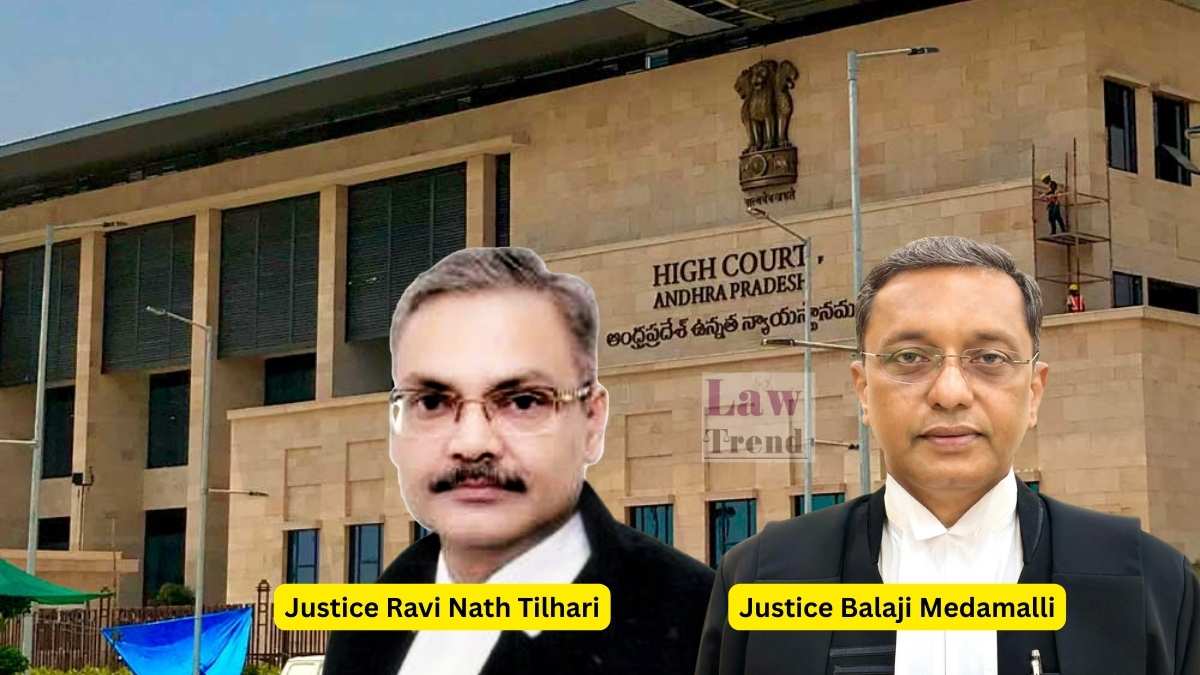
The High Court of Andhra Pradesh has ruled that a Civil Miscellaneous Appeal (CMA) is the appropriate legal remedy against a final order passed under Section 25 of the Hindu Marriage Act, 1955. The Division Bench, comprising Justice Ravi Nath Tilhari and Justice Balaji Medamalli, overruled an office objection which had suggested that a Civil Revision Petition (CRP) under Article 227 of the Constitution of India should have been filed instead.
Background
The matter arose from a matrimonial dispute where the husband had initially filed a petition for divorce, and the wife had filed for the restitution of conjugal rights. The trial court allowed the divorce petition and dismissed the petition for restitution. Subsequently, the wife filed an application under Section 25 of the Hindu Marriage Act for permanent alimony and maintenance.
The application was partly allowed by the lower court. Aggrieved by the part rejection of her claim, the wife preferred a Civil Miscellaneous Appeal (CMA) before the High Court. However, the High Court Registry raised a technical objection, contending that since the order was passed under Section 25, a CRP under Article 227 of the Constitution was the maintainable remedy rather than an appeal.
Arguments of the Parties
The learned counsel for the appellant resubmitted the appeal, arguing that a CMA is maintainable because the impugned order was a final determination of rights under Section 25. Reference was made to Section 28(2) of the Hindu Marriage Act, which specifically provides for appeals against orders made under Sections 25 and 26, provided they are not interim in nature. The counsel further clarified that the challenge was not limited to the subject of costs, which would otherwise be barred under Section 28(3).
Court’s Analysis and Observations
The Court examined the statutory framework of the Hindu Marriage Act, specifically focusing on Sections 25 and 28.
Section 25 deals with permanent alimony and maintenance, allowing the court to grant such relief at the time of passing a decree or any time subsequent thereto. The Bench observed:
“In the present case, the application has been filed by the wife after the decree has been passed i.e., subsequent to the decree. The application has been finally allowed, though partly. So, it is not a case for grant of interim order but a case of final order under Section 25 of the Act.”
Turning to the maintainability of the appeal, the Court analyzed Section 28, which governs appeals from decrees and orders. The Bench noted that while Section 28(1) makes all decrees appealable, Section 28(2) explicitly states:
“Orders made by the court in any proceeding under this Act under section 25 or section 26 shall, subject to the provisions of sub-section (3), be appealable if they are not interim orders…”
The Court highlighted that the order in question was a “final order” and did not fall under the exceptions of being an interim order or an order solely regarding costs.
The Division Bench also cited the precedent in M.P. Gopi v. Prameela (1995 AIHC 3431), where it was held that orders under Section 25 are substantive and create independent rights. The Court quoted the following observation from the cited case:
“The character of the order impugned… clearly shows that it is an order under a substantive provision creating independent rights under Hindu law of Marriage after the dispute is finally terminated. By no stretch of imagination the order can be said to be an interlocutory order.”
Decision
The High Court concluded that the appeal was competent both under the Hindu Marriage Act and the Family Courts Act.
“We hold that the Civil Miscellaneous Appeal is maintainable under Section 28(2) of the Act. Office objection is overruled.”
The Court directed the Registry to number the appeal and posted the matter for further hearing next week.
- Case Title: The Visakhapatnam Port Authority vs. M/s s.Vishwanadh Avenues India Private Limited
- Case Number: CMA (SR) NO: 53594 of 2025