

Child Victim’s Trustworthy Testimony Alone Can Sustain Conviction; Oral Penetration Amounts to Rape: Chhattisgarh High Court
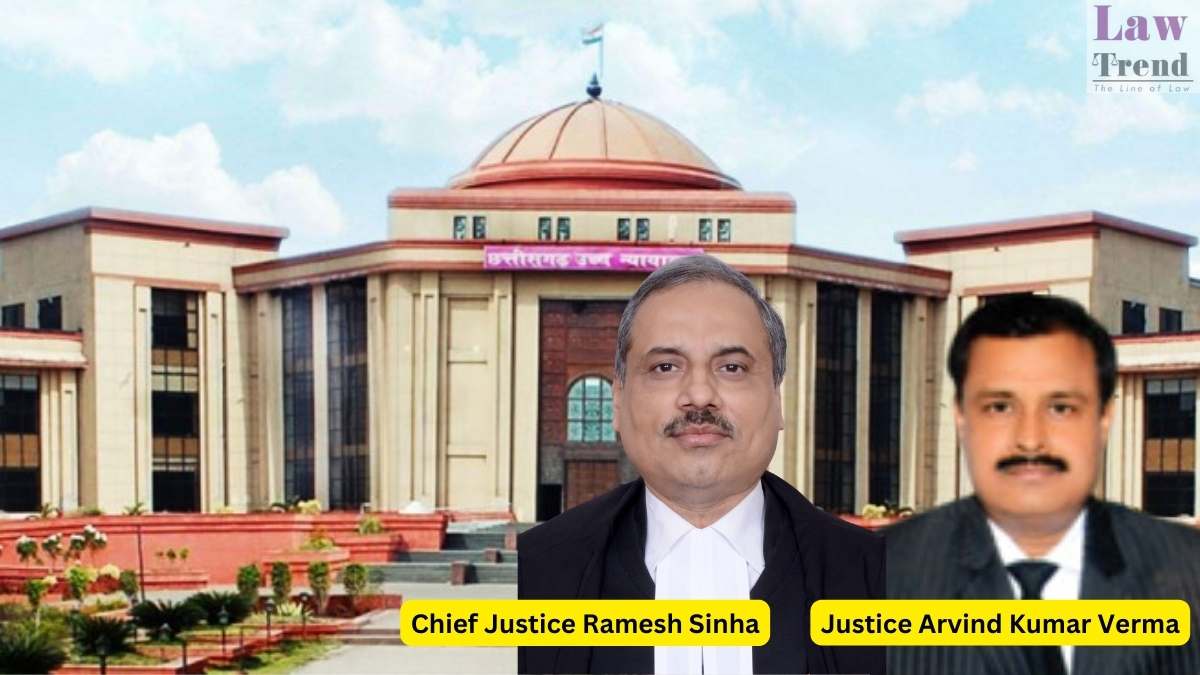

The High Court of Chhattisgarh has dismissed a criminal appeal challenging the life imprisonment of a 20-year-old man convicted of abducting and sexually assaulting a 9-year-old girl. A Division Bench comprising Chief Justice Ramesh Sinha and Justice Arvind Kumar Verma affirmed the trial court’s judgment, ruling that oral penetration squarely falls within the definition of rape under Section 375 of the Indian Penal Code (IPC). The Court further held that the testimony of a child victim, if natural and trustworthy, is sufficient to sustain a conviction without corroboration.

Background of the Case

The case stems from an incident dated December 30, 2018, in Village Matiyari, under the jurisdiction of Police Station Seepat, District Bilaspur. According to the prosecution, the complainant lodged a written report stating that his daughter (Victim No. 1), aged 9 years, and her cousin (Victim No. 2), aged 7 years, had gone out to look for a cow. An unknown person, later identified as the appellant, Pritam Gir alias Ghislu, lured them by asking them to bring gutkha and khaai worth Rs. 5. He then took them to a pond on the pretext of showing them a calf and sexually assaulted Victim No. 1.

The victim informed her father that the accused had committed the act, causing her severe pain and bleeding. Following the investigation, the police filed a charge sheet against the accused under Section 376AB of the IPC and Sections 4 and 6 of the Protection of Children from Sexual Offences (POCSO) Act.

On August 12, 2022, the Additional Sessions Judge, Second Fast Track Special Court, Bilaspur, convicted Pritam Gir under Sections 363, 366, and 376 of the IPC and Sections 5(m)/6 of the POCSO Act, sentencing him to life imprisonment. The appellant challenged this conviction in the High Court.

Submissions of the Parties

Counsel for the Appellant, Mr. Qamrul Aziz, argued that the trial court failed to properly appreciate the evidence. He submitted that the prosecution did not prove the case beyond reasonable doubt, describing the victims’ statements as “full of conjectures and surmises.” He further contended that the age of the victims had not been scientifically proved as no ossification test was conducted, rendering the conviction liable to be set aside.

READ ALSO  Victim Status Requires Perceivable Harm to Mind or Reputation: Kerala High Court

Government Advocate Mr. Priyank Rathi, appearing for the State, opposed the appeal, submitting that the appellant had committed a heinous crime against a 9-year-old minor. He argued that the prosecution had duly proved the charges of allurement, abduction, and rape beyond reasonable doubt.

Court’s Analysis and Observations

The Division Bench examined the evidence “with utmost circumspection” and addressed the key legal issues raised.

Determination of Age The Court first addressed the age of the victim. Referring to the Supreme Court’s decision in Jarnail Singh Vs. State of Haryana (2013), the Bench reiterated that Rule 12 of the Juvenile Justice Rules, 2007, applies to determining the age of a victim. The Court noted that the Headmaster of the Government Primary School, Matiyari, produced the admission register showing the victim’s date of birth as March 16, 2009. Since the school records were available and unchallenged by contrary evidence, the Court held that the trial court rightly determined the victim was 9 years old on the date of the incident.

Kidnapping and Abduction (Sections 363 & 366 IPC) The Court upheld the conviction under Section 363 (Kidnapping) and Section 366 (Abduction). Citing the Supreme Court in S. Varadarajan v. State of Madras, the Bench observed that the appellant had “solicited or persuaded” the minors to leave their guardian’s protection by sending them to buy gutkha and luring them to the pond. Regarding Section 366, the Court referred to Mohammed Yousuff alias Moula v. State of Karnataka, noting that the prosecution must prove abduction was for the purpose of illicit intercourse. The Court held:

READ ALSO  Chhattisgarh HC Orders ₹2 Lakh Compensation for Breach of Confidentiality of Newborn and HIV-Positive Mother

“In the instant case, as the offence of sexual assault has been found proved by the prosecution which satisfies the requirement of Section 366 of the IPC, we are of the considered view that the trial Court is absolutely justified in convicting the appellant.”

Rape and Oral Penetration The Court scrutinized the statements of Victim No. 1 and Victim No. 2, who consistently testified that the accused took them to a pond, stripped them, and inserted his “urinal into her mouth.” Victim No. 1 also testified that the act caused bleeding. The Court observed that under Section 375 of the IPC, rape includes penetrating the penis into the “mouth, urethra or anus of a woman.” The medical evidence supported the testimony. The Forensic Science Laboratory (FSL) report confirmed the presence of semen stains and human sperm on the victim’s undergarments and leggings, as well as on the accused’s clothing.

“Thus, the presence of human sperms in the panties and diaper of victim No.1 confirms that the accused raped the victim No.1… Oral penetration by the accused squarely falls within the definition of rape and penetrative sexual assault under law.”

Reliability of Child Testimony Rejecting the defense’s claim that the victims were unreliable, the Court cited Supreme Court precedents in Ganesan v. State and State (NCT of Delhi) v. Pankaj Chaudhary. The Bench observed that the sole testimony of a prosecutrix, if trustworthy, does not require corroboration.

READ ALSO  Conviction Cannot Be Based on Dying Declaration Without Clear Proof of Victim’s Mental Fitness: Chhattisgarh High Court

“We see no reason to doubt the credibility and/or trustworthiness of the victims. They are found to be reliable and trustworthy. Therefore, without any further corroboration, the conviction of the accused relying upon the sole testimony of the victims can be sustained.”

Decision

The High Court concluded that the prosecution successfully proved its case beyond reasonable doubt. The Bench dismissed the appeal, affirming the trial court’s judgment dated August 12, 2022.

“The appellant/convict is stated to be in jail. He shall serve out the sentence awarded by the trial Court… Accordingly, the appeal being devoid of merit is liable to be and is hereby dismissed.”

Case Details:

Case Title: Pritam Gir @ Ghislu v. State of Chhattisgarh

Case No.: CRA No. 1540 of 2022

Bench: Chief Justice Ramesh Sinha and Justice Arvind Kumar Verma

Counsel for Appellant: Mr. Qamrul Aziz, Advocate

Counsel for State: Mr. Priyank Rathi, Govt. Advocate

Law Trend
Law Trendhttps://lawtrend.in/
Legal News Website Providing Latest Judgments of Supreme Court and High Court

Related Articles

Latest Articles

