

Chhattisgarh HC Upholds Life Imprisonment for Husband and Paramour in Wife’s Contract Killing Case, Rules Criminal Conspiracy Established by Circumstantial Evidence
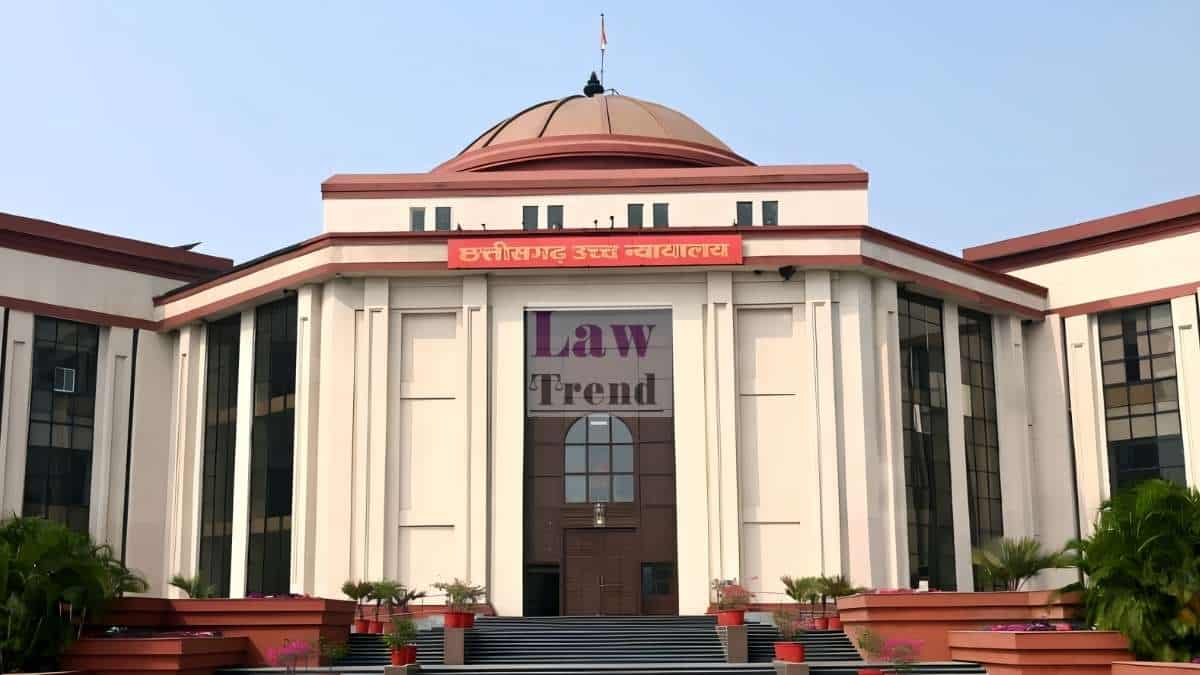

The High Court of Chhattisgarh has dismissed a batch of criminal appeals and upheld the conviction and life imprisonment sentences of a husband, his paramour, and three hired accomplices for the brutal murder of his wife in 2015. The Division Bench comprising Justice Rajani Dubey and Justice Sachin Singh Rajput ruled that the prosecution had successfully established the chain of circumstantial evidence proving a criminal conspiracy to eliminate the deceased.

Case Background

The deceased, Annu Shukla, was married to the appellant, Apendra Shukla, in 2012. According to the prosecution, shortly after the marriage, the deceased discovered an illicit relationship between her husband and the co-accused, Ku. Malti. The deceased informed her parents that she was being subjected to harassment and beatings by Apendra whenever she objected to the affair. It was alleged that Malti frequently visited the matrimonial home, treating the deceased as a “maid.”

On January 20, 2015, Annu Shukla was found dead at her matrimonial home in Village Mendra with multiple stab wounds. The police investigation revealed that the murder was a result of a conspiracy hatched by Apendra Shukla and Malti, who hired contract killers—Rajat alias Tingu, Chhotu alias Virendra, and Chiranjeet Kumar alias Deva (from Bihar)—to execute the crime.

The trial court, by a judgment dated February 19, 2019, convicted the accused under Sections 302 (Murder) and 120-B (Criminal Conspiracy) of the Indian Penal Code (IPC), sentencing them to life imprisonment. The appellants challenged this decision in the High Court.

Arguments of the Parties

The counsel for the appellants argued that the conviction was based entirely on circumstantial evidence with no eyewitnesses to the incident. They contended that the testimony of the prosecution witnesses was “replete with material contradictions and omissions.” Specific objections were raised regarding the seizure of articles, arguing that the seizure witnesses had turned hostile and that the recovery of incriminating items was doubtful. The defence also argued that the chain of circumstances was incomplete and that the accused were implicated merely on suspicion.

READ ALSO  Court Can’t Strike Down a Policy Decision of the Government Merely because it feels that another policy would have been more scientific or logical: HC

The State counsel, supporting the trial court’s judgment, submitted that there was ample evidence establishing the involvement of all accused in a conspiracy. The State highlighted the motive, stating that the deceased was an obstacle to the affair between Apendra and Malti. The prosecution relied heavily on Call Detail Records (CDRs) showing frequent communication among the accused, financial transactions involving the pawning of jewelry by Malti to fund the crime, and the recovery of the murder weapon and blood-stained clothes.

Court’s Observations and Analysis

The High Court undertook a detailed examination of the evidence, focusing on the charge of criminal conspiracy under Section 120-B of the IPC. The Court cited the Supreme Court judgment in Yogesh @ Sachin Jagdish Joshi v. State of Maharashtra, observing that while direct evidence of a conspiracy is rare, its existence “can be inferred from the surrounding circumstances and the conduct of the accused.”

The Bench noted the following key circumstances that completed the chain of evidence:

  • Motive: The testimony of the deceased’s parents (PW-11 and PW-12) established that Apendra and Malti were in an illicit relationship and had a strong motive to “eliminate the deceased” to continue their affair.
  • Call Detail Records (CDRs): The Court observed that the accused were in frequent contact between January 1, 2015, and January 20, 2015. The judgment noted, “The dots showing the involvement of the accused persons in the crime in question, are fully connected.”
  • Financial Trail: The Court relied on the testimony of a money lender (PW-3), who confirmed that accused Malti had pawned gold ornaments for Rs. 60,000 on January 19, 2015. Although the receipt bore a date of “19.02.2015,” the witness clarified it was a clerical error, and the transaction actually occurred a day before the murder, corroborating the theory that funds were arranged for the killers.
  • Presence of Hired Killers: The hotel register (Ex. P-10) and testimony of hotel staff (PW-7) proved that the accused Chiranjeet, hailing from Bihar, stayed in a lodge in Bilaspur from January 19 to January 20, 2015.
READ ALSO  No Automatic Right to Lease Renewal; Lessee in Breach or Misuse Cannot Claim Extension: Chhattisgarh HC

Referring to the nature of the crime, the Court observed:

“The brutality of the offence is writ large looking to the six stab wounds on the vital part like stomach of the deceased were inflicted. This shows that the accused persons did not want to take a chance to see the deceased alive.”

The Court also relied on the principle laid down in Firozuddin Basheeruddin v. State of Kerala, stating that conspiracy is a “partnership in crime” and a “clandestine activity.” The Bench held that the meeting of minds was duly established by the frequent telephonic conversations and the subsequent execution of the plan.

Decision

READ ALSO  Section 149 CPC Permits Filing of a Defective Appeal Without Court Fee; Seeking Condonation of Delay on the Ground of Lack of Funds to Buy Court Fee is Impermissible: SC

The High Court held that the prosecution had proved its case beyond reasonable doubt. The Division Bench stated:

“The evidence scrutinized by this Court do not speak anything other than the one that it is the accused/appellants who entered into a conspiracy to do away with the deceased so as to clear the way for accused Apendra and Malti to make their ugly dream come true.”

Consequently, the appeals filed by Ku. Malti (CRA No. 423 of 2019), Apendra Shukla (CRA No. 579 of 2019), and the co-accused Rajat, Chhotu, and Chiranjeet (CRA No. 517 of 2019) were dismissed. The conviction and life sentences awarded by the trial court were maintained.

Case Details:

  • Case Title: Ku. Malti v. State of Chhattisgarh (and connected appeals)
  • Case Numbers: CRA No. 423 of 2019, CRA No. 579 of 2019, CRA No. 517 of 2019
  • Coram: Justice Rajani Dubey and Justice Sachin Singh Rajput
  • Counsel for Appellants: Shri M.P.S. Bhatia, Ms. Devanshi Chakraborty, Shri Dheerendra Pandey, Shri Barun Kumar Chakrabarty, Shri Parasmani Shrivas, Shri Vinay Nagdev, Shri Lukesh Kumar Mishra
  • Counsel for Respondent (State): Shri Ajay Pandey, GA

Law Trend
Law Trendhttps://lawtrend.in/
Legal News Website Providing Latest Judgments of Supreme Court and High Court

Related Articles

Latest Articles

