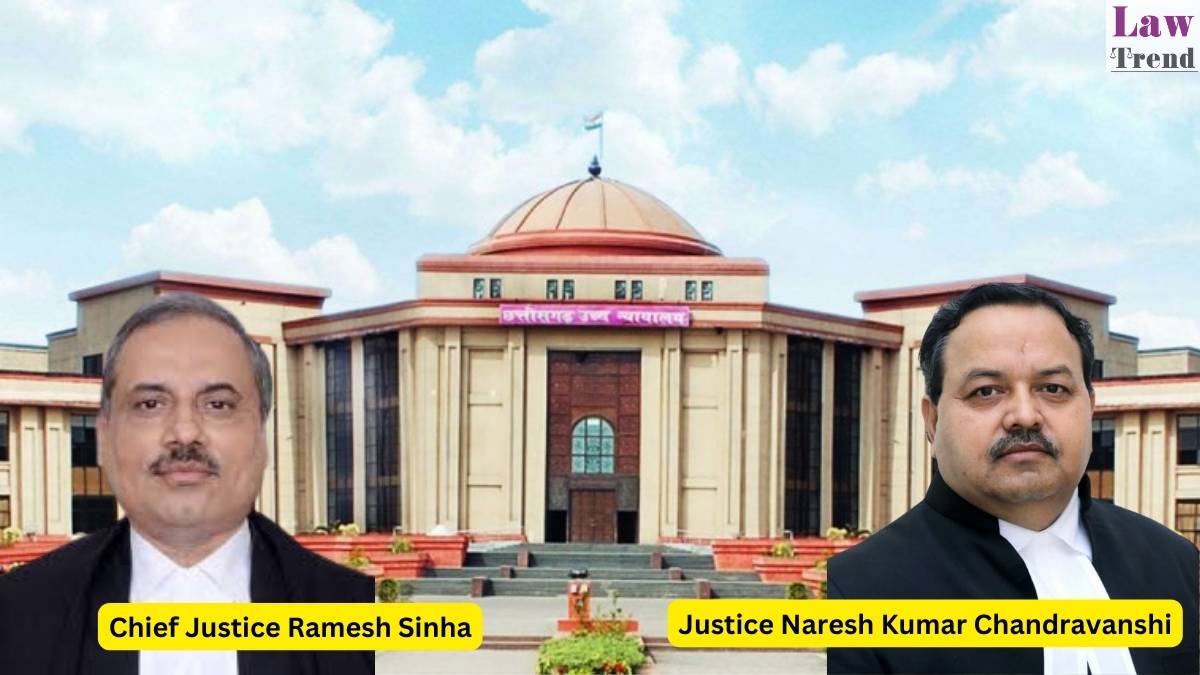
The High Court of Chhattisgarh has declared the levy of transit fees on iron ore transported via railways as ultra vires the Indian Forest Act, 1927, and beyond the legislative competence of the State Government.
In a judgment delivered on January 6, 2026, a Division Bench comprising Chief Justice Ramesh Sinha and Justice Naresh Kumar Chandravanshi allowed the writ petition filed by the Steel Authority of India Limited (SAIL), Bhilai Steel Plant. The Court quashed state notifications imposing transit fees on iron ore transported by rail, ruling that Section 41 of the Indian Forest Act, 1927, which empowers the State to regulate transit by “land or water,” does not extend to railway transportation.
Background of the Case
The petitioners, SAIL and its Bhilai Steel Plant unit, challenged the constitutional validity of Rules 3 and 5 of the Chhattisgarh Transit (Forest Produce) Rules, 2001. They specifically assailed two notifications issued by the State Government:
- Notification dated June 30, 2015, imposing a transit fee of ₹15 per ton.
- Notification dated July 27, 2022, enhancing the fee to ₹57 per ton.
The State demanded these fees for the transportation of iron ore extracted from forest land. SAIL contended that the iron ore was transported to non-forest land exclusively through the railway network and that the State lacked the authority to levy fees on such transit.
Arguments of the Parties
The Petitioners’ Stand: Senior Advocate Rajeev Shakdhar, appearing for the petitioners, argued that the impugned rules and notifications were ultra vires the Indian Forest Act, 1927. He submitted that the Act allows regulation only for transit “by land or water,” and railways constitute a distinct mode of transport under the exclusive domain of the Union Government (Entry 22 of the Union List).
The petitioners contended that the levy was, in substance, a tax on minerals disguised as a transit fee, lacking any element of quid pro quo (service rendered) by the State. They argued that the imposition of fees on a tonnage basis, rather than a vehicle or pass basis, indicated it was a fiscal measure (tax) rather than a regulatory fee.
The State’s Defence: Deputy Advocate General Praveen Das, representing the State of Chhattisgarh, argued that Section 2(4) of the Indian Forest Act includes minerals within the definition of “forest produce.” He contended that Section 41 of the Act, which empowers the State to regulate transit, uses the term “by land,” which is wide enough to include railways.
The State relied on the Supreme Court judgment in State of Uttarakhand v. Kumaon Stone Crusher (2018), arguing that the power to levy transit fees had been upheld by the Apex Court.
Court’s Analysis and Observations
The Division Bench rejected the State’s interpretation of Section 41 of the Indian Forest Act, 1927. The Court observed that the expression “by land or water” in Section 41 must be strictly construed to preserve its constitutionality.
On Legislative Competence: The Court noted that ‘Railways’ falls under Entry 22 of the Union List (List I) of the Seventh Schedule of the Constitution. The Bench held:
“Any interpretation which brings railway transportation within the sweep of Section 41 would render the provision constitutionally vulnerable, as it would trench upon a field reserved exclusively for the Union… Therefore, Section 41 must be read as authorising regulation of transit by conventional land-based modes such as carts, trucks or head-loads, and by water routes, but not by rail.”
On the Nature of the Levy: The Court found that the levy was imposed on a tonnage basis (₹57 per ton) without correlation to any regulatory service. The Court stated:
“Such a levy, in pith and substance, bears the characteristics of a tax rather than a regulatory fee… The absence of any discernible quid pro quo, coupled with the scale and structure of the levy, leads to an irresistible conclusion that the impost is fiscal in nature.”
Reliance on Precedents: The Court distinguished the Kumaon Stone Crusher judgment cited by the State, noting that it dealt with road-based transportation. Instead, the Court relied on the Allahabad High Court judgment in Hindalco Industries Limited v. State of U.P., which held that transit rules did not envisage railway transportation. The Bench noted that the Special Leave Petition against the Hindalco judgment had been dismissed by the Supreme Court.
The Decision
The High Court allowed the writ petition (WPC No. 4676 of 2022) and issued the following directions:
- Quashing of Notifications: The Court quashed the notifications dated June 30, 2015, and July 27, 2022, as well as consequential letters dated August 23, 2022, and September 2, 2022, “insofar as they relate to levy and recovery of transit fee on transportation of iron ore by Railways.”
- Lack of Authority: The Court held that the State respondents have “no authority to demand or realise transit fee from the petitioners in respect of transportation of iron ore by rail.”
- Ultra Vires: The Court declared that Rules 3 and 5 of the 2001 Rules do not provide for a levy on railway transport, and the attempt to apply them to such transport is ultra vires the Act of 1927.
The Court concluded that the impugned action suffered from the “vice of lack of authority of law,” rendering it violative of Article 265 of the Constitution of India.