New Delhi: The Supreme Court has quashed criminal proceedings initiated under Section 3(1)(s) of the Scheduled Castes and the Scheduled Tribes (Prevention of Atrocities) Act, 1989, against three individuals, ruling that alleged caste-based abuses uttered inside a private residence do not satisfy the essential requirement of being committed “within public view.”
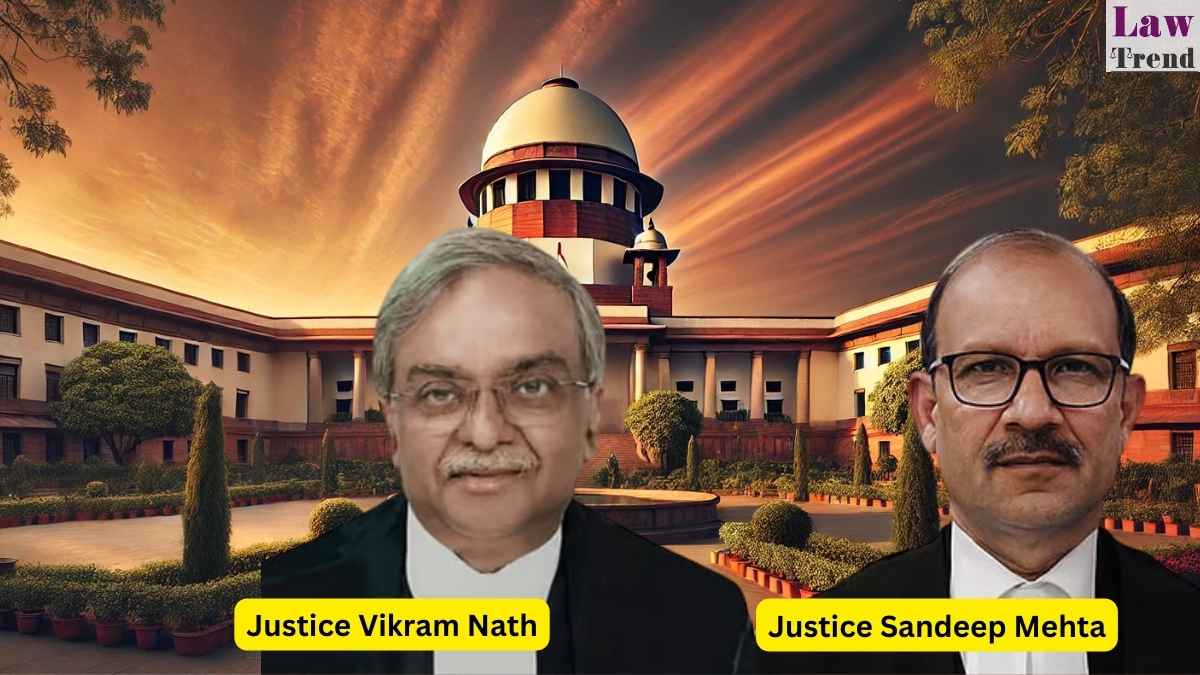
The Bench, comprising Justice Vikram Nath and Justice Sandeep Mehta, partly allowed the appeal in the case of Sohanvir @ Sohanvir Dhama & Ors. v. State of U.P. & Anr. (2025 INSC 1397), setting aside the judgment of the Allahabad High Court which had upheld the summoning order.
Background of the Case
The case arose from a complaint filed by Respondent No. 2, a member of the Scheduled Castes/Scheduled Tribes community employed as a sweeper. She alleged that on July 23, 2023, the Appellant No. 1, along with his son and servant, abused and assaulted her when she was sweeping. She further alleged that after she ran back to her house, the Appellants “chased her, entered her house and directed caste-based abuses at her,” tore her clothes, and threatened her.
Based on her application under Section 156(3) of the Code of Criminal Procedure (CrPC), a complaint was registered on December 2, 2023, under Sections 323 (voluntarily causing hurt) and 504 (intentional insult with intent to provoke breach of the peace) of the Indian Penal Code (IPC) and Section 3(1)(s) of the SC/ST Act.
The Special Judge issued summons to the Appellants on September 12, 2024. The Appellants challenged this order before the Allahabad High Court, which dismissed their appeal on July 8, 2025. The High Court had observed that “a portion of the alleged occurrence took place outside the complainant’s house, which constitutes a public place within public view.”
Arguments of the Parties
Before the Supreme Court, the Appellants contended that the allegations were a “counter-blast” to an FIR registered against the complainant’s son for attempting to kill Appellant No. 3.
Specifically regarding the SC/ST Act charges, the learned counsel for the Appellants argued that the offence under Section 3(1)(s) was not made out because the alleged caste-related abuse occurred inside the complainant’s residence. They submitted that the essential ingredient of the provision—that the abuse must occur “within public view”—was absent.
The Appellants argued:
“The allegations themselves indicate that the alleged abuses were uttered within the Respondent No.2-complainant’s residence, away from public view.”
Court’s Analysis and Observations
The Supreme Court examined Section 3(1)(s) of the SC/ST Act, which punishes anyone who “abuses any member of a Scheduled Caste or a Scheduled Tribe by caste name in any place within public view.”
Referring to the interpretation of “public view,” the Bench cited its recent decision in Karuppudayar v. State represented by the Deputy Superintendent of Police, Lalgudi, Trichy & Others (2025 INSC 132), which relied on Hitesh Verma v. State of Uttarakhand (2020). The Court reiterated:
“It could thus be seen that, to be a place ‘within public view’, the place should be open where the members of the public can witness or hear the utterance made by the accused to the victim. If the alleged offence takes place within the four corners of the wall where members of the public are not present, then it cannot be said that it has taken place at a place within public view.”
Applying this legal position to the facts, the Court observed that the application filed by the complainant stated that the abuses were used “inside the premises of the complainant.”
The Court noted:
“This circumstance, on its face, does not satisfy the statutory requirement that the abuses were made ‘in any place within public view,’ which is an essential component of the offence under Section 3(1)(s) of the SC/ST Act. The house of the complainant cannot be considered to be within public view.”
The Bench further pointed out that the counsel for the Respondent No. 2 failed to show any specific averment in the complaint or statement under Section 200 CrPC that the abuses were hurled within public view. The Court held that the High Court had “erred in concluding that the incident occurred in public view.”
Decision
The Supreme Court concluded that a prima facie case under Section 3(1)(s) of the SC/ST Act was not made out against the Appellants. The Court held that while appellate powers to quash summoning orders should be exercised with caution, the High Court ought to have intervened in this instance where essential ingredients were missing.
The Court ordered:
“Accordingly, the proceedings initiated against the Appellants under the Section 3(1)(s) of the SC/ST Act are hereby quashed. However, the trial insofar as it pertains to the remaining offences under the IPC shall proceed in accordance with law.”
The appeal was allowed in part.
Case Details:
- Case Title: Sohanvir @ Sohanvir Dhama & Ors. v. State of U.P. & Anr.
- Citation: 2025 INSC 1397
- Bench: Justice Vikram Nath and Justice Sandeep Mehta