

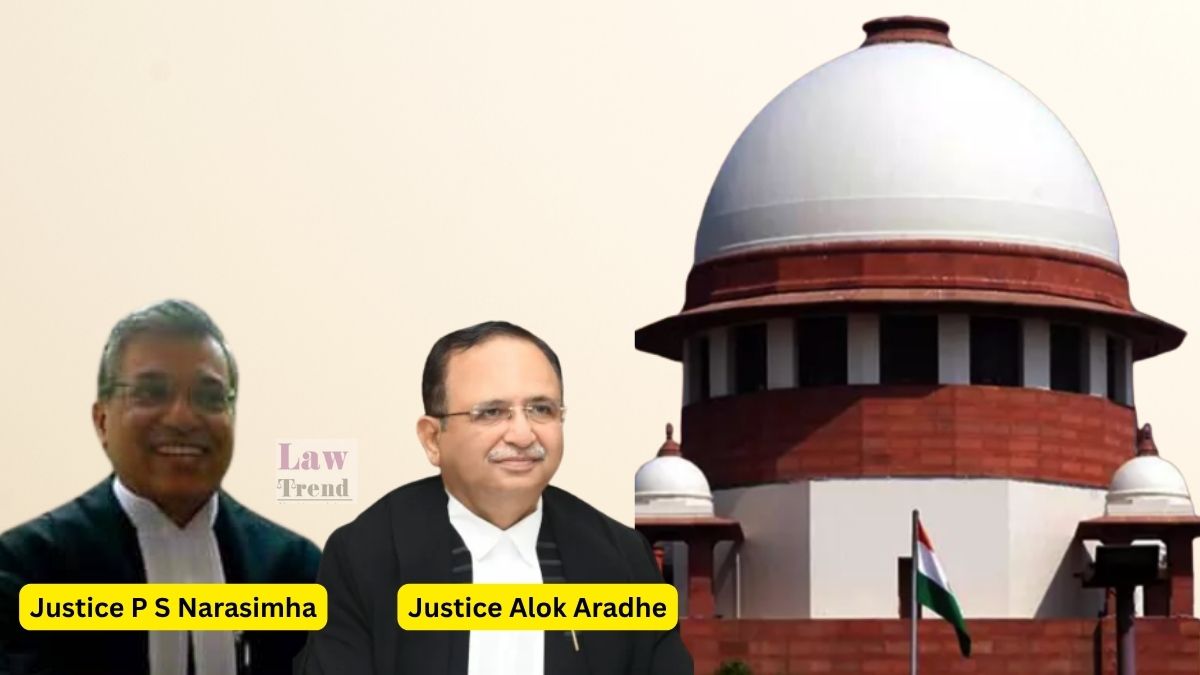
The Supreme Court of India has held that an order of blacklisting is a “drastic step” that cannot be treated as a mechanistic or logical consequence of a contract termination. In a judgment delivered on April 2, 2026, a Bench comprising Justice Pamidighantam Sri Narasimha and Justice Alok Aradhe ruled that while the State may be justified in terminating a contract for negligence, the decision to blacklist must independently satisfy the principles of natural justice and demonstrate an objective application of mind.
The Court upheld the termination of the appellant’s contracts due to substantiated negligence but set aside the five-year blacklisting order, directing that it cease to operate with immediate effect.
Background of the Case
The appellant, M/s A.K.G. Construction and Developers Pvt. Ltd., was a registered contractor with the Drinking Water and Sanitation Department of the State of Jharkhand. On March 6, 2023, it was awarded a contract for the construction of an Elevated Service Reservoir (ESR). On June 1, 2024, the top dome of the reservoir collapsed.
Following the incident, the Department issued a purported show-cause notice on June 4, 2024, asking why action should not be taken for “negligence” and “low-quality construction.” The appellant attributed the collapse to an unexpected cyclone and offered to reconstruct the reservoir at its own expense. However, after multi-level inquiries involving experts from BIT Sindri and various IITs, the Department passed an order on August 23, 2024, which simultaneously terminated all of the appellant’s subsisting contracts and blacklisted the firm for five years.
The appellant’s challenges before the Appellate Authority and the High Court were unsuccessful. The High Court dismissed the writ petition, holding that the appellant’s offer to reconstruct was an admission of negligence and that proper opportunity had been afforded.
Arguments of the Parties
Appellant’s Submissions: Mr. M.S. Ganesh, learned senior counsel for the appellant, argued that both the termination and blacklisting were “illegal and arbitrary.” He contended that the various inquiry reports were prepared without giving the appellant an opportunity to participate. He further submitted that the decision was disproportionate as it resulted in the termination of all existing contracts across the department.
Respondent’s Submissions: Mr. Kumar Anurag Singh, representing the State of Jharkhand, relied on Clause 59 of the General Conditions of Contract (GCC) and Rule 10 of the Contractor Registration Rules, 2012. He argued that the GCC did not require a prior notice for termination. Regarding blacklisting, he contended that the notice dated June 4, 2024, satisfied the requirements of Rule 10.5 as it asked “why action should not be taken… as per rules.”
Court’s Analysis and Observations
The Supreme Court emphasized that judicial review of administrative actions involving termination and blacklisting requires “distinct standards of legality, rationality and proportionality” because the consequences of these actions carry “differing gravity.”
On Termination: The Bench found the findings of negligence to be “unimpeachable” based on the expert reports. It noted that the appellant had a sufficient opportunity to defend itself during the appellate and High Court proceedings. Thus, the termination was upheld on merits and due process grounds.
On Blacklisting: The Court’s scrutiny focused on Rule 10 of the 2012 Rules, which details the severe civil consequences of blacklisting, including the cancellation of registration in all categories and the forfeiture of security deposits for all ongoing works.
The Court observed:
“A decision of blacklisting is not automatic and certainly not a logical consequence of a decision of termination… These decisions operate in two dimensions — past and subsisting for termination and future for blacklisting.”
Referring to the landmark cases of Erusian Equipment & Chemicals Ltd. v. State of West Bengal and UMC Technologies Pvt Ltd v. Food Corporation of India, the Bench reiterated that blacklisting is “stigmatic and exclusionary” and acts as an “instrument of coercion.”
The Court highlighted that for a show-cause notice to be valid for blacklisting:
- It must specifically propose the penalty of blacklisting.
- It must allow the noticee an “adequate, informed and meaningful opportunity” to respond to that specific proposal.
- The final order must contain reasons demonstrating an application of mind regarding why such a drastic step is necessary.
The Bench found the Department’s notice dated June 4, 2024, deficient, noting it did not explicitly mention blacklisting. The Court remarked that a contractor cannot be expected to “assume” that a notice for negligence is also a notice for blacklisting.
The Decision
The Supreme Court concluded that the blacklisting order dated August 23, 2024, suffered from “patent infirmities” and lacked the application of mind required under Rule 10.5.
While the Court would typically remit the matter for a fresh show-cause notice, it noted that more than one and a half years had passed since the original order. To avoid further litigation and “suitably mould the relief,” the Bench ordered:
- The order of termination of all contracts is confirmed as legal and valid.
- The order blacklisting the appellant is set aside and shall cease to operate with immediate effect.
Case Details:
- Case Title: M/s A.K.G. Construction and Developers Pvt. Ltd v. State of Jharkhand & Ors.
- Case Number: Civil Appeal arising out of SLP (C) No. 23858 of 2025
- Bench: Justice Pamidighantam Sri Narasimha, Justice Alok Aradhe
- Date: April 02, 2026




