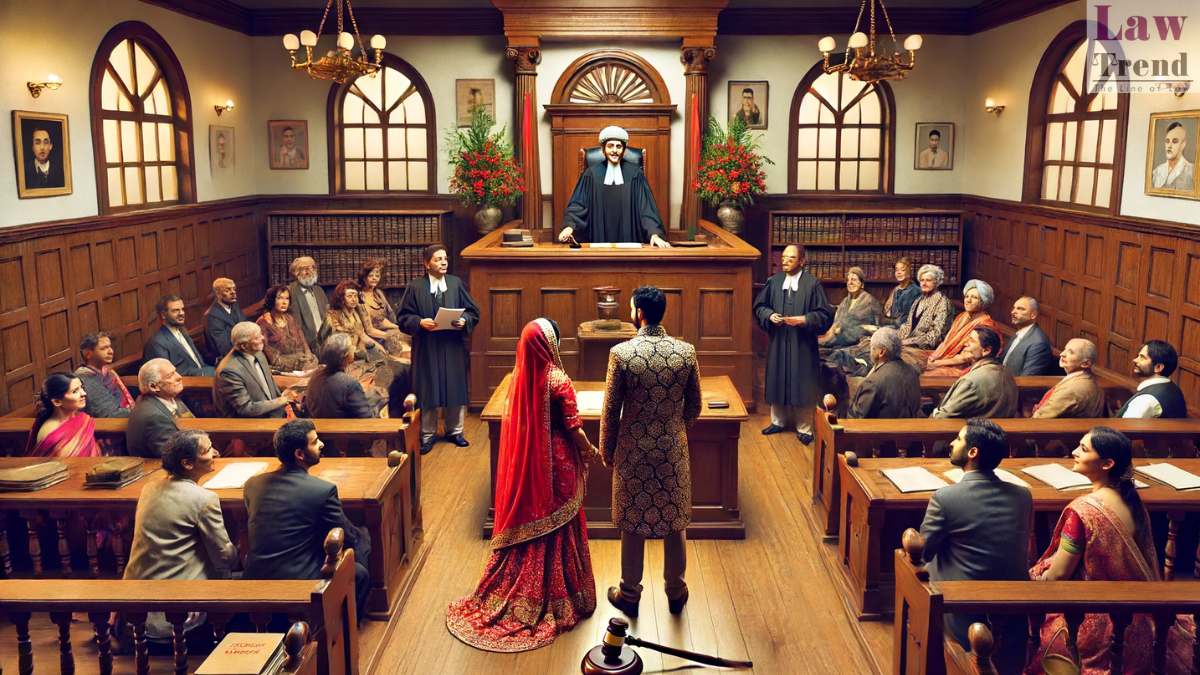
The High Court of Orissa has dismissed an appeal filed by a second wife seeking a family pension, ruling that a second marriage contracted during the lifetime of the first wife is void ab initio under the Hindu Marriage Act, 1955. The Court held that such a void marriage does not automatically become valid upon the death of the first wife, and consequently, the second wife is not entitled to pensionary benefits under the Odisha Civil Services (Pension) Rules, 1992.
The Division Bench, comprising Justice Dixit Krishna Shripad and Justice Chittaranjan Dash, delivered the judgment on January 13, 2026, rejecting the Writ Appeal filed by Kankalata Dwibedi against the State of Odisha and others.
Background of the Case
The appellant, Kankalata Dwibedi, had challenged an order dated November 12, 2021, passed by the Controller of Accounts, Odisha (Opposite Party No. 4). The authorities had rejected her claim for a family pension on the grounds that the deceased employee, Late Niranjan Dwibedy, had married her as his second wife during the lifetime of his first wife, Late Indumati Dwibedy.
The rejection order relied on the Note below Clause-(d) of Sub-Rule (6) of Rule 56 of the OCS (Pension) Rules, 1992, stating that “Smt. Kanaklata Dwibedy being the 2nd wife of Late Niranjan Dwibedy is not entitled to family pension, not being legally married wife of Late Dwibedy.”
The appellant initially filed a writ petition (W.P.(C) No. 3822 of 2022) challenging this rejection, which was dismissed by a learned Single Judge on July 16, 2025. Aggrieved by this decision, she preferred the present intra-court appeal.
Arguments of the Parties
Learned counsel for the appellant, M/s. Madhumita Panda, argued that the Odisha Civil Services (Pension) Rules, 1992 specifically employ the expression “wife/wives,” suggesting that a second wife could be entitled to a family pension, particularly since the first wife had also passed away.
It was further submitted that the deceased employee entered into the second wedlock because his first wife did not beget any children. The counsel relied on the judgment of the Apex Court in Smt. Sriramabai w/o. Pundalik Bhave v. The Captain, Record Officer for O.I.C. Records, Sena Corps Abhilekh (2023 INSC 744) to support the claim.
Learned Additional Standing Counsel (ASC) Mr. J.K. Khandayatray, appearing for the respondents, opposed the appeal, justifying the reasoning of the impugned order and the rejection of the pension claim.
Court’s Observations and Analysis
The Court declined to interfere with the Single Judge’s order, agreeing with the reasoning that a second marriage during the subsistence of the first is impermissible under Hindu Law.
On Monogamy and the Hindu Marriage Act: Justice Krishna S. Dixit, writing for the Bench, observed that following the enactment of the Hindu Marriage Act, 1955, “monogamy is the thumb rule with no exception whatsoever.” The Court stated that the idea of a second marriage during the subsistence of the first “abhors the pith & substance of this Act.”
Addressing the appellant’s argument regarding childlessness, the Court remarked:
“The Act does not recognize childlessness as a justifiable circumstance for entering into wedlock with a person who is already in the subsisting wedlock with another. To put it in other words, after the Act came into force, monogamy is the grand norm with no exception whatsoever.”
On Interpretation of Pension Rules: The Court rejected the contention that the use of the word “wives” in the Pension Rules authorized polygamy. The Bench held:
“The word ‘wives’ appearing in the Rules does not authorize an employee to contract marriage with multiple persons by way of polygamy or polyandry… The interpretation sought to be placed by the Appellant’s counsel on the subject Rule by stressing on the rules of dictionary & grammar, spurns at the root of such a policy and therefore, does not merit acceptance. After all, the sages of law say that law is neither a slave of dictionary nor a servant of grammar book.”
On the Validity of Void Marriage Post-Death of First Wife: The Court invoked the legal maxim ex nihilo nihil fit (out of nothing, nothing comes out) to reject the argument that the second marriage became valid after the death of the first wife. The judgment stated:
“What is void ab initio, does not become valid by the happening of subsequent event… Granting family pension to the so called ‘second wife’, amounts to placing premium on illegality.”
Distinguishing Precedents: The Bench distinguished the case of Smt. Sriramabai cited by the appellant, noting that it involved a presumption of valid marriage due to prolonged cohabitation where the facts regarding the first marriage were different. In the present case, the second marriage was admittedly contracted during the subsistence of the first, constituting an offence of bigamy under Section 17 of the Hindu Marriage Act and Section 495 of the IPC.
The Court relied on the Supreme Court’s decision in Raj Kumari v. Krishna (2015 (14) SCC 511), which denied family pension to a second wife, and the Karnataka High Court judgment in Mahalakshmamma v. The Secretary (2023:KHC:41044-DB), which observed that recognizing such relations is “detrimental to public interest.”
Decision
The Division Bench concluded that the Writ Appeal was “devoid of merits” and accordingly rejected it, upholding the decision to deny the family pension.
Case Details:
Case Title: Kankalata Dwibedi vs State of Odisha and others
Case Number: W.A. NO.1460 OF 2025
Coram: Justice Dixit Krishna Shripad and Justice Chittaranjan Dash