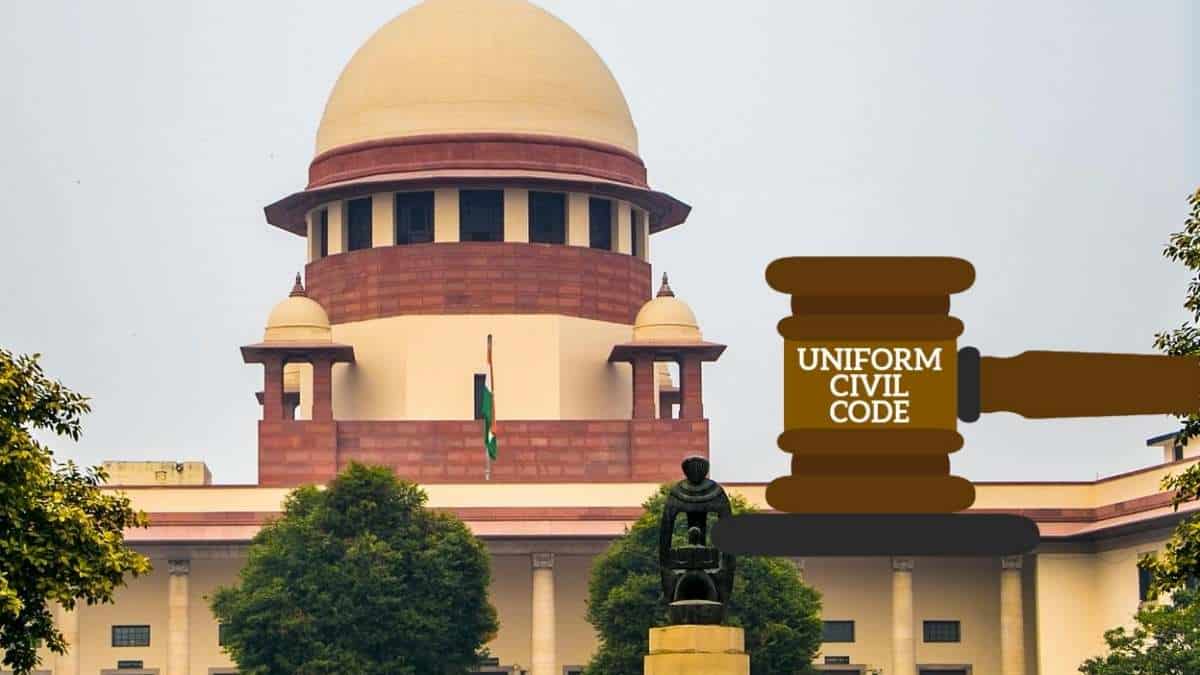
The Supreme Court of India on Tuesday strongly advocated for the enactment of a Uniform Civil Code (UCC), emphasizing that legislative intervention, rather than the judicial voiding of personal laws, is the appropriate path to resolve complexities surrounding women’s inheritance rights.
A three-judge bench led by Chief Justice of India (CJI) Surya Kant cautioned that hastily striking down the Muslim Personal Law (Shariat) Application Act, 1937, could create a legal vacuum that might inadvertently prove detrimental to Muslim women.
The Court’s observations came during the hearing of a petition challenging the constitutional validity of the Muslim Personal Law (Shariat) Application Act, 1937. The petitioners alleged that the provisions of this law discriminate against Muslim women, particularly concerning matters of succession, where they traditionally receive half the share of what men are entitled to. The petitioners sought judicial intervention to declare these discriminatory practices unconstitutional.
Appearing for the petitioners, Advocate Prashant Bhushan argued that the disparity in succession shares between Muslim men and women is a violation of fundamental rights. He asserted that inheritance is a civil right and not an essential religious practice, meaning it does not enjoy protection under Article 25 of the Constitution. Bhushan emphasized that a situation where a Muslim woman does not possess the same equal rights as a Muslim man cannot be permitted to continue in the country.
Anticipating the Court’s concern about a potential legal gap if the 1937 Act were struck down, Bhushan suggested that the Indian Succession Act—which grants equal succession rights to men and women—could automatically govern the field instead.
The Bench, which also comprised Justice Joymalya Bagchi and Justice R Mahadevan, expressed distinct reservations about utilizing judicial powers to strike down personal laws without a comprehensive legislative framework ready to replace them.
Justice Bagchi remarked that creating a legal vacuum by nullifying personal laws should be avoided, suggesting instead that the matter be left to the legislature to enact a uniform civil code, a measure the Court has previously endorsed. He further questioned the feasibility of invalidating all bigamous marriages rooted in personal law through judicial decree, emphasizing that effecting such fundamental duties falls squarely within the legislative domain.
CJI Kant agreed with this assessment, affirming that a uniform civil code is the correct legal solution to the issue at hand.
The Court repeatedly pressed the petitioners on the consequences of repealing the existing law. The Chief Justice asked the petitioners what legal framework would replace the 1937 Act if it were struck down, expressing deep concern over the resulting legal void. Justice Bagchi similarly questioned whether, in the absence of the 1937 Act, Muslim succession would merely revert to being governed by uncodified personal customs under Article 372 of the Constitution.
Furthermore, CJI Kant cautioned that an overzealous push for reform might inadvertently strip Muslim women of their existing rights or leave them worse off, reiterating the core issue of what sustainable framework would replace the current statute if it were abolished.
Ultimately, the Supreme Court concluded that the complex socio-legal situation warrants formal legislative intervention rather than piecemeal judicial orders. The Court refrained from passing an immediate order on the constitutional validity of the 1937 Act. Instead, the bench advised the petitioners to amend their plea to propose legally sound, alternative frameworks.
Concluding the proceedings, CJI Kant advised the petitioners’ counsel to revise their petition to present viable alternatives. He stressed that the ultimate goal is to restore the rights of Indian women who are facing deprivation, which requires a well-considered and structurally sound approach rather than simply striking down existing laws without a backup plan.