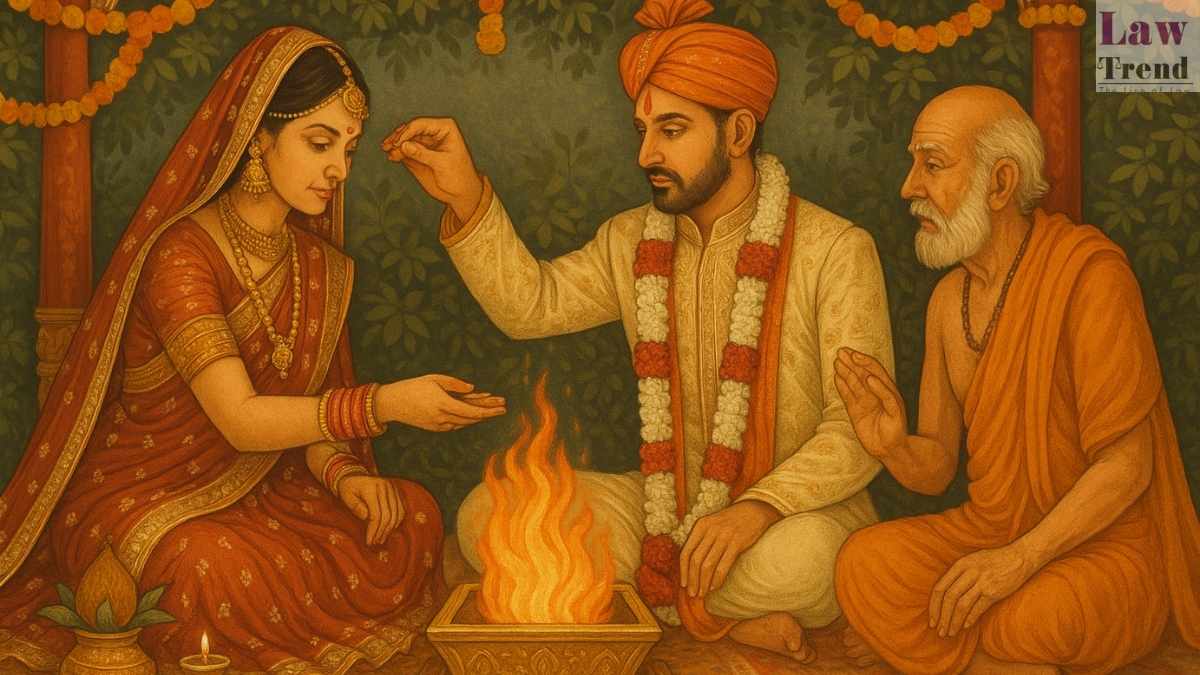
The Gwalior Bench of the Madhya Pradesh High Court has held that a marriage certificate issued by an Arya Samaj Mandir is not conclusive proof of a valid Hindu marriage if the essential ceremony of ‘Saptapadi’ (seven steps) is not established.
The Division Bench, comprising Justice Anand Pathak and Justice Hirdesh, set aside a Family Court judgment that had dismissed a suit seeking a declaration that the respondent was not the legally wedded wife of the plaintiff. The Court underscored that under the Hindu Marriage Act, 1955, the performance of customary rites and ceremonies is mandatory for a marriage to be valid.
Case Background
The appeal was filed by the legal representative (son) of the original plaintiff. The original plaintiff, a 75-year-old retired Company Commander, had filed a suit in the Family Court, Gwalior, seeking a declaration that the respondent was not his legally wedded wife and prayed for a permanent injunction.
The plaintiff alleged that after the death of his wife, he published an advertisement seeking a bride for his son. He claimed the respondent contacted him and, taking advantage of his loneliness, blackmailed him into a fabricated marriage. The plaintiff contended that the respondent had obtained a “fake and forged” marriage certificate dated March 26, 2012, from the Arya Samaj Mandir, Loha Mandi, Gwalior. He further alleged that the respondent had a subsisting marriage with another individual and had previously been married to a former spouse.
The respondent, conversely, argued that she legally married the plaintiff according to Arya Samaj rituals after her marriage to her former spouse was dissolved by a divorce decree in 2008. She denied ever being married to the other alleged individual and relied on the marriage certificate and a municipal registration to prove her status as the plaintiff’s wife.
The Principal Judge, Family Court, Gwalior, dismissed the plaintiff’s suit on September 2, 2024, holding that the marriage stood proved based on the Arya Samaj certificate, photographs, and witness testimony. The plaintiff’s legal heir challenged this dismissal in the High Court.
Arguments
Senior Advocate Harish Dixit, appearing for the appellant, argued that the Trial Court failed to determine whether the marriage was solemnized in accordance with the law. He submitted that there was “not even a whisper” in the statements of the respondent or her witnesses regarding the performance of ‘Saptapadi’, a mandatory ceremony under Section 7 of the Hindu Marriage Act.
The appellant relied heavily on the Supreme Court’s recent decision in Dolly Rani v. Manish Kumar Chanchal (2025), arguing that a marriage certificate alone does not prove a valid marriage; the factum of marriage rituals must be independently proved.
Advocate Madan Mohan Shrivastava, appearing for the respondent, contended that the marriage was solemnized on March 26, 2012, strictly in accordance with Vedic rituals, including Saptapadi. He argued that the Arya Samaj institution was duly recognized and that the documents produced, including the marriage certificate and municipal registration, clearly established the marriage. He distinguished the facts from the Dolly Rani case, asserting that in the present matter, valid Vedic rites were performed.
Court’s Analysis
The High Court focused on the pivotal issue of whether the marriage was validly solemnized under Section 7 of the Hindu Marriage Act.
The Bench extensively cited the Supreme Court judgment in Dolly Rani v. Manish Kumar Chanchal, reiterating that “solemnised” means performing the marriage with ceremonies in proper form. The Court observed:
“Unless and until the marriage is performed with appropriate ceremonies and in due form, it cannot be said to be ‘solemnised’… Where a Hindu marriage is not performed in accordance with the applicable rites or ceremonies, such as Saptapadi when included, the marriage will not be construed as a Hindu marriage.”
The Court examined the evidence on record, noting that the witnesses produced by the respondent—including the priest and the Pradhan of the Arya Samaj—never stated in their testimony that ‘Saptapadi’ was performed. Furthermore, the Court observed:
“The photographs produced on behalf of respondent before the Trial Court do not depict any sacred fire, pheras, or Saptpadi. There is no evidence that both parties were followers of the Arya Samaj or that rituals prescribed under the Arya Marriage Validation Act were followed.”
Making a strong observation on the sanctity of marriage, the Bench stated:
“In Hindu religion, marriage is a sacrament and has a sacred character. Marriage is not an event for mere ‘song and dance’ or ‘wining and dining.’ Hindu marriage is conducted as per Vedic procedure… Any Hindu marriage solemnized in accordance with Vedic procedure constitutes a valid marriage if it fulfills requirements of Section 7 of Hindu Marriage Act.”
The Court held that the mere issuance of a certificate by the Arya Samaj or the Municipal Corporation could not confer the status of husband and wife in the absence of proof of essential ceremonies.
Decision
The High Court allowed the First Appeal, setting aside the judgment and decree dated September 2, 2024, passed by the Family Court, Gwalior.
The Court decreed the suit in favor of the appellant, declaring that the respondent is not the legally wedded wife of the original plaintiff. It held that the Arya Samaj certificate and the corresponding registration entry did not establish a valid marriage.
Additionally, the Court granted a decree of permanent injunction restraining the respondent from interfering in the personal life of the plaintiff (represented by his legal heir) or claiming any marital rights against him.