

Arbitrator Can Award ‘Quantum Meruit’ Compensation for Extra Work if Contract is Silent on Rate: Supreme Court
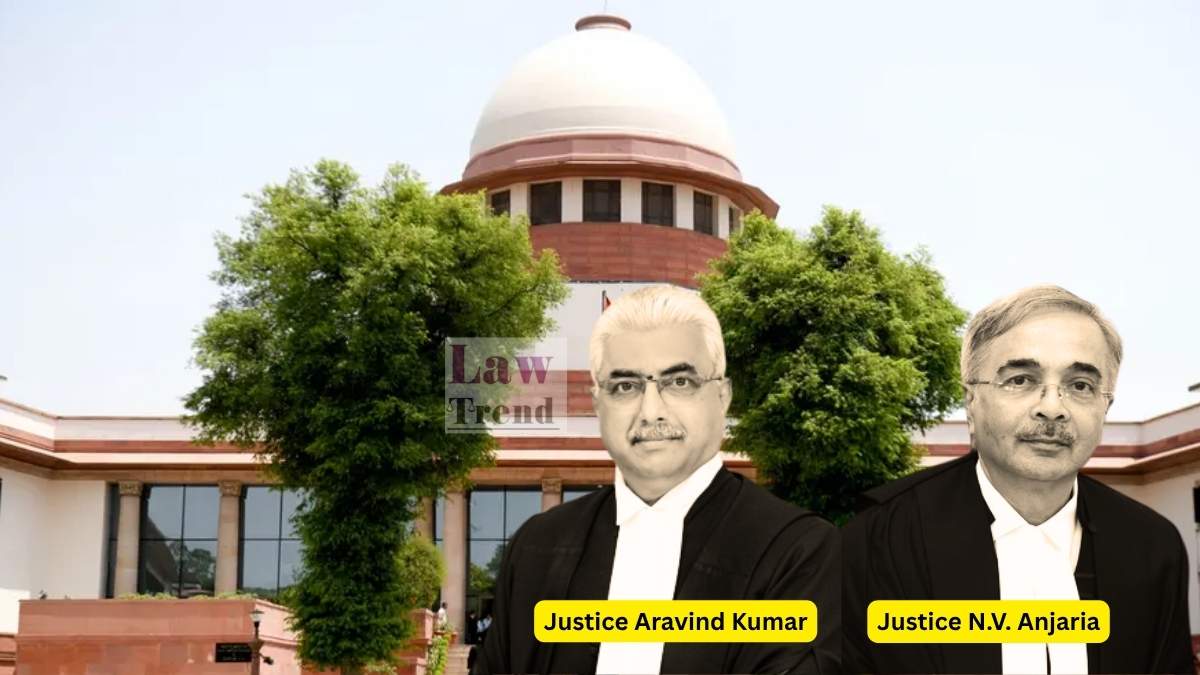

The Supreme Court of India has set aside a judgment of the Chhattisgarh High Court that had annulled an arbitral award on the grounds of “patent illegality.” The Bench, comprising Justice Aravind Kumar and Justice N.V. Anjaria, restored the award in favor of the appellant, Ramesh Kumar Jain, holding that an Arbitral Tribunal does not rewrite a contract by awarding reasonable compensation under the principle of quantum meruit when the contract is silent on the rate for extra work performed. The Court reiterated that the scope of interference under Section 37 of the Arbitration and Conciliation Act, 1996 (A&C Act) is extremely narrow and co-extensive with the limited parameters of Section 34.

The appeal arose from a decision of the High Court of Chhattisgarh, which had exercised jurisdiction under Section 37 of the A&C Act to set aside an arbitral award dated July 15, 2012. The sole arbitrator had awarded a sum of Rs. 3,71,80,584 along with statutory interest to the appellant, Ramesh Kumar Jain, for extra work performed for the respondent, Bharat Aluminium Company Limited (BALCO).

The Commercial Court had previously upheld the award under Section 34, finding it well-reasoned. However, the High Court reversed this, ruling that the arbitrator had “rewritten the contract” and acted without evidence, thereby committing patent illegality. The Supreme Court, in its judgment delivered on December 18, 2025, reversed the High Court’s decision, emphasizing that “re-assessment or re-appreciation of evidence lies outside the contours of judicial review under section(s) 34 and 37.”

Background

The dispute originated from a contract for mining and transporting Bauxite. BALCO invited a tender for mining and transporting 3,70,000 Metric Tons (MTs) of Bauxite from Mainpat mines to its Korba Alumina plant. Ramesh Kumar Jain, the lowest bidder, entered into an agreement on December 11, 1999, to supply 2,22,000 MTs at the rate of Rs. 634.20 per MT.

After the completion of the agreed quantity, BALCO, by a letter dated January 5, 2002, requested the appellant to continue mining and transporting. The letter stated that the rate for this extra work would be “decided in due course of time after consulting with the appellant.” The appellant supplied an additional 1,95,000 MT of Bauxite between June 2001 and March 2002.

READ ALSO  Investigating Officers Cannot Shrug Off Their Responsibilities: Allahabad High Court Criticizes Lack of Vigilance in Evidence Handling

A dispute subsequently arose regarding payment for this extra work and other claims, leading to arbitration. The sole arbitrator awarded the appellant various sums, including:

  • Rs. 31,85,000 for extra work on 1,95,000 MT (allowing an increase of Rs. 10 per MT).
  • Rs. 1,23,06,058 for extra transportation costs due to restrictions on truck capacity.
  • Rs. 71,36,568 for idle manpower and machinery during a strike period.
  • Interest on delayed bills.

BALCO challenged the award under Section 34 of the A&C Act. The Commercial Court dismissed the challenge, affirming the award. On appeal under Section 37, the High Court set aside the award, holding that fixing an additional rate of Rs. 10 per MT in the absence of a contractual agreement amounted to rewriting the contract. The High Court also termed the arbitrator’s assessment of damages as “guesswork” and devoid of evidence.

Arguments of the Parties

Appellant’s Submissions Senior Advocate Mukul Rohatgi, appearing for the appellant, argued that the High Court exceeded its jurisdiction by reappraising the factual matrix. He contended that under Section 37, the court cannot sit in appeal over the merits. Citing Delhi Airport Metro Express Pvt. Ltd. v. Delhi Metro Rail Corporation (2022) and Parsa Kente Collieries Ltd. v. RRVUN Ltd. (2019), he submitted that the “arbitral tribunal is the master of evidence” and findings of fact should not be scrutinized as if in an appeal.

Regarding the extra work, Rohatgi argued that while the respondent requested the work, the rates were never agreed upon, as evidenced by correspondence. He asserted that the arbitrator was permitted to employ “honest guesswork” to quantify damages where material existed to show loss, even if granular details were missing.

Respondent’s Submissions Senior Advocate Ranjith Kumar, representing BALCO, argued that the contract did not contain a clause for price increase other than a diesel variation clause. He submitted that the arbitrator “rewrote the contract” by increasing the rate by Rs. 10 per MT without evidence, which was contrary to the terms fixed at Rs. 634.20 per MT.

READ ALSO  Unexplained Investments Can Be Treated as Assessee’s Income; No Need for Revenue to Prove Specific Source: Chhattisgarh High Court

The respondent relied on SsangYong Engineering v. NHAI (2019) and PSA SICAL Terminals Pvt. Ltd. v. Board of Trustees of V.O. Chidambaranar Port Trust (2021) to argue that the award suffered from patent illegality. It was contended that the arbitrator granted claims for idle machinery and transportation losses based solely on unsubstantiated tabular statements, amounting to a decision based on “no evidence.”

Court’s Analysis

The Supreme Court examined the scope of judicial interference under Sections 34 and 37 of the A&C Act. The Bench observed that the High Court had “impermissibly re-appreciated facts and substituted its own interpretation.”

On Patent Illegality The Court clarified the concept of “patent illegality,” noting that it refers to an illegality that strikes at the root of the award. While a finding based on “no evidence” can be termed patently illegal, the Court distinguished this from “scant or weak evidence.”

“If there is some evidence, even a single witness’s testimony or a set of documents, on which the arbitrator could rely upon… the court cannot regard the conclusion drawn by the arbitrator as patently illegal merely because that evidence has less probative value.”

On Quantum Meruit and Contractual Silence The Court rejected the High Court’s view that the arbitrator had rewritten the contract by awarding an additional Rs. 10 per MT. The Bench noted that the consideration for the extra work was explicitly left open in the letter dated January 5, 2002.

“In such a factual matrix, the arbitral tribunal cannot be said to have rewritten or varied the contract rather the arbitrator addressed a vacuum in the contractual arrangement by determining reasonable compensation in terms of Section 70 of the Contract Act, 1872, to obviate the possibility of unjust enrichment.”

READ ALSO  Beneficiary of Acquired Land Is Not Entitled to File a Reference Under Sec 28A(3) of the Land Acquisition Act: Allahabad HC

The Court held that where a contract is silent on a legitimate claim arising from natural contractual obligations, the arbitrator is within their powers to apply principles of restitution.

“The quantification of additional compensation at Rs. 10/- PMT… represents an assessment of reasonable value for the extra work performed and does not amount to substitution of any agreed contractual rate as no such sum was mutually inked down by both the parties.”

On Evidence and “Guesswork” Addressing the High Court’s finding that the award was based on guesswork, the Supreme Court found that the arbitrator had, in fact, scrutinized oral and documentary evidence, including the testimony of the claimant and the respondent’s Engineer-in-charge. The Court noted that the arbitrator had even rejected or reduced certain claims where evidence was insufficient, demonstrating application of mind.

“The errors pointed out in the impugned judgement… do not, singly or cumulatively, amount to patent illegality warranting annulment. There were at least some evidence and logical rationale for each award element.”

Decision

The Supreme Court allowed the appeal and set aside the judgment of the High Court dated May 3, 2023. The Court restored the judgment of the Commercial Court, Raipur, dated January 1, 2017, which had upheld the arbitral award dated July 15, 2012.

The Bench concluded:

“In our assessment, the High Court allowed itself to be deviated by things that are in truth within a range of normalcy in arbitral adjudication… The High Court’s scrutinized the award from a stricter standard of proof than arbitration law demands.”

Case Details:

  • Case Title: Ramesh Kumar Jain v. Bharat Aluminium Company Limited (BALCO)
  • Case No: Civil Appeal No. of 2025 (Arising out of SLP (C) No. 14529 of 2023)
  • Citation: 2025 INSC 1457
  • Coram: Justice Aravind Kumar and Justice N.V. Anjaria

Law Trend
Law Trendhttps://lawtrend.in/
Legal News Website Providing Latest Judgments of Supreme Court and High Court

Related Articles

Latest Articles

