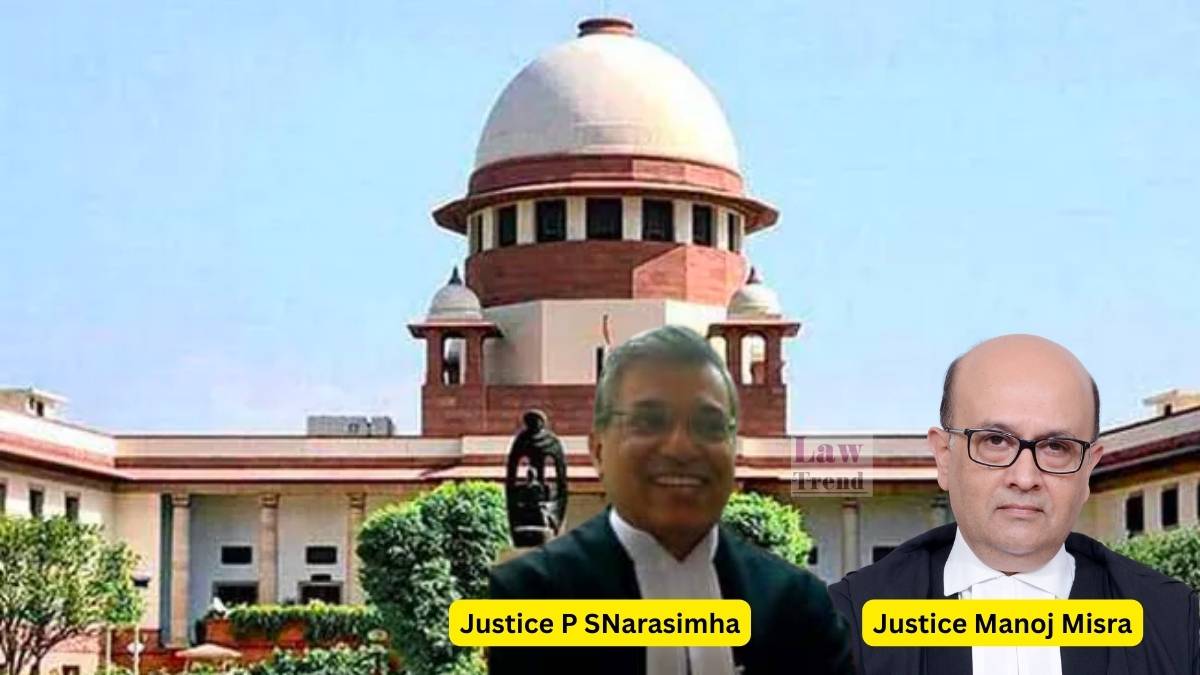
Reaffirming an essential rule of criminal jurisprudence, a division bench of the Supreme Court of India, comprising Justice Pamidighantam Sri Narasimha and Justice Manoj Misra, has held that it is not an inflexible rule of law that an approver’s testimony must be independently corroborated to form the basis of a conviction. The Court ruled that while prudence dictates seeking corroboration in material particulars, a court can convict an accused solely on an uncorroborated accomplice’s account if it is satisfied with its reliability. This landmark principle was highlighted as the Bench upheld the conspiracy conviction of Gopi Chand @ Pappu in a 1984 dacoity-murder case, while subsequently ordering his immediate release because he has already served over 18 years in prison.
Background of the Case
The appeals arose from a grim double murder and dacoity occurring in July 1984. Two bodies were discovered under different police jurisdictions in Delhi: the body of driver Arun Kumar was found on July 13 near Rajiv Farm, Burari, and the body of cleaner Jasbir was found on July 16 near village Hiranki. The victims operated Truck No. URM 660, owned by Dayal Chand (PW-23).
Investigations revealed a plot by five individuals—including the appellant Gopi Chand and co-accused Ashok Kumar, who later turned approver—to hire the truck under the guise of carrying pumpkins, murder the crew, and steal the vehicle. Gopi Chand was arrested on July 29, 1984. Ashok Kumar sought a pardon, became an approver, and testified as PW-1.
Following consolidated trials, the trial court convicted Gopi Chand, Tejpal, and Kishan Lal for offences under Sections 302, 396, 201, and 120-B of the Indian Penal Code (IPC), sentencing them to life imprisonment. The Delhi High Court dismissed their appeals in August 2013. Gopi Chand approached the Supreme Court as the sole appellant after the sentences of his co-convicts were remitted under State policy.
Arguments of the Parties
The learned senior counsel for the appellant, Mr. A Sirajudeen, argued that the entire prosecution case was built on the flawed testimony of the approver (PW-1). He asserted that:
- It is unsafe to rely on an approver’s testimony without independent material corroboration, which was lacking here.
- The statement of PW-1 was exculpatory and hence unreliable.
- No specific charge of criminal conspiracy to commit murder was framed against the appellant.
Conversely, Additional Solicitor General Mr. Vikramjeet Banerjee, representing the State (NCT of Delhi), argued that the approver’s statement was deeply inculpatory and corroborated by physical and circumstantial evidence. He contended that the lack of a specific charge did not cause prejudice, as Gopi Chand’s counsel cross-examined the witnesses fully aware of the murder charges.
The Court’s Analysis
1. Credibility and Corroboration of Approver’s Evidence
The Supreme Court detailed the interplay between Section 133 of the Evidence Act, 1872 (which designates an accomplice as a competent witness) and Illustration (b) to Section 114 (which cautions that an accomplice is unworthy of credit without corroboration).
Reviewing past authorities like Somasundaram @ Somu v. State (2020), the Court noted that the requirement of corroboration is a rule of prudence and caution, not an absolute rule of law. It observed:
“the combined result of Section 133 read with illustration (b) to Section 114 of the Evidence Act is that the courts have evolved, as a rule of prudence, the requirement that it would be unsafe to convict an accuse solely based on uncorroborated testimony of an accomplice. The corroboration must be in relation to the material particulars of the testimony of an accomplice.”
Analyzing the evidence, the Bench rejected the plea that PW-1’s statement was exculpatory. PW-1 admitted to holding the legs of the cleaner, Jasbir, to render him unconscious while others pressed his neck. The Court held that even though PW-1 did not strike the fatal blow, his active participation made his evidence highly inculpatory. Furthermore, the Bench found substantial independent corroboration, such as the recovery of the stolen truck, the location of Jasbir’s body matching the approver’s directions, and the tattoo identifying the victim.
2. Joint Liability in Conspiracy and Foreseeable Offences
The appellant contended he could not be convicted of conspiracy to murder since he only guarded the truck and was not present at the direct execution site. Repelling this argument, the Supreme Court evaluated Section 120-A and 120-B of the IPC alongside Section 10 of the Evidence Act.
Referring to Firozuddin Basheeruddin v. State of Kerala (2001) and State through SP, CBI/SIT v. Nalini (1999), the Bench held:
“one who enters into a conspiratorial relationship is liable for every reasonable foreseeable crime committed by every other member of the conspiracy in furtherance of its objectives, whether or not he knew of the crimes or aided in their commission.”
The Court explained that the conspirators brought a sharp weapon (Gandasa) to commit dacoity, making violence and murder a highly foreseeable risk of their common intention:
“…when you separate a person from the possession of his property or goods, use of force is a foregone conclusion unless it is done clandestinely, as in the case of theft. Here, the possession was taken not clandestinely but by force. In such a situation, causing injury to the victim including his murder is a foreseeable event to further the cause for which partners in crime had joined hands.”
The conviction under Section 302 read with Section 120-B IPC was therefore upheld.
3. Modification of Sentence
While upholding the conviction, the Bench considered Gopi Chand’s clean custody record and the fact that the incident happened in 1984. He had served over 18 years in actual prison. Following Munna Moyuddin Shaikh v. State of Gujarat (2026), Union of India v. V. Sriharan (2016), and Shiva Kumar v. State of Karnataka (2023), the Court noted that life imprisonment can be modified to a fixed-term sentence of the period already undergone, provided it exceeds 14 years.
The Decision
The Supreme Court partly allowed Gopi Chand’s appeals. While maintaining his convictions, the Court modified his sentence of life imprisonment to the period of sentence already undergone. The Bench directed his immediate release from custody, if not required in any other case.
Case Details
Case Title: Gopi Chand @ Pappu v. State (NCT of Delhi)
Case No.: Criminal Appeal No(s). 847 & 848 of 2014
Bench: Justice Pamidighantam Sri Narasimha, Justice Manoj Misra
Date: May 29, 2026