

Appellate Court Can Reverse Acquittal Only for “Substantial and Compelling Reasons”; Presumption of Innocence Stands Reinforced After Acquittal: SC

The Supreme Court has dismissed an appeal challenging the acquittal of three accused in the 1996 murder case of an Indian Army Captain, holding that the prosecution’s narrative was “highly improbable” and suffered from “material discrepancies.”

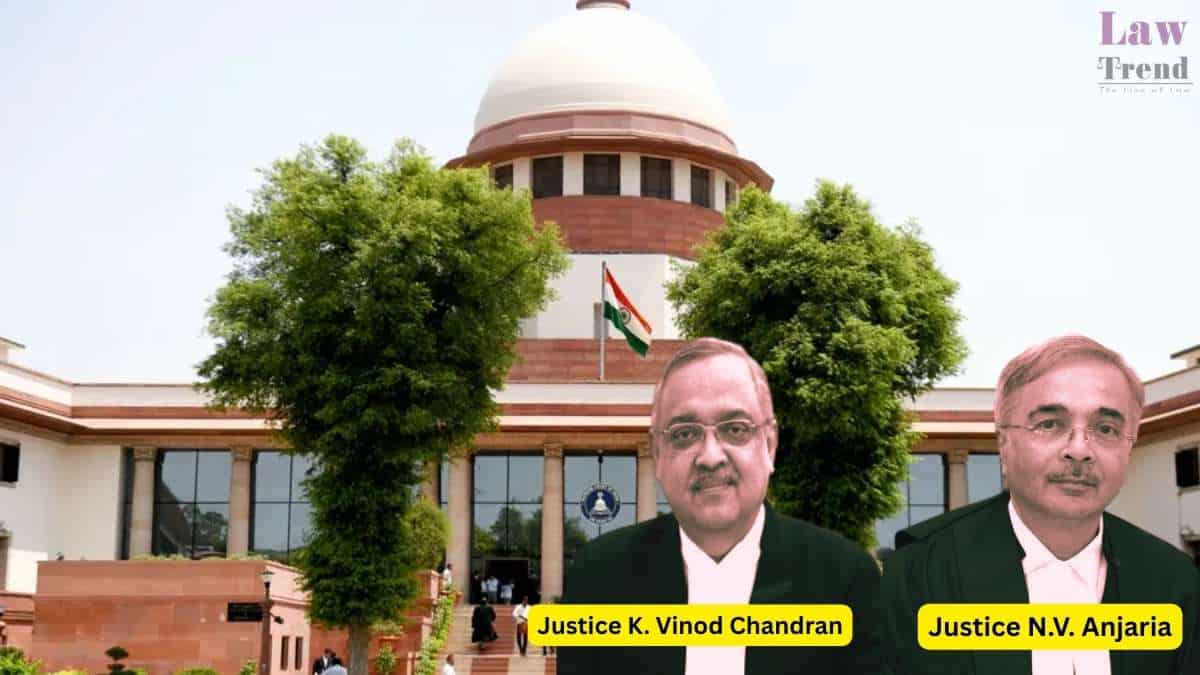
A Bench comprising Justice K. Vinod Chandran and Justice N.V. Anjaria affirmed the Allahabad High Court’s 2012 decision to set aside the conviction of the respondents, emphasizing that the appellate court should not disturb an acquittal if the view taken by the lower court is “possible and plausible.”

Background of the Case

The case stems from a family property dispute between the complainant, Raj Pal Singh (the appellant), and his brother, Dharam Pal (Respondent No. 2). The deceased, Praveen Kumar, was the complainant’s son and a serving Captain in the Indian Army.

According to the prosecution, on June 8, 1996, at around 8 a.m., when Praveen Kumar returned home to his village in Ghaziabad after attending a marriage, the accused—Dharam Pal, his son Rajveer, and one Sudhir—allegedly dragged him towards the first floor of the house. The prosecution claimed that Sudhir was armed with a country-made pistol. It was alleged that upon Dharam Pal’s instigation, Rajveer shot Praveen using Dharam Pal’s licensed gun, resulting in his death.

The Trial Court, by an order dated November 23, 2007, convicted the three respondents under Section 302 read with Section 34 of the Indian Penal Code (IPC) and sentenced them to life imprisonment. However, the Allahabad High Court overturned this verdict on October 10, 2012, acquitting all accused. Aggrieved by this acquittal, the complainant approached the Supreme Court.

READ ALSO  Calling Someone 'Miyan-Tiyan' and 'Pakistani' in Poor Taste, But Not a Crime: Supreme Court

Arguments and Evidence

The prosecution relied heavily on the testimony of eyewitnesses, including the complainant (PW-1) and Jal Singh (PW-2). They deposed that the accused dragged the deceased and pulled him up a staircase. They claimed Dharam Pal hit the deceased with a hockey stick and that Rajveer fired the fatal shot.

However, the accused pleaded false implication due to enmity. In their statements under Section 313 of the Code of Criminal Procedure (CrPC), they denied presence at the spot. Dharam Pal stated he was in his room when he heard a gunshot, while Rajveer claimed to be at his workplace.

Court’s Observations and Analysis

The Supreme Court meticulously reviewed the High Court’s reasoning, finding that the prosecution’s story lacked credibility on several grounds.

1. Improbability of the Incident

The Court noted the physical impossibility of the prosecution’s version of events. It observed that it was “highly improbable” that three persons could drag a young serving Army Captain for 14 steps and pull him up a narrow staircase. The Bench highlighted that one of the accused, Dharam Pal, “was a 65-year-old person and was a cancer patient, for whom it was not possible to pull and drag Praveen an armyman.”

2. Unexplained Possession of Weapons

The Court found that the possession of weapons was not convincingly established. Regarding the allegation that Sudhir held a pistol and Dharam Pal used a hockey stick, the Court observed:

READ ALSO  सुप्रीम कोर्ट ने कुछ राज्यों में हिंदुओ को अल्पसंख्यक का दर्जा देने वाली याचिका पर सुनवाई टाली

“It did not come out from the evidence, even inferentially, that any of the accused had any weapon, much less the pistol or gun in their hand when they were dragging Praveen towards the stairs.”

The judgment further noted that the First Information Report (FIR) did not mention Dharam Pal having a hockey stick, and there was no suggestion in the evidence as to “how and from where” the weapons were fetched.

3. Contradictory Reports

The Court pointed out significant discrepancies between the initial report filed by the village Chowkidar and the complaint filed by the appellant. The Chowkidar’s report suggested a confrontation on June 7, 1996, where Dharam Pal allegedly fired in self-defence. In contrast, the appellant’s complaint, submitted days later on June 12, 1996, described a different incident on June 8, 1996, attributing the firing to Rajveer.

4. Lack of Ballistic Evidence

The Bench observed a critical lapse in the investigation. Although Dharam Pal’s licensed firearm was recovered, the Court noted:

“No endeavour appears to have been made to subject the same to expert ballistic examination in order to establish whether the bullets or pellets which caused the fatal injuries had been fired therefrom.”

Legal Principles on Acquittal

In its legal analysis, the Supreme Court reiterated the principles regarding the presumption of innocence. Citing the precedent in Shivaji Sahabrao Bobade vs. State of Maharashtra (1973), the Court remarked that the distinction between “may be proved” and “must be proved” is legal, not merely grammatical.

READ ALSO  Will Mere Brandishing of Weapon Openly Attract Section 397 of IPC? Answers Supreme Court

The Bench also referred to Chandrappa and Others vs. State of Karnataka (2007), stating that an appellate court must not interfere with an order of acquittal if the trial court’s view is “possible and plausible.” The Court held:

“Once the court acquits the accused, the presumption of innocence is reinforced… Reversal of acquittal should not be a matter of course just because the other view is considered to be possible by the appellate court.”

The Court emphasized that “substantial and compelling reasons” must exist to upset an acquittal, and even if the appellate court believes another view is possible, it should not disturb the acquittal if the trial court’s view favors the accused.

Decision

The Supreme Court concluded that the High Court had rightly appreciated the evidence and arrived at a plausible conclusion in acquitting the respondents. The Bench held that the High Court’s view did not appear to be “in any way unreasonable.”

Consequently, the Court dismissed the appeal and upheld the acquittal of Rajveer, Dharam Pal, and Sudhir.

Case Details:

  • Case Title: Raj Pal Singh v. Rajveer & Ors.
  • Case No: Criminal Appeal No(s). 809 of 2014
  • Citation: 2025 INSC 1442
  • Coram: Justice K. Vinod Chandran and Justice N.V. Anjaria

Law Trend
Law Trendhttps://lawtrend.in/
Legal News Website Providing Latest Judgments of Supreme Court and High Court

Related Articles

Latest Articles

