

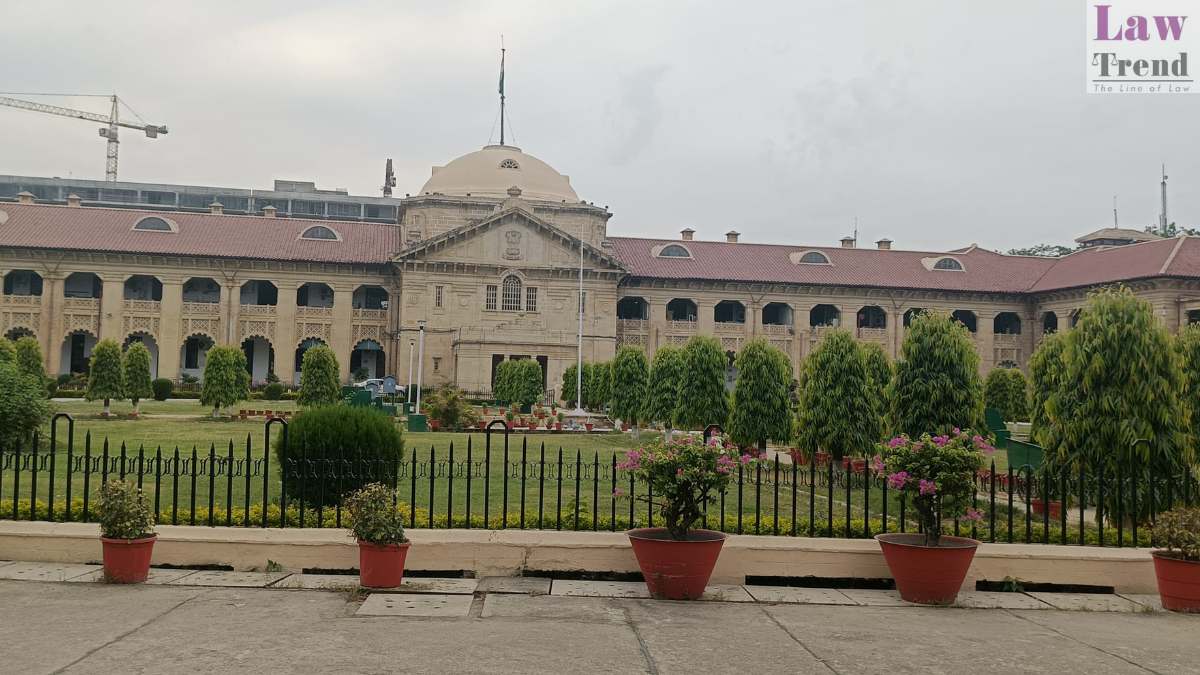
The High Court of Judicature at Allahabad has dismissed an application seeking the quashing of a discharge rejection order and a subsequent charge-framing order, ruling that an accused cannot be discharged or acquitted solely due to lapses or defects in the police investigation. Justice Vivek Kumar Singh held that the court must evaluate the prosecution’s evidence independently of such lapses to determine if a prima facie case exists.
Background
The case, Amir @ Jamir Ahmad v. State of U.P. and Another (Application U/S 528 BNSS No. 44853 of 2024), originated from an incident on December 12, 2019. According to the First Information Report (FIR) lodged at Police Station Shankargarh, District Prayagraj, a police patrolling party received information regarding a truck illegally transporting bulls from Chitrakoot to Bihar.
The police alleged that the truck driver attempted to run over the police party before losing control. Five persons, including the applicant Amir, were arrested at the spot, and 19 bulls were recovered. The applicant was charged under Section 307 IPC, Sections 3/5A/8 of the U.P. Prevention of Cow Slaughter Act, 1955, and Section 11 of the Prevention of Cruelty to Animals Act, 1960.
Arguments of the Parties
The learned Senior Counsel for the applicant contended that Amir was falsely implicated and was not arrested at the scene of the crime. It was argued that the Station House Officer (SHO) of Ghoorpur had called the applicant to the police station via mobile, where he was subsequently detained.
The defense highlighted discrepancies in the Case Diary, specifically “Parcha No. SCD-9,” which allegedly contained a statement from the applicant’s Gunner confirming that the applicant was in Kanpur at the time of the incident. The applicant claimed this parcha was illegally removed and replaced by the Investigating Officer (IO) to cover up a “tainted, faulty, and defective” investigation.
Conversely, the learned A.G.A. for the State argued that the applicant had previously challenged the charge-sheet on similar grounds, which was refused by the High Court in 2023. Regarding the missing Case Diary entry, the State submitted that a preliminary inquiry found a Sub-Inspector at fault for the missing document, but asserted that the Gunner’s statement referred to a date (September 12, 2019) that was irrelevant to the December 12 incident. The State maintained that prima facie evidence existed to proceed with the trial.
Court’s Analysis
The Court focused on whether an accused could be discharged due to a “faulty, impartial, or defective investigation.” Justice Vivek Kumar Singh observed:
“The principle of law is crystal clear that on the account of defective investigation the benefit will not inure to the accused persons on that ground alone. It is well within the domain of the courts to consider the rest of the evidence which the prosecution has gathered.”
Citing the Supreme Court’s decision in Ram Bali v. State of U.P. (2004), the Court noted that if primacy is given to negligent investigations, the “faith and confidence of the people would be shaken not only in the Law enforcing agency but also in the administration of justice.”
Regarding the stage of discharge (Sections 227/228 Cr.P.C. and Sections 250/251 BNSS), the Court emphasized that a “mini-trial” is not contemplated. Referencing Sajjan Kumar v. CBI (2010), the Court outlined that the judge must only “sift and weigh the evidence for the limited purpose of finding out whether or not a prima facie case against the accused has been made out.”
The Court further stated:
“At the initial stage of framing of a charge, the court is concerned not with proof but with a strong suspicion that the accused has committed an offence, which, if put to trial, could prove him guilty.”
Decision
The Court found that the trial court had passed a well-reasoned order on August 14, 2024, rejecting the discharge application, and had correctly framed charges on September 12, 2024. The High Court concluded that the grounds raised by the applicant involved “disputed questions of fact” that must be adjudicated during the trial through the appreciation of evidence.
Finding no “illegality, infirmity, or perversity” in the lower court’s orders, the High Court dismissed the application.
Case Details:
- Case Title: Amir @ Jamir Ahmad v. State of U.P. and Another
- Case Number: APPLICATION U/S 528 BNSS No. 44853 of 2024
- Court: High Court of Judicature at Allahabad
- Bench: Justice Vivek Kumar Singh
- Date of Judgment: April 1, 2026




