

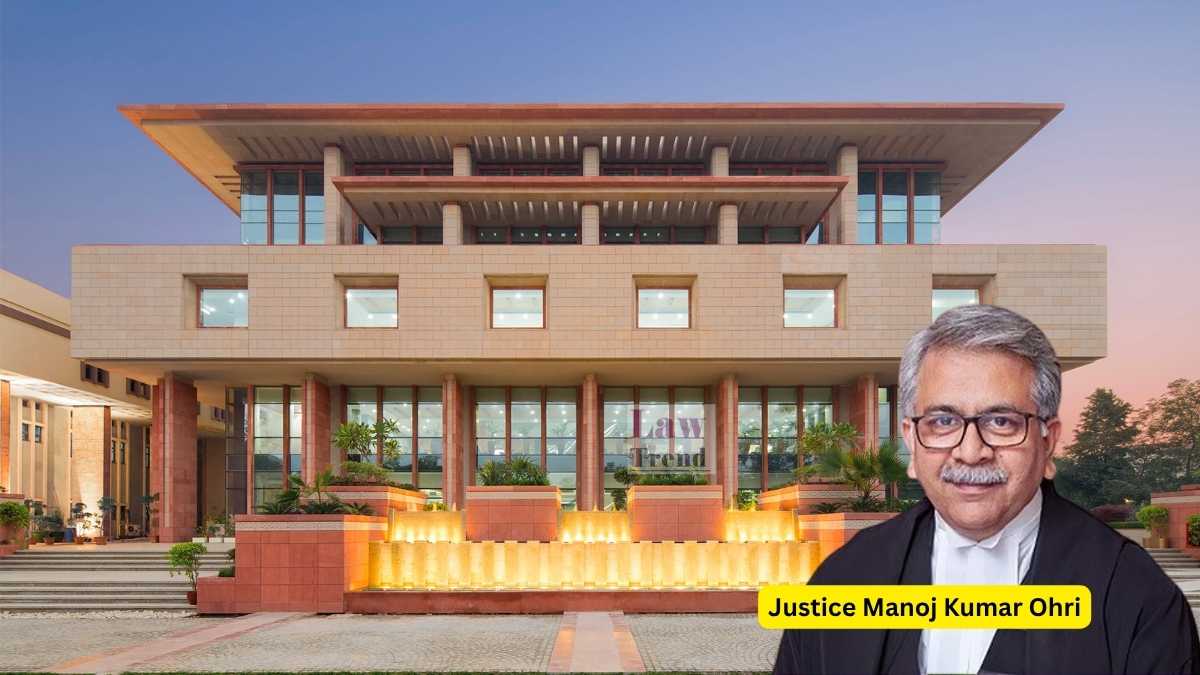
The Delhi High Court has set aside a judgment of the Railway Claims Tribunal which had dismissed a compensation claim on the grounds that the deceased was not a “bona fide passenger.” The Court ruled that once a fall from a running train is established, discrepancies regarding the recovery of a journey ticket assume limited significance.
Justice Manoj Kumar Ohri, while allowing the appeal, observed that the respondent failed to rebut the legal presumption of being a bona fide passenger and remanded the matter back to the Tribunal to assess and disburse the compensation.
Background of the Case
The case originated from a claim application filed by Smt. Sunita (since deceased and represented by her legal heirs) regarding the death of her son, Sonu @ Suraj Chopra. On June 7, 2013, the deceased was traveling from Haridwar to Old Delhi with his brother, Vijay Chopra, and a friend, Jitender Sharma. Due to a heavy rush and a sudden jolt in the compartment, he fell from the running train near Sahibabad Railway Station and later succumbed to his injuries at GTB Hospital.
On April 12, 2017, the Railway Claims Tribunal dismissed the claim, concluding that the deceased was neither a bona fide passenger (as no ticket was recovered) nor was the incident an “untoward incident” as defined under the Railways Act, 1989.
Arguments of the Parties
Counsel for the appellant argued that the Tribunal erred by ignoring the testimonies of the brother (AW-2) and friend, who established that tickets were purchased but lost in the deceased’s bag during the incident. It was contended that the Tribunal placed undue weight on discrepancies in medical records while ignoring the contemporaneous Daily Diary (DD) entries which recorded the incident immediately after it occurred.
Per contra, the Union of India (UOI) supported the Tribunal’s findings. The respondent argued that the lack of a recovered ticket made the deceased’s status as a bona fide passenger doubtful. They further claimed the incident occurred due to the deceased’s own negligence, citing a DRM report, and therefore did not qualify as an “untoward incident.”
The Court’s Analysis
The Court focused on two primary issues: whether the incident was an “untoward incident” and whether the deceased was a bona fide passenger.
1. On Untoward Incident and Negligence: The Court noted that even the Tribunal had found that the death occurred due to a fall from a train. Justice Ohri clarified that once an accidental fall from a running train is established, it “squarely fall[s] within the definition of an ‘untoward incident’ under the Act.” The Court emphasized that under Section 124-A, considerations of negligence—such as standing near the door—do not exempt the Railways from liability unless a specific statutory exception is proven.
2. On Bona Fide Passenger and Ticket Recovery: Regarding the missing ticket, the Court cited the landmark Supreme Court decision in Union of India vs. Rina Devi (2019) 3 SCC 572, stating:
“The absence of recovery of a ticket cannot, by itself, be treated as conclusive.”
The Court found that the appellant had discharged the initial burden of proof through the testimony of Vijay Chopra, who deposed that the tickets were kept in a bag that was not recovered. The Court held that this testimony was corroborated by DD No. 20B, which showed that Vijay had brought the deceased to the hospital immediately after the fall.
The Court dismissed the Tribunal’s skepticism regarding the presence of the brother, noting:
“The non-mention of his name in other records prepared in emergent circumstances does not outweigh such contemporaneous evidence.”
Decision of the Court
The High Court concluded that the requirements laid down in the Rina Devi case were satisfied and that the respondent’s objections were “inconsequential and futile.”
The Court set aside the Tribunal’s judgment and allowed the appeal. The matter has been remanded to the Railway Claims Tribunal with directions to:
- Assess the amount of compensation payable to the legal representatives.
- Direct the authorities to disburse the amount within two months.
- List the matter before the Tribunal on April 20, 2026, for the first instance.
Case Details
- Case Title: Sunita vs. Union of India
- Case Number: FAO 473/2017
- Bench: Justice Manoj Kumar Ohri
- Date: April 06, 2026




