

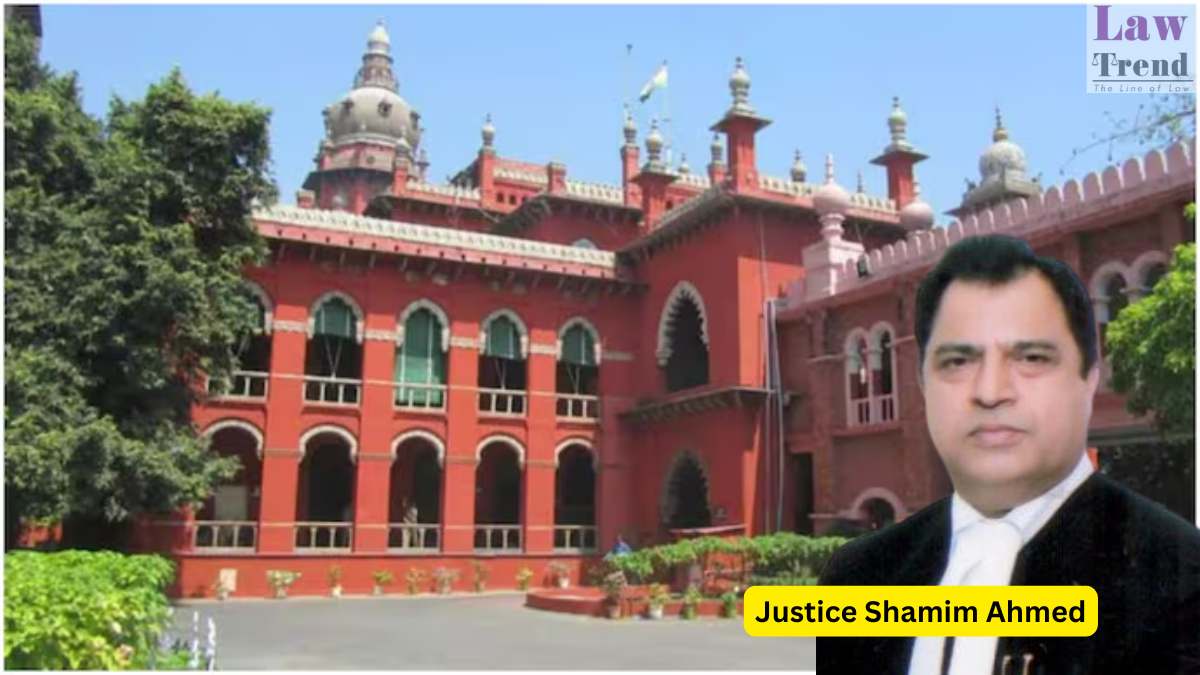
The Madras High Court has held that a wife’s employment in government service and her monthly salary of ₹31,000 cannot, by themselves, constitute sufficient grounds to deny her maintenance under Section 125 of the Code of Criminal Procedure (CrPC). The Court emphasised that the adequacy of her income must be assessed with reference to her reasonable needs and the standard of living enjoyed during the matrimonial relationship.
Justice Shamim Ahmed, in a judgement pronounced on November 27, 2026, set aside an order of the VI Additional Family Court, Chennai, rejecting a woman’s maintenance petition and directed her husband to pay ₹25,000 per month as maintenance.
Background
According to the petitioner-wife, the parties married on March 2, 1998, according to Hindu rites and customs, and a daughter was born in November 1999.
The wife alleged that her husband deserted her and their daughter and married another woman during the subsistence of their marriage.
A mutual consent divorce petition filed by the parties in 2018 was dismissed in March 2019 after the wife complained that she had been coerced into giving her consent.
Subsequently, the wife filed a maintenance petition under Section 125 CrPC. However, on September 30, 2024, the Family Court dismissed her petition on the grounds that a valid marriage had not been established and that she was capable of maintaining herself through her government employment.
Aggrieved by the decision, the wife approached the High Court.
Arguments Before the Court
Advocate Prasad Vijayakumar, appearing for the petitioner-wife on behalf of Advocate R. Rachana, submitted that several public and official documents, including the daughter’s birth certificate, ration card, voter identity document and mutual consent divorce petition, acknowledged the marital relationship between the parties.
He argued that the wife was unemployed when she filed the maintenance petition in 2019 and subsequently secured government employment, earning approximately ₹31,000 per month.
It was further submitted that the husband worked as a professor, operated two tuition centres and had substantial income from various sources.
Advocate N.S. Sriram Prabhu, appearing for the husband on behalf of Advocate P. Anbarasan, denied the marital relationship and alleged that the petitioner had worked as his housemaid. He contended that the maintenance proceedings were instituted to extract money from him.
Court’s Analysis
Government Employment Does Not Automatically Disentitle Wife From Maintenance
The High Court referred to the Supreme Court’s decisions in Shailja v. Khobbanna, Sunita Kachwaha v. Anil Kachwaha and Rajnesh v. Neha, which recognise that a wife’s independent income does not automatically disentitle her from claiming maintenance.
The Court observed:
“The object of Section 125 of Cr.PC (Section 144 of BNSS) is not to compel a wife to lead a life of deprivation, merely because she has some independent income.”
Justice Ahmed further emphasised that courts must consider whether the wife’s income is sufficient to meet her reasonable needs and maintain a standard of living reasonably commensurate with the status of the matrimonial family.
Considering rising inflation and the high cost of living, the High Court found that the wife’s monthly salary of ₹31,000 could not be regarded as sufficient in the circumstances of the case.
The Court held:
“The mere fact that she has subsequently obtained employment cannot be a ground to completely deny her claim.”
Long-Term Cohabitation Raises Presumption of Marriage
The High Court also rejected the husband’s denial of the marital relationship.
Relying on the Supreme Court’s decisions in Badri Prasad v. Deputy Director of Consolidation, Tulsa v. Durghatiya and Kamala v. M.R. Mohan Kumar, the Court observed that prolonged cohabitation as husband and wife raises a strong, though rebuttable, presumption of marriage.
The Court found that the documentary evidence, the long-standing relationship and the birth of their daughter supported the wife’s claim.
It further held that the husband had failed to rebut the presumption of a valid marriage through credible evidence.
Husband’s Financial Position Considerably Stronger
The High Court also examined an earlier judgement concerning the daughter’s separate maintenance proceedings.
In those proceedings, a coordinate Bench had recorded that the husband earned approximately ₹1,30,000 per month as a professor and received rental income ranging from ₹2 lakh to ₹5 lakh per month, besides owning immovable properties.
The husband had not produced convincing material establishing any substantial change in his financial circumstances.
The Court observed:
“The fact that she has secured employment cannot absolve the Respondent of his obligation to provide reasonable financial support to her.”
The High Court further noted that a husband’s marriage to another woman constitutes a just ground for the wife to refuse to live with him under the Explanation to Section 125(3) CrPC.
Decision
The High Court held that the Family Court had adopted an unduly technical approach while examining the evidence concerning the marriage and had failed to appreciate the settled legal position governing maintenance claims by earning wives.
Considering the income and assets of the husband, the wife’s earnings, the duration of the matrimonial relationship and her reasonable needs, the Court awarded monthly maintenance of ₹25,000.
Accordingly, the criminal revision petition was allowed, and the Family Court’s order dated September 30, 2024, was set aside.
The husband was directed to pay maintenance from November 2026 onwards, on or before the 10th day of every succeeding calendar month.
Case Details
Case No.: Criminal Revision Case No. 1223 of 2025
Bench: Justice Shamim Ahmed
Date: November 27, 2026


