

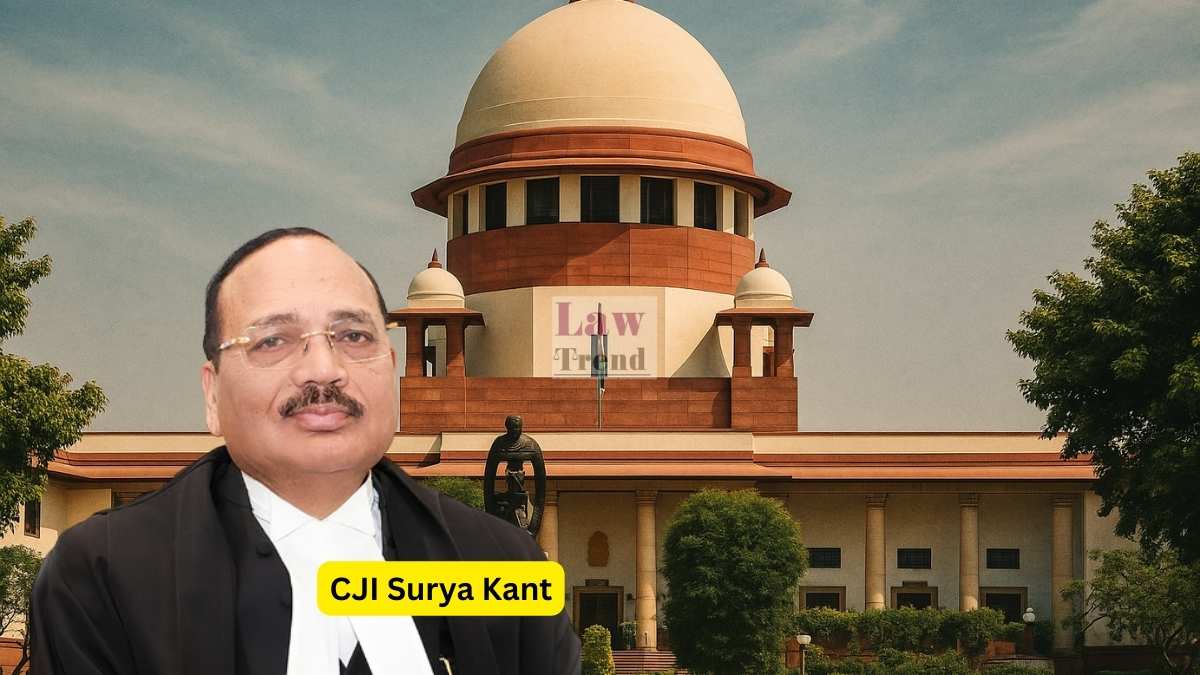
Chief Justice of India Surya Kant on Monday recused himself from proceedings concerning Supertech Limited’s stalled housing projects after disclosing that one of the applicants in the matter was personally known to him. The Supreme Court will now constitute a special Bench to hear the dispute involving the real estate developer, its creditors and homebuyers.
The matter, titled Apex Heights Pvt. Ltd. v. Ram Kishor Arora & Anr., was listed before a three-judge Bench comprising Chief Justice Surya Kant, Justice Joymalya Bagchi and Justice V Mohana.
During the hearing, CJI Surya Kant disclosed that one of the applicants was personally known to him, although the person was neither his client nor a relative. He also questioned why the individual had unnecessarily become a party to the proceedings. In view of the acquaintance, the CJI decided to recuse himself and indicated that a special Bench would be constituted to hear the matter.
Following the disclosure, the Chief Justice indicated that a specially constituted Bench would take up the matter.
Dispute Over Completion of Supertech Projects
The proceedings arise from the insolvency of Supertech Limited and efforts to complete residential projects in which thousands of homebuyers have invested.
The insolvency process began following an application by Union Bank of India, which the National Company Law Tribunal (NCLT) admitted on March 25, 2022.
The dispute subsequently reached the National Company Law Appellate Tribunal (NCLAT), which directed that 16 stalled residential projects be completed through the government-owned NBCC India Limited.
In February 2026, the Supreme Court upheld the appellate tribunal’s decision to involve NBCC in completing these projects, placing particular emphasis on protecting homebuyers who had been awaiting possession for more than two decades.
The Court held that, at that stage, the interests of homebuyers in obtaining their homes should receive priority over competing financial claims raised by secured creditors, operational creditors and land authorities.
It further directed that existing homebuyers should not be subjected to additional construction costs beyond those stipulated in their respective builder-buyer agreements.
Supreme Court’s Monitoring Framework
To oversee the completion process, the Supreme Court established a monitoring mechanism involving an Apex Court Committee and separate project-level committees.
These bodies were entrusted with supervising construction progress and the management of funds associated with the unfinished projects.
The proceedings have continued as various stakeholders seek further directions concerning the implementation of the framework.
At the previous hearing on November 16, the Supreme Court permitted the parties to submit their suggestions to the amicus curiae by November 20. The amicus was directed to consolidate those submissions and place them before the Court.
Following Monday’s recusal, the pending issues concerning the implementation of the project-completion arrangement will be considered by a newly constituted Bench.


