

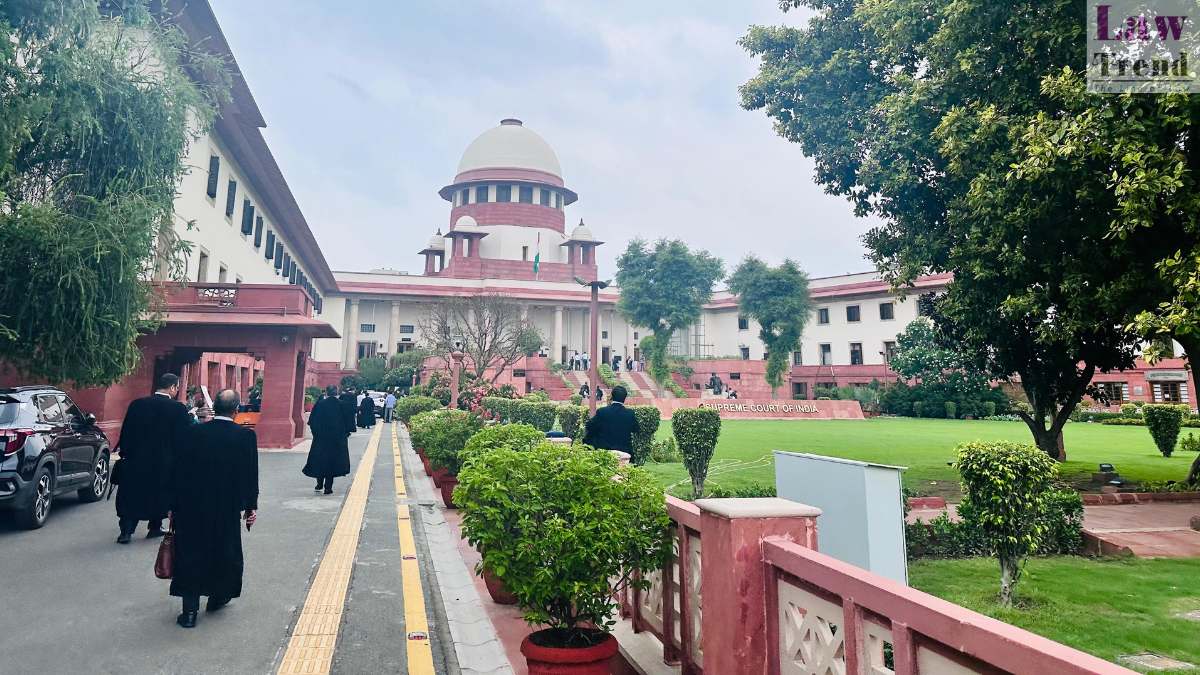
The Supreme Court has held that the National Company Law Appellate Tribunal (NCLAT) wrongly applied Section 4 of the Limitation Act, 1963 to extend the deadline for appeals under the Insolvency and Bankruptcy Code (IBC). The appeals in question had been filed on the 46th day. Applying its earlier ruling in Tata Steel Ltd. v. Raj Kumar Banerjee, the Court dismissed as time-barred two appeals challenging the resolution plan of Lulu International Shopping Malls Private Limited for Manjeera Retail Holdings Private Limited.
A Bench of Justice Sanjay Kumar and Justice Sanjeev Sachdeva allowed Lulu’s appeals against an NCLAT, Chennai order dated February 10, 2026, which had refused to recall the NCLAT’s earlier order condoning the delay.
Background
The NCLT, Hyderabad, initiated insolvency proceedings against Manjeera Retail Holdings on July 18, 2023. Lulu emerged as the successful resolution applicant after its plan received 100% approval from the Committee of Creditors, and the NCLT approved the plan on March 26, 2025. Lulu claims to have invested ₹271.52 crore in implementing the plan.
Gorinka Pratyusha, Srinivas Kalluri and Rajani Kalluri, who claimed to have agreements to buy commercial units in Manjeera Mall, challenged the approval. They alleged that the Resolution Professional had recorded their payments as “advances from customers” instead of treating them as financial creditors.
Under Section 61(2) of the IBC, an appeal must be filed within 30 days, with a further condonable period of 15 days and no more. The 30-day period ended on April 25, 2025, and the extended period on May 10, 2025. Both appeals were e-filed on May 11, 2025, the 46th day.
On October 10, 2025, the NCLAT condoned the delay under Section 4 of the Limitation Act, because the 45th day was a second Saturday. Lulu then sought a recall, citing Tata Steel. The NCLAT dismissed the recall applications, treating that decision as a later precedent that could not justify recalling an order passed on merits.
Supreme Court’s Findings
The Court first noted that the NCLAT was wrong to treat Tata Steel as a later decision. It had been decided on May 7, 2025, long before the NCLAT’s order of October 10, 2025. The Bench added, “when this Court clarifies the legal position in relation to a statutory provision, the same would be the law of the land and there is no question of an order contrary thereto passed earlier by a Court or Tribunal being saved, unless such order has attained finality.”
On the recall power, the Court acknowledged that the NCLAT cannot review its orders under the IBC. However, it can recall them in exercise of its inherent jurisdiction under Rule 11 of the NCLAT Rules, 2016. The Bench relied on the five-member NCLAT decision in Union Bank of India v. Dinkar T. Venkatasubramanian, confirmed by the Supreme Court, and on Greater Noida Industrial Development Authority v. Prabhjit Singh Soni. It held that the NCLAT “was not justified in refusing to exercise its inherent jurisdiction even when apprised of the settled legal position”.
The Court also found that the respondents had not shown sufficient cause for the delay. It pointed out that the appeals were e-filed on May 11, 2025, which was a Sunday and also a holiday. It observed, “such e-filing of the appeals could as well have been done on 10.05.2025 itself.”
Counsel for the respondents argued that the condonation order of October 10, 2025 had never been separately challenged and had therefore attained finality. The Court called this a “specious argument”. It held that the recall applications had kept the issue alive and that the matter could be corrected under Section 62 of the IBC.
The Bench concluded, “entertainment of the appeals by the NCLAT was illegal, as the appeals were filed beyond the time prescribed in Section 61(2) of the IBC.”
Outcome
The Supreme Court set aside the NCLAT’s order of February 10, 2026, allowed the recall applications, and set aside the condonation order of October 10, 2025. As a result, Company Appeal (AT)(CH)(Ins) Nos. 388 and 389 of 2025 were dismissed on the ground of limitation. The parties were directed to bear their own costs.
Case Title: Lulu International Shopping Malls Private Limited v. Gorinka Pratyusha and Others Etc.
Case No.: Civil Appeal Nos. 3110-3111 of 2026
Bench: Justice Sanjay Kumar and Justice Sanjeev Sachdeva
Date: November 16, 2026


