

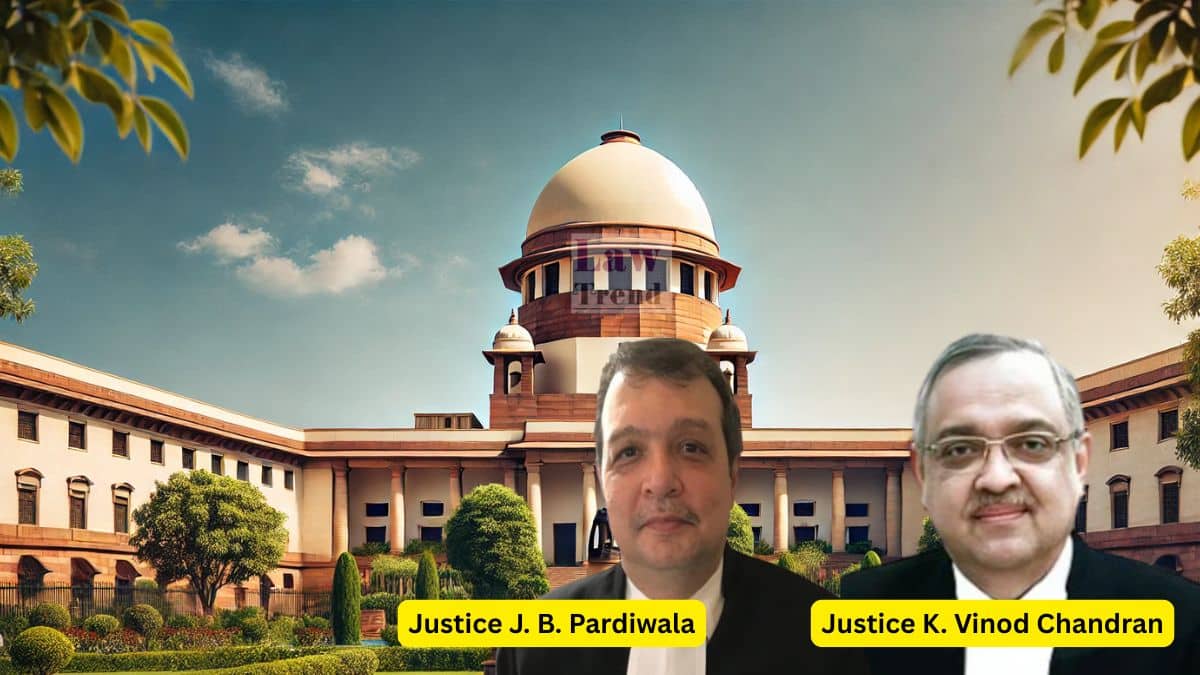
The Supreme Court has held that a debenture holder and lender exercising pervasive control over a corporate debtor’s management and projects is a “related party” under Section 5(24) of the Insolvency and Bankruptcy Code, 2016 (IBC), and cannot be part of the Committee of Creditors (CoC). A Bench of Justice J.B. Pardiwala and Justice K. Vinod Chandran dismissed appeals filed by ECL Finance Ltd. and IDBI Trusteeship Services Ltd., upholding their exclusion from the CoC of Palm Developers Private Limited.
Background
The claims arose from a Debenture Trust Deed dated 13.05.2016 and a Facility Agreement dated 22.09.2017. Palm Developers, the corporate debtor, stood as guarantor to Saha Infratech Private Limited (SIPL), which issued non-convertible debentures and availed a term loan facility.
SIPL had proposed debentures worth ₹160 crore in two tranches, but only the first tranche of ₹110 crore was subscribed, and all of it is now held by ECL. IDBI Trusteeship Services Ltd. (ITSL) was appointed as Debenture Trustee. SIPL separately obtained a ₹90 crore revolving credit facility from ECL, with the corporate debtor as Obligor No. 5.
After the corporate insolvency resolution process (CIRP) began on 27.01.2020, ITSL claimed about ₹131.17 crore as Debenture Trustee and ECL claimed about ₹139.02 crore under the term loan. Both were included in the CoC, which was challenged by an individual homebuyer. The NCLT held both appellants to be related parties under Section 5(24)(m)(i), and the NCLAT affirmed.
Senior Counsel Gaurav Mitra appeared for the appellants, while Senior Counsel Jayant Mehta and Arijit Prasad appeared for the respondents.
Guarantee and Locus Issues
The Court found that the NCLT had misread the ruling in Anuj Jain v. Axis Bank Limited in holding that a guarantor’s liability was not a financial debt. It also held that the NCLAT erred in rejecting the claims because the corporate guarantee was not invoked before the CIRP, relying on China Development Bank v. Doha Bank Q.P.S.C.
On the homebuyer’s standing, the Court agreed with the NCLAT, relying on Phoenix ARC Private Limited v. Spade Financial Services Limited, that an individual financial creditor could object to the inclusion of related parties in the CoC.
Lower Threshold Than Section 29A
Referring to ArcelorMittal India Private Limited v. Satish Kumar Gupta, the Court noted that “control” under Section 29A(c) and (g) requires proactive and positive control. However, it held that Section 5(24)(m)(i) only requires an association with the corporate debtor through participation in its policy making process. The Court observed:
“The requirement would not be to the extent of being in the driving seat, but a role of navigation would suffice, in determining policy and channelising business interests.”
Court’s Findings on Control
The Court examined Clause 7.1 of the Articles of Association, which gave the debenture holders and lenders the final say on any deadlock at board or shareholder meetings. It also noted an amendment to the Debenture Trust Deed allowing the Debenture Trustee to approve or modify the quarterly construction budget, and observed that it “clearly confers a proactive role on the debenture holder and the Trustee in steering the Company, SIPL, through difficult times; but also, the CD, who is the security provider.”
Under the Facility Agreement and Sanction Letter, ECL had the right to appoint a nominee director and an observer, its consent was needed to remove key managerial personnel, and it could appoint real estate agents to sell units. A power of attorney also gave ECL sweeping powers over construction, approvals and sales.
Justice Vinod Chandran, writing for the Bench, held that ECL had “all-pervasive control” over the borrower’s projects and that this could not be called a mere restrictive or negative control. Since ECL held all the debentures, ITSL, which protects its interest, was also barred. ECL’s status as debenture holder disabled it even in its capacity as a lender.
Assignment Held Not Bona Fide
The Court noted that ECL had assigned its rights under the Facility Agreement to the second appellant long after the CIRP began. Relying on Phoenix ARC, it held that the recent assignment could only be seen as an attempt to defeat the related party bar, pointing to a forensic audit report noted by the Tribunal on alleged diversion of funds. The Court ruled that “The assignment hence fails the test of a bona fide assignment”.
Outcome
Finding no question of law or perversity in the NCLAT’s order, the Supreme Court dismissed the appeals and closed the connected contempt petitions.
Case Title: ECL Finance Ltd. and Anr. v. Abhinav Mukherjee and Ors.
Case No.: Civil Appeal No. 6268 of 2022 with Civil Appeal No. 6273 of 2022
Bench: Justice J.B. Pardiwala and Justice K. Vinod Chandran
Date: October 27, 2026


