

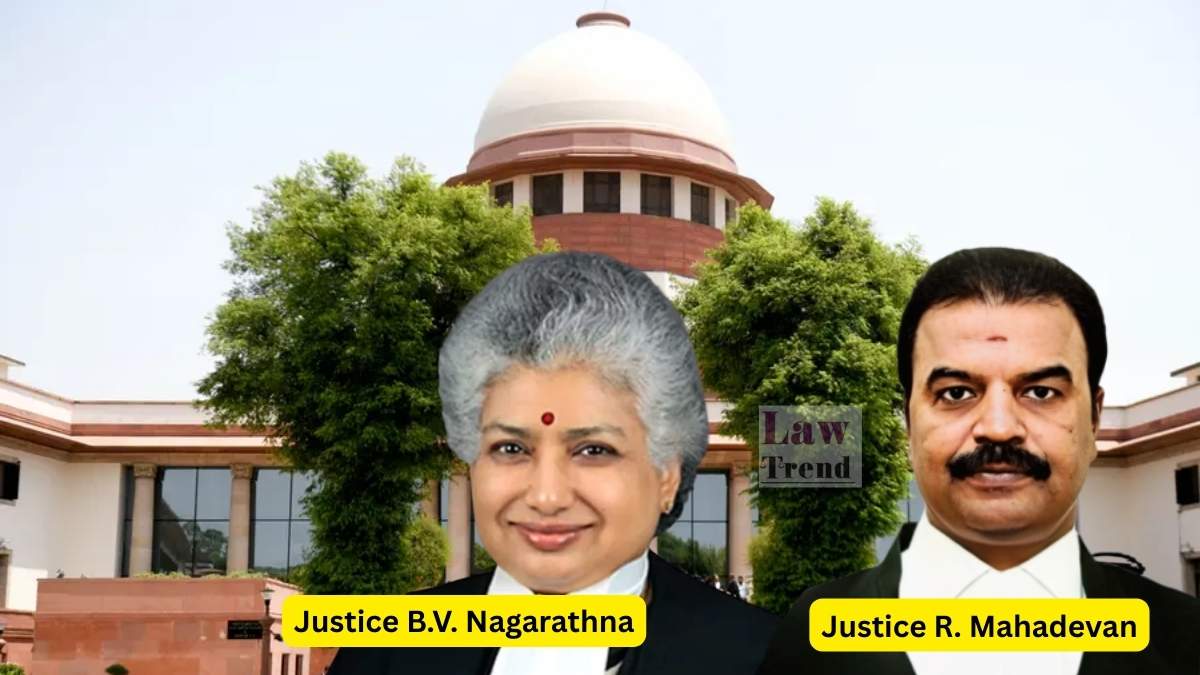
The Supreme Court of India has held that the subsequent discovery of a compromise decree directly bearing on the title of suit property satisfies the requirement of “due diligence” under the proviso to Order VI Rule 17 of the Code of Civil Procedure, 1908 (CPC), permitting a belated amendment of the plaint even after the commencement of trial. Setting aside concurrent orders of the Senior Civil Judge, Cuttack, and the High Court of Orissa, a Bench comprising Justice B.V. Nagarathna and Justice R. Mahadevan ruled that an enlargement of factual and legal questions does not amount to a fundamental alteration of the character of a suit, and that arguable questions concerning limitation or statutory bars should not be shut out at the threshold. Delivering the judgment for the Bench, Justice R. Mahadevan allowed the amendment subject to payment of Rs. 25,000/- in costs.
Background of the Dispute
The litigation traces back to Title Suit No. 86 of 2009, instituted by the original plaintiff, Rabindranath Sahoo, seeking declaration of right, title, and interest, recovery of possession, and rectification of registered sale deeds dated February 15, 1971, and July 28, 1978. The dispute pertained to Hal Plot No. 3370/4045 (Ac. 0.10 decimals) and Hal Plot No. 3371/4050 (Ac. 0.02 decimals), aggregating Ac. 0.12 decimals out of Ac. 0.16 decimals under Hal Khata No. 198.
According to the appellants, successive sale deeds had been executed over Plot No. 3370/4045 between various defendants up to 2015. Over Plot No. 3371/4050, a sale deed was executed by Defendant No. 8 in favor of Defendant Nos. 9 and 10 in 2007, though the vendor’s source of title was then unknown to the plaintiff.
Upon Defendant Nos. 9 and 10 disclosing in their written statement that the plot stood recorded in their names, the plaintiff amended the plaint to plead exclusive title tracing to a 1940 partition. Subsequently, the plaintiff filed a further application under Order VI Rule 17 read with Section 151 CPC, stating that the defendants had not disclosed their mutation case number. Following an inquiry at the office of the Tahsildar, Niali, the plaintiff discovered a compromise decree passed in Title Suit No. 105 of 1998, to which he was not a party. By this decree, Ac. 0.04 decimals—encompassing the disputed Ac. 0.02 decimals in Plot No. 3371/4050—had been allotted to Defendant No. 8.
The plaintiff sought to incorporate foundational pleadings regarding T.S. No. 105 of 1998 and prayed for a declaration that the final decree passed therein was null and void. Following the plaintiff’s demise, his legal heirs pursued the application. The trial court rejected the amendment on September 21, 2022, and the Orissa High Court affirmed the dismissal on April 10, 2023, leading to the appeal before the Supreme Court.
Arguments of the Parties
Counsel for the appellants contended that the underlying transactions were complex, originating in 1940 and involving multiple claimants. They submitted that an earlier order of the Tahsildar, Niali, dated August 31, 2007, had acknowledged significant confusion arising from competing sale deeds and piecemeal record corrections. It was urged that certified copies of the compromise plaint and final decree were secured only on June 22, 2020, demonstrating due diligence. Relying on A.K. Gupta & Sons Ltd. v. Damodar Valley Corporation and Abdul Rehman & another v. Mohd. Ruldu & others, the appellants argued that the amendment neither raised an entirely new cause of action nor altered the suit’s basic nature, and that the issue of limitation must be determined on the facts of the case rather than at the threshold.
Opposing the appeal, counsel for Respondent Nos. 1 and 9 to 11 submitted that the proceedings had been protracted for nearly fourteen years through repeated amendment applications, following an initial suit for permanent injunction in 2007. They argued that the amendment was sought at an advanced stage after the commencement of trial, fundamentally altering the suit’s character in violation of the proviso to Order VI Rule 17 CPC, citing Basavaraj v. Indira and others.
The respondents further argued that the application failed to furnish adequate particulars as to when the search was conducted or why the plea could not have been raised earlier. Additionally, they contended that the proposed challenge was ex facie barred by limitation and prohibited by Order XXIII Rule 3A of the CPC, which bars a separate suit to challenge a compromise decree.
The Court’s Analysis and Precedents
The Supreme Court examined the scope of Order VI Rule 17 CPC and its proviso, observing that while the power to permit amendments post-commencement of trial is conditioned on establishing “due diligence,” the core objective remains the effective and complete determination of the real controversy between the parties.
Reviewing established authorities, the Bench referred to Rajesh Kumar Aggarwal & others v. K.K. Modi and others, noting that the “real controversy test” is cardinal. The Court highlighted its earlier ruling in Abdul Rahman v. Mohd. Ruldu & others, observing:
“We reiterate that all amendments which are necessary for the purpose of determining the real questions in controversy between the parties should be allowed if it does not change the basic nature of the suit. A change in the nature of relief claimed shall not be considered as a change in the nature of suit and the power of amendment should be exercised in the larger interests of doing full and complete justice between the parties.”
The Court also considered the guiding factors articulated in Revajeetu Builders and Developers v. Narayanaswamy and Sons & others, the comprehensive guidelines in Life Insurance Corporation of India v. Sanjeev Builders Private Limited and another, and the recent reiteration in Akkiraju Panduranga Rao and another v. Gunlapally Ranga Rao cautioning against hyper-technical approaches.
Applying these principles, the Bench held that the appellants had established due diligence under the proviso to Order VI Rule 17:
“The subsequent discovery of the compromise proceedings, coupled with the assertion that the original plaintiff was not a party to those proceedings and that the source of title of the vendors was not disclosed in the written statement, provides a sufficient basis for accepting the plea of due diligence for the purposes of the proviso to Order VI Rule 17 of the CPC.”
Addressing whether the amendment fundamentally altered the nature of the suit, the Court noted:
“The proposed amendment may enlarge the factual and legal questions requiring adjudication; however, such enlargement cannot, by itself, be equated with a fundamental alteration of the nature and character of the suit.”
“The real inquiry is whether the amendment introduces a distinct and independent controversy having no connection with the original cause of action, or whether it merely brings on record additional facts and consequential reliefs having a direct nexus with the existing controversy.”
On the objections regarding limitation, the Bench cited Ragu Thilak D. John v. S. Rayappan and others, Sampat Kumar v. Ayyakannu and another, and Pankaja and another v. Yellappa (Dead) by LRs and others, emphasizing that where the date of knowledge is disputed and the plea of limitation is arguable, it should not lead to summary rejection of the amendment.
The Court similarly declined to pronounce on the bar under Order XXIII Rule 3A CPC at this preliminary stage, holding that the legal consequences of the plaintiff being a non-party to the compromise decree are matters best left for determination by the trial court after completion of pleadings. The Court also observed that disallowing the amendment would fragment the title dispute and risk inconsistent findings, whereas any prejudice to the defendants could be redressed by permitting an additional written statement and awarding costs.
The Decision
The Supreme Court set aside the order dated September 21, 2022, passed by the trial court and the order dated April 10, 2023, passed by the High Court. The application for amendment was allowed subject to the payment of Rs. 25,000/- as costs to the contesting respondents within two weeks.
The appellants were directed to carry out consequential amendments in the plaint within four weeks thereafter, with liberty granted to the respondents to file their additional written statements. The Court clarified that allowing the amendment does not reflect an acceptance of its merits, expressly leaving open all questions regarding limitation, maintainability, Order XXIII Rule 3A CPC, the validity of the compromise decree, and title for adjudication by the trial court.
Case Details
Case Title: Haramani Sahoo and Others v. Lalita Nayak and Others
Case No.: Civil Appeal No. 13681 of 2026
Bench: Justice B.V. Nagarathna and Justice R. Mahadevan
Date: October 12, 2026




