

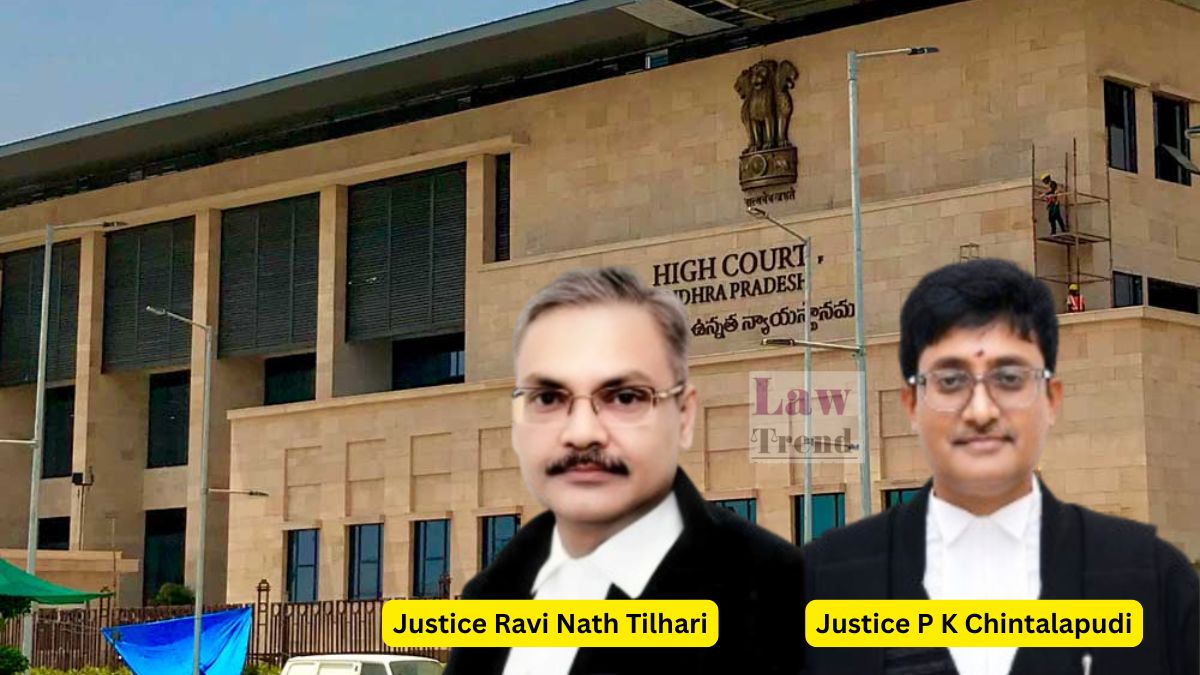
Setting aside a preventive detention order, the High Court of Andhra Pradesh has ruled that criminal cases registered outside the territorial jurisdiction of a detaining authority can only form the basis of preventive detention if the authority explicitly records subjective satisfaction that such external activities adversely impacted public order within its own local limits. A Division Bench comprising Justice Ravi Nath Tilhari and Justice Purushottam Kumar Chintalapudi allowed a habeas corpus petition, holding that general assertions without specific reasoning, combined with the non-consideration of bail conditions imposed on the detenu, completely vitiated the detention order.
Background of the Case
The petitioner, Devalla Divya, approached the High Court under Article 226 of the Constitution of India challenging the preventive detention order passed against the detenu, Devalla Jayaprakash alias Jaya. The detention order was issued on December 2, 2025, by the Collector and District Magistrate of SPSR Nellore District under Sections 3(1) and 3(2) of the Andhra Pradesh Prevention of Dangerous Activities of Bootleggers, Dacoits, Drug Offenders, Goondas, Immoral Traffic Offenders and Land Grabbers Act, 1986, classifying the detenu as a “Goonda” under Section 2(g) of the Act. The order was subsequently confirmed by the State Government vide G.O.Rt.No.202 on February 2, 2026, following approval by the Advisory Board.
The detention order relied upon three criminal cases registered under the Bharatiya Nyaya Sanhita, 2023 (BNS):
- Crime No. 137/2024 of Chillakur Police Station under Section 118(1) read with Section 3(5) BNS, dated August 13, 2024, wherein a notice under Section 41-A of the CrPC was served and a charge sheet was filed.
- Crime No. 138/2024 of Gudur Rural Police Station under Sections 333 and 109 read with Section 3(5) BNS, dated August 13, 2024, wherein the detenu was arrayed as Accused No. 1 (A-1) and was granted bail by the VII Additional Sessions Court, Gudur, on January 23, 2025.
- Crime No. 149/2025 of Vedayapalem Police Station under Sections 103(1), 58, and 61(2)(A) read with Section 3(5) BNS, dated March 14, 2025, wherein the detenu was Accused No. 7 and was granted bail by the IV Additional District and Sessions Judge, Nellore, on July 28, 2025.
At the time the alleged offences were committed and registered in Crime Nos. 137 and 138 of 2024, both Chillakur and Gudur Rural police stations did not fall under the territorial jurisdiction of SPSR Nellore District. Following a district restructuring under G.O.Ms.No.52 dated April 11, 2022, both police stations had been transferred to Tirupati District, though they were subsequently re-notified as part of SPSR Nellore District vide G.O.Ms.No.15 on January 21, 2026.
Arguments of the Parties
Learned counsel for the petitioner, Sri S. Rama Lakshman Reddy, submitted that Crime Nos. 137 and 138 of 2024 fell outside the territorial limits of the District Collector, Nellore, at the time of the alleged offences, rendering them irrelevant material that vitiated the detaining authority’s subjective satisfaction. He further contended that while the detaining authority noticed that the detenu had obtained bail in the second and third cases, it completely failed to consider the bail conditions or assess whether those conditions were sufficient to deter future offences. The petitioner placed reliance on the Madras High Court judgment in Suman v. The State of Tamil Nadu, as well as Syed Mohiyuddin v. The State of Andhra Pradesh and the Supreme Court decision in Nenavath Bujji v. The State of Telangana.
Opposing the petition, Sri Keerthi Teja Kondaveeti, learned Government Pleader, argued that the offences fell within the statutory definition of a “Goonda” and that the 1986 Act contains no bar preventing an authority from considering offences registered outside its territorial limits when assessing continuous criminal conduct. He asserted that the distance between Vedayapalem Police Station and the other two police stations was only around 30 kilometers. Through an additional affidavit, the respondent-authority contended that the detenu’s external activities had a direct impact on public order within the local limits of Nellore, and that the detaining authority was conscious of the bail orders when reaching its subjective satisfaction.
Court’s Analysis and Case Citations
The Bench examined Section 3 of the Act of 1986, observing that what is material is not simply where the offence was registered, but the prevailing or likely circumstances within the local limits of the detaining authority:
“It transpires to us that, what is relevant is, not the place, if falling outside the territorial jurisdiction of the detaining authority, where the offence is registered, but the circumstances prevailing or likely to prevail in the area within the local limits of the jurisdiction of the detaining authority that it is necessary to pass an order of preventive detention as provided in sub-section (1).”
Examining Suman v. The State of Tamil Nadu, the Court noted that all incidents need not occur within the territorial jurisdiction, provided there is a reasonable territorial nexus. However, referring directly to the Supreme Court’s ruling in Nenavath Bujji v. The State of Telangana (which discussed Ameena Begum v. State of Telangana, Khudiram Das v. State of W.B., Khaja Bilal Ahmed v. State of Telangana, and Shibban Lal Saksena v. State of U.P.), the Court emphasized that:
“Secondly, if at all the detaining authority wanted to take into consideration the two FIRs registered with the police station not falling within his territorial jurisdiction then he should have recorded the subjective satisfaction that the incidence of the two FIRs created ‘public disorder’.”
On scrutinizing the detention order, the Court found no discussion or recording of how the incidents in Chillakur and Gudur Rural affected public order in Nellore District. The Court observed:
“‘Prejudicial to the maintenance of public order’ or ‘Adversely effecting the public order’, must have a connection with the activities committed outside the territorial jurisdiction of the detaining authority. Any adverse effect on the public order within the territorial jurisdiction of the detaining authority must be shown. The detaining authority must have been satisfied on that aspect. In the absence of any finding recorded on such satisfaction, the order of preventive detention cannot be sustained based on the two criminal cases, for the area falling outside the territorial jurisdiction of the detaining authority.”
Addressing the State’s reliance on the additional affidavit to bridge this gap, the High Court held that reasons cannot be supplemented later. Citing the Supreme Court’s landmark rulings in Mohinder Singh Gill v. Chief Election Commissioner and Commissioner of Police, Bombay v. Gordhandas Bhanji (as reiterated in Syed Mohiyuddin), the Court underscored:
“Public orders, publicly made, in exercise of a statutory authority cannot be construed in the light of explanations subsequently given by the officer making the order of what he meant, or of what was in his mind, or what he intended to do. Public orders made by public authorities are meant to have public effect and are intended to affect the actings and conduct of those to whom they are addressed and must be construed objectively with reference to the language used in the order itself.”
On the second issue of non-consideration of bail conditions, the Court held that the legal position is well settled under Supreme Court rulings in Rushikesh Tanaji Bhoite v. State of Maharashtra and Rekha v. State of T.N., as well as the High Court’s decisions in Buddiga Dhana Lakshmi v. State of Andhra Pradesh, Ponnada Geetha, and Vasanthu Sumalatha v. State of Andhra Pradesh. The Court observed that bail orders and the conditions imposed therein constitute vital material. While the detaining authority took note of the grant of bail, it failed to apply its mind to the conditions imposed and whether those conditions were adequate to prevent the detenu from indulging in further criminal activities.
Citing Shiv Parsad Bhatnagar v. State of M.P., the Bench reiterated that:
“the single vicious ground is sufficient to vitiate an order of detention.”
The Decision
The High Court concluded that the detention order was unsustainable due to:
- The failure to record subjective satisfaction showing how the two criminal cases outside the territorial limits had a prejudicial effect on the maintenance of public order within the local limits of the detaining authority; and
- The failure to examine whether the conditions imposed while granting bail in Crime Nos. 138 of 2024 and 149 of 2025 were sufficient to prevent future illegal activities without resorting to preventive detention.
Accordingly, the High Court allowed the writ petition, quashed the detention order dated December 2, 2025, and the confirmation order dated February 2, 2026, and directed that the detenu be set at liberty immediately, provided he is not required in any other pending case. The detaining authority was granted liberty to pass a fresh order in accordance with law, subject to the condition that the total period of detention does not exceed the statutory limit.
Case Title: Devalla Divya v. The State of Andhra Pradesh and 3 others
Case No.: Writ Petition No. 35016 of 2025
Bench: Justice Ravi Nath Tilhari and Justice Purushottam Kumar Chintalapudi




