

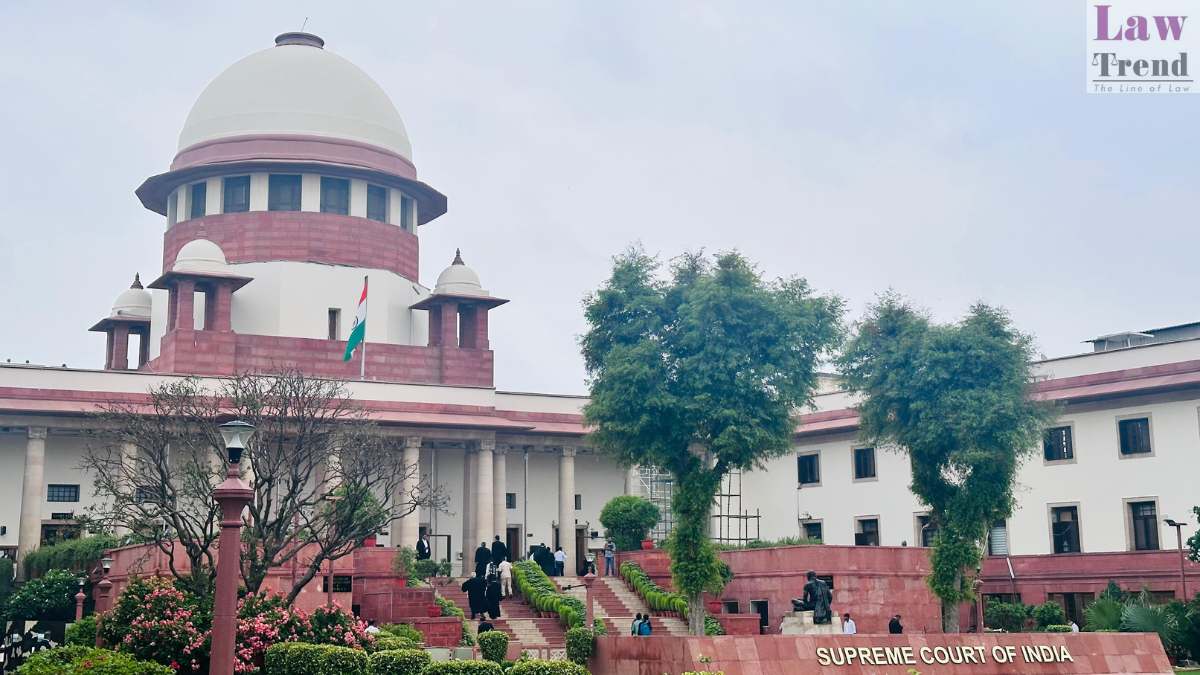
The Supreme Court of India has ruled that the personal presentation of an election petition by the petitioner is an indispensable statutory mandate under Section 81(1) of the Representation of the People Act, 1951, and non-compliance with this requirement leaves the court with no option but to dismiss the petition at the threshold under Section 86(1). A bench comprising Justice Prashant Kumar Mishra and Justice Shree Chandrashekhar upheld the Madras High Court’s order dismissing an election petition that challenged the election of Tamil Nadu legislator S. Regupathy on the ground that it had been presented by the petitioner’s counsel rather than by the petitioner in person.
Background of the Case
The controversy stemmed from the 2026 Tamil Nadu Legislative Assembly Elections, where S. Regupathy was declared the returned candidate from the 181-Thirumayam Assembly Constituency on May 4, 2026.
The petitioner, V. Pon. Paneerselvam, filed an election petition before the Madras High Court under Sections 80, 80A, 81, 83, 100(1)(b), 100(1)(d)(i) and (iv) read with Section 123(2) of the Representation of the People Act, 1951 (RP Act), along with the relevant High Court Rules. Paneerselvam sought to declare Regupathy’s election null and void and to hold him guilty of the corrupt practice of undue influence, alleging deliberate suppression and false declaration of his spouse’s assets and income anomalies in his statutory Form 26 Affidavit.
However, in an order dated July 22, 2026, the Madras High Court dismissed the election petition (ELP No. 36/2026) as not maintainable at the threshold. The High Court rested its decision on Rule 7 of the Madras High Court Election Petitions Rules, 1967, which explicitly mandates that every election petition must be presented by the petitioner in person before the II Assistant Registrar, Original Side, or an officer designated by the Registrar. Because the petition was presented by the petitioner’s counsel, the High Court held it to be non-maintainable. Aggrieved, Paneerselvam approached the Supreme Court via a Special Leave Petition.
Arguments of the Parties
Before the Supreme Court, the petitioner contended that he had personally presented the election petition before the Registry on June 16, 2026. In support of this claim, he relied on a CISF entry pass to prove his entry into the High Court premises on that date, as well as CCTV footage which he asserted captured the presentation and his personal verification. The petitioner also placed reliance on the Supreme Court’s ruling in Dr. Vijay Laxmi Sadho v. Jagdish, arguing that non-compliance with rules framed solely by a High Court could not attract dismissal under Section 86(1) of the RP Act.
The primary legal questions before the bench were whether presentation by the petitioner in person is mandatory under Section 81 of the RP Act, whether non-compliance warrants dismissal at the threshold under Section 86(1), and whether the High Court possessed the competence to frame procedural rules governing the presentation of such petitions.
Court’s Analysis of Section 81 and Judicial Precedents
Examining the statutory framework, the Supreme Court highlighted that Section 81(1) of the RP Act is cast in precise terms. Citing the precedent in G.V. Sreerama Reddy and Another v. Returning Officer and Others (2009), the bench reiterated that Section 81(1) embodies five distinct, mandatory components:
- The petitioner must be either a candidate or an elector;
- The petition must be presented “by” the petitioner;
- It must be based on grounds specified in Sections 100 and 101;
- It must be presented in the High Court; and
- It must be filed within 45 days from the date of the election.
The bench stressed the strict nature of this requirement:
Thus, the requirement of presentation under Section 81 cannot be viewed as a mere procedural formality divorced from the statutory scheme, as its compliance bears direct nexus with the maintainability of the election petition and a defect, if any, shall not be curable.
Referring to K. Venkateswara Rao and Anr. v. Bekkam Narasimha Reddi & Ors. and Hukumdev Narain Yadav v. Lalit Narain Mishra, the court observed that the RP Act is a special, self-contained code that requires strict adherence and does not admit extraneous procedural relaxations.
Addressing the statutory usage of the word “by” in Section 81(1), the court held:
The requirement that the petition be presented “by” the petitioner enables the High Court, at the stage of presentation itself, to undertake a preliminary verification so as to ensure that the proceeding is not frivolous or vexatious.
The bench also reviewed the legislative history of Section 81. Under the pre-1966 law, sub-section (2) of Section 81 had expressly permitted presentation through an authorized representative or by registered post to the Election Commission. However, when the Representation of the People (Amendment) Act, 1966 transferred election dispute jurisdiction to the High Courts, sub-section (2) was omitted, leaving no statutory recognition for presentation through agents or post.
High Court Rules and Factual Findings
On the question of whether the High Court could frame rules regulating the receipt of petitions, the Supreme Court cited Jamal Uddin Ahmad v. Abu Saleh Najmuddin and Another (2003). Applying the doctrine of incidental powers and the principle of cursus curiae est lex curiae (the practice of the court is the law of the court), the bench noted that administrative and ministerial functions—such as receiving documents and preliminary scrutiny—can validly be delegated to Registry officers.
Holding Rule 7 of the Madras High Court Election Petitions Rules, 1967 to be intra vires, the court observed:
The rule regulates the manner in which an election petition is to be presented and received before the High Court and, in doing so, operates as an incident of the jurisdiction conferred upon the High Court by the RP Act. The rule does not, by its terms, trench upon or run contrary to any requirement expressly prescribed by Section 81 of the Act.
Turning to the facts, the court found the petitioner’s claim of personal presentation unproven. The CISF entry pass and CCTV footage established nothing more than his presence in the court complex on June 16, 2026. In contrast, the official receipt evidencing the security deposit under Section 117 of the RP Act had been issued in the name of the petitioner’s counsel.
The bench rejected the petitioner’s reliance on Dr. Vijay Laxmi Sadho v. Jagdish, explaining that the said decision dealt with affidavit defects under Section 83, which are not listed as grounds for summary dismissal under Section 86(1). In contrast, Section 81 violations explicitly mandate dismissal under Section 86(1).
The court also distinguished Sheo Sadan Singh v. Mohan Lal Gautam, where an election petition presented by an advocate’s clerk was accepted because it occurred in the immediate physical presence of the petitioner, amounting to substantial compliance. In Paneerselvam’s case, there was no proof or plea that he was present alongside his counsel at the time of presentation.
Decision
Concurring with the Madras High Court, the Supreme Court held that the petition had not been presented in accordance with the mandatory requirements of Section 81 of the RP Act and the governing High Court Rules.
Finding the appeal devoid of merit, the bench dismissed the Special Leave Petition.
Case Details:
Case Title: V. Pon. Paneerselvam v. S. Regupathy and Others
Case No.: Special Leave Petition (Civil) No. 30538 of 2026
Bench: Justice Prashant Kumar Mishra and Justice Shree Chandrashekhar
Date: October 07, 2026




