

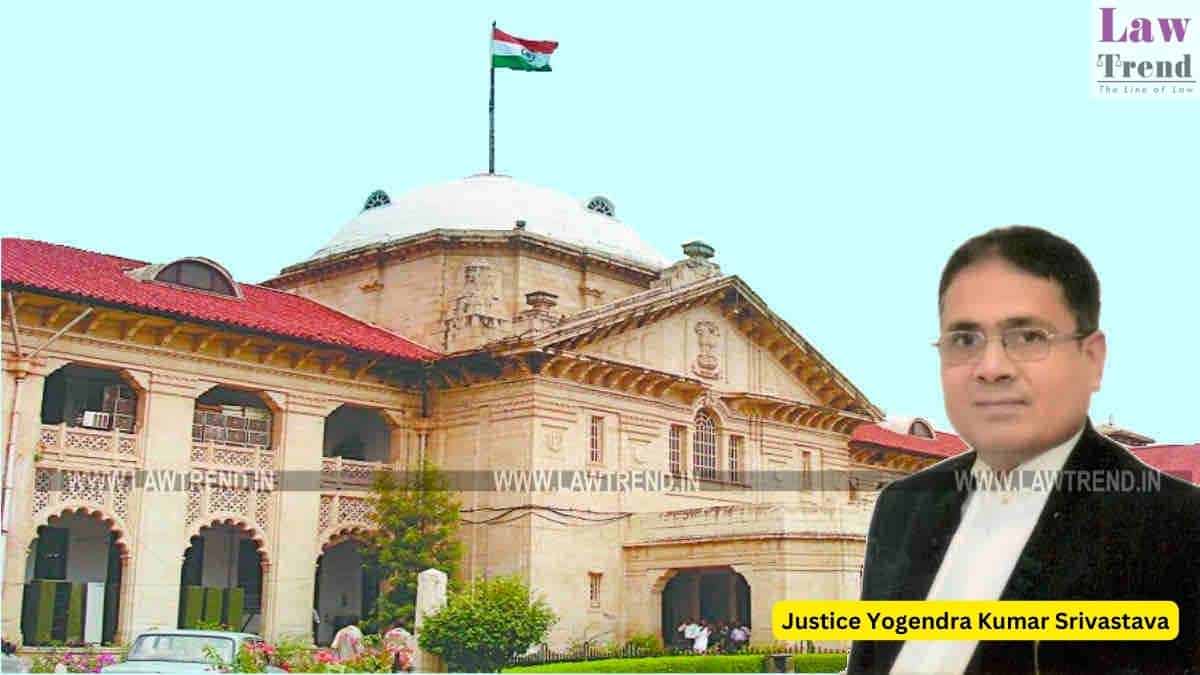
In a significant ruling clarifying procedural law, the High Court of Judicature at Allahabad has held that the mere fact that a civil suit has reached the stage of final arguments after the conclusion of evidence does not operate as an absolute prohibition against bringing additional relevant documents on record under Order VII Rule 14(3) of the Code of Civil Procedure, 1908 (CPC). Justice Yogendra Kumar Srivastava set aside an order of the Additional District Judge, Court No. 18, Kanpur Nagar, which had rejected a plaintiff-landlord’s application to introduce a subsequently obtained municipal tax assessment document. The Court underscored that procedural law is designed to facilitate substantive justice rather than defeat it, provided the delay is bona fide, the document is relevant to an existing plea, and adequate safeguards are extended to the opposite party.
Background of the Case
The dispute originated from S.C.C. Civil Suit No. 46 of 2019 (initially instituted in 2014 as a regular civil suit), titled Mona v. Gyanendra, filed by the petitioners-plaintiffs seeking eviction of the respondents-defendants from disputed premises alongside recovery of rent and damages. Pursuant to an amendment allowed on August 21, 2023, the plaintiffs incorporated paragraphs 2-A and 4-A into the plaint, asserting that the disputed construction was raised after April 26, 1985, thereby exempting the premises from the provisions of the U.P. Urban Buildings (Regulation of Letting, Rent and Eviction) Act, 1972 (U.P. Act No. 13 of 1972).
The plaintiffs concluded their evidence on July 3, 2025, and the defendants concluded theirs on January 20, 2026, after which the suit was listed for arguments. During the pendency, the plaintiffs sought from the Municipal Corporation, Kanpur, the first tax assessment of the premises. This document was ultimately obtained on February 13, 2026, following a complaint on the Government portal.
On February 21, 2026, the plaintiffs moved Application Paper No. 158-C under Order VII Rule 14(3) read with Section 151 CPC to place on record the first tax assessment, the portal complaint copy, and a sanctioned plan. The trial court rejected the application on April 2, 2026, holding that the documents were introduced years after filing, after evidence had closed, and during final arguments, while time-bound directions for expeditious disposal had been issued by the High Court. Aggrieved, the plaintiffs approached the High Court under Article 227 of the Constitution of India.
Arguments of the Parties
Counsel for the petitioners argued that Order VII Rule 14(3) CPC explicitly contemplates the reception of documents at a subsequent stage with the leave of the court. It was urged that the first tax assessment went to the root of the suit—namely, the date of construction and the statutory protection under U.P. Act No. 13 of 1972. The counsel submitted that the document was not deliberately withheld, could not have been produced earlier as it was received from the civic body only on February 13, 2026, and supported an existing plea without altering the cause of action. Furthermore, time-bound disposal directions could not override procedural fairness or deprive the court of crucial evidence.
Opposing the petition, counsel for the respondents contended that the trial court committed no jurisdictional error. It was submitted that both parties had closed their evidence and the plaintiffs were merely attempting to reopen the evidentiary stage and delay proceedings pending since 2014. The respondents argued that no convincing justification was provided for the delay, that some documents (such as the map) were already on record, and that the remaining documents were photocopies whose evidentiary value and admissibility were questionable.
The Court’s Analysis and Legal Principles
Justice Dr. Yogendra Kumar Srivastava observed that Order VII Rule 14(3) CPC does not impose an absolute ban on producing documents after the conclusion of evidence. Referring to the High Court’s earlier decision in Mohammad Arif v. Laiq Ahmad (2026), the Bench reiterated the three-fold test governing judicial discretion under Order VII Rule 14(3):
“15. The discretion under Order VII Rule 14(3) CPC is required to be exercised judiciously by applying a three fold test: (i) whether the omission to file the document earlier was bona fide, (ii) whether the document is relevant and necessary for effective adjudication of the dispute; and (iii) whether permitting its production at a later stage would occasion serious prejudice or irreparable injustice to the defendant.”
Citing the Supreme Court judgments in Sangram Singh v. Election Tribunal, Kotah and State of Punjab v. Shamlal Murari, the Court held that procedural rules exist to advance justice and must align with natural justice principles. Although reaching the stage of final arguments warrants stricter scrutiny, it cannot convert judicial discretion into a total prohibition.
The Court articulated comprehensive guidelines for exercising discretion under Order VII Rule 14(3) CPC:
- Whether the document was previously within the knowledge or possession of the party.
- If unavailable earlier despite due diligence, subsequent availability is a material factor.
- Documents supporting existing pleadings stand on a different footing than those altering the case.
- Late-stage requests require closer scrutiny, but the stage of arguments alone does not bar production.
- Mere inconvenience or the need for additional proceedings does not constitute legal prejudice if it can be remedied with procedural safeguards.
- The threshold reception of a document is distinct from its final proof, admissibility, and evidentiary value.
- Multiple documents must be evaluated individually rather than rejected en masse.
- The court may impose safeguards, including costs, witness recall, or limited consequential evidence within fixed timelines.
Addressing Section 151 CPC, the Court cited Padam Sen v. State of Uttar Pradesh, reaffirming that inherent powers cannot circumvent or enlarge express statutory provisions but merely act in aid of them. The Bench also emphasized that directives for expeditious disposal must harmonize with procedural fairness rather than exclude vital evidence.
Applying these principles, the High Court observed that the first tax assessment had been procured from a public authority only on February 13, 2026, was not deliberately withheld, and directly pertained to the existing plea under paragraphs 2-A and 4-A regarding the building’s construction date. The Court ruled that rejecting the entire application because one document (the map) was already on record, or because others were photocopies, was improper, as questions of admissibility and proof remain open for determination during trial.
Decision of the Court
The High Court allowed the petition and set aside the Additional District Judge’s order dated April 2, 2026. Application Paper No. 158-C was allowed to the extent of documents that were not previously available, subject to proof and admissibility in accordance with law. Documents already on record need not be produced afresh.
To ensure fairness, the High Court directed the trial court to provide the respondents a reasonable opportunity to inspect and respond to the documents, and—if permissible in law—to seek recall of witnesses for further cross-examination or lead consequential rebuttal evidence. The court below was instructed to regulate these consequential proceedings strictly in a time-bound manner to avoid unnecessary delay, and thereafter decide the suit expeditiously in accordance with earlier binding directions.
Case Title: Km. Mona Shukla and 4 others Versus Gyanendra Katiyar
Case No.: Matters Under Article 227 No. 6369 of 2026
Bench: Justice Yogendra Kumar Srivastava
Date: September 15, 2026




