

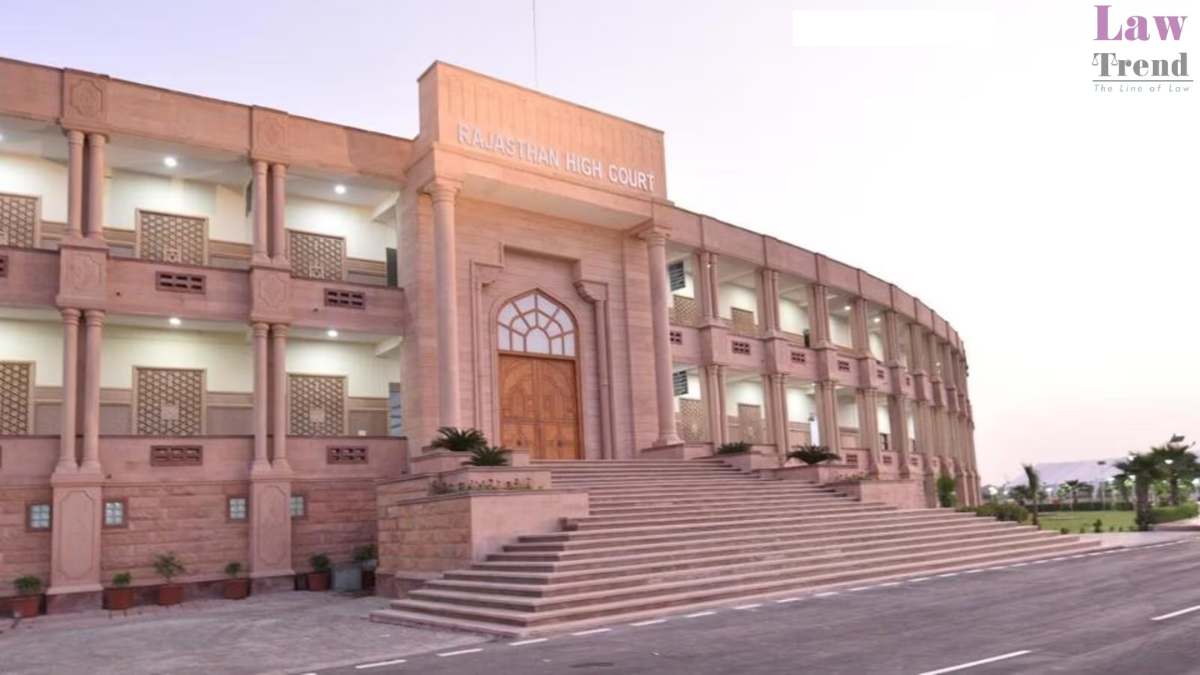
The Rajasthan High Court has said that providing adequate infrastructure to courts is a constitutional necessity and cannot depend on executive discretion or government favour, while directing the State to expedite restoration of its Jodhpur principal seat and process plans for additional courtrooms.
A Division Bench of Chief Justice Sanjay K Agrawal and Justice Vinit Kumar Mathur made the observations in suo motu proceedings concerning the structural condition of the High Court building, including its approximately 21-metre-high Central Dome.
The court said the judiciary, as one of the three essential pillars of constitutional democracy, cannot be treated like an ordinary government department when infrastructure and administrative facilities are provided. Administration of justice, it said, is an essential sovereign and constitutional function of the State.
The Bench further said adequate judicial infrastructure flows from the constitutional obligation to secure effective access to justice and meaningful protection of rights guaranteed under Article 21 of the Constitution.
Financial Constraints Cannot Justify Inadequate Court Facilities
Addressing the question of resources, the High Court said financial considerations may be relevant in public administration but cannot justify the continued denial or inadequate provision of basic facilities required for judicial functions and access to justice.
Judicial infrastructure, the Bench said, should not be regarded simply as government expenditure granted to the judiciary at the executive’s discretion. Instead, it must be treated as an essential constitutional requirement for the proper functioning of the justice-delivery system.
The court also stressed that the dignity, independence and effectiveness of the judiciary require adequate financial, infrastructural and administrative resources so that courts can efficiently perform their constitutional responsibilities and citizens can obtain timely and meaningful justice.
The Bench referred to the Supreme Court’s repeated emphasis, particularly in proceedings relating to the All India Judges’ Association, on providing the judiciary with adequate infrastructure, courtrooms, residential facilities, proper working conditions, staff and other administrative resources.
IIT Bombay Found Building Repairable
The suo motu proceedings arose from concerns over the condition of the High Court’s principal seat at Jodhpur. The court first took cognisance of the issue on August 10 and considered it again on August 24.
On August 10, the High Court recorded an opinion from IIT Bombay that the approximately 21-metre-high Central Dome was in a state of imminent collapse and could fall at any moment, posing a serious danger to people on the premises.
The State informed the court on September 15 that IIT Bombay’s final report dated September 3 had concluded that the building could be repaired. According to the report, the recommended rehabilitation could extend the structure’s residual life by at least 20 years, provided the work is properly executed with appropriate materials and followed by adequate maintenance.
Nearly 40 per cent of the building requires urgent attention, while the remaining portion also needs repairs and preventive measures.
The rehabilitation is proposed in phases covering 11,000 square metres, 12,000 square metres and 10,000 square metres. Preventive maintenance is also proposed over 33,000 square metres. The entire exercise is expected to take 24 months.
Rs 117.65 Crore Estimated For Rehabilitation
The estimated cost of the rehabilitation project is Rs 117.65 crore. Of this, Rs 27.41 crore and Rs 30.24 crore have been sanctioned for the first and second phases respectively, while sanction of Rs 60 crore for the third phase is under process.
The State also informed the court about administrative measures taken to supervise the work. Two nodal officers have been appointed, while eight officers have been assigned inspections at different intervals.
Four Public Works Department officers have been transferred for continuous supervision of the project. A dedicated team, including a superintending engineer and an executive engineer, was constituted on September 11.
The State further said chargesheets seeking imposition of major penalties had been issued against public servants. The enquiries are expected to conclude within one or two months after the officials concerned are given an opportunity of hearing.
Proposal For 50 Additional Courtrooms
The High Court had also sought Rs 1.5 crore for preparing a detailed project report for an extended building containing 50 courtrooms, with provision to add another 10 courtrooms.
Financial sanction for preparing the detailed project report was granted on September 11.
The Bench directed the State to take immediate steps for completing restoration of the existing building and to process the proposal relating to the additional courtrooms.
The suo motu proceedings will next be heard on October 5.




