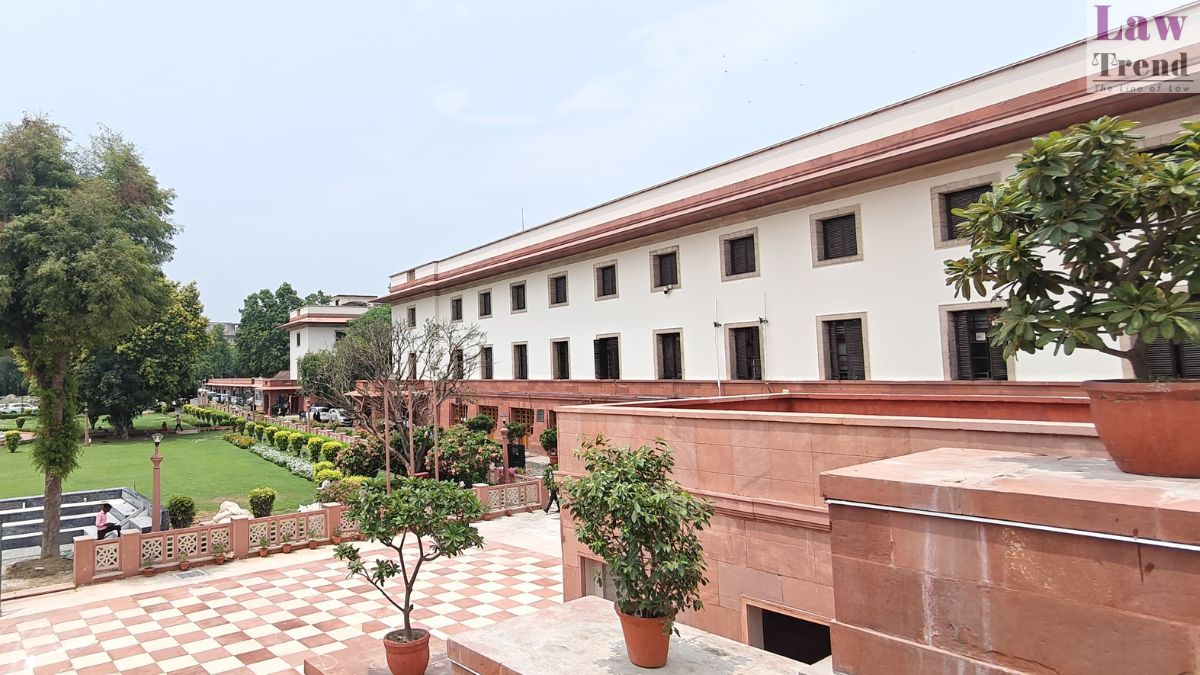
A Supreme Court bench comprising Justice Ujjal Bhuyan and Justice Manoj Misra has held that government orders modifying or invalidating open university foundation courses and distance education degrees cannot be applied retrospectively to deny promotion benefits to employees who acquired their qualifications under the prevailing norms. Setting aside the judgment of a Division Bench and a Review Bench of the Madras High Court, the apex court restored the order of a Single Judge and directed the Government of Tamil Nadu to consider the appellant, R.J. Gajendra Kumar, for promotion to the post of Assistant Director of Tourism in accordance with law.
Background of the Case
The appellant completed his SSLC (10th standard) in 1982 and finished the 11th standard during 1982-83. Following the death of his father, who worked as Receptionist Grade I in the Tourism Department, the appellant was appointed as Junior Assistant on compassionate grounds on May 25, 1983.
With permission from the Director of Tourism, the appellant enrolled in and completed the second-year foundation course from Madurai Kamaraj Open University in April 1984. He subsequently obtained a B.Com degree through distance education from the same university in October 1987, alongside postgraduate diplomas and an M.Com degree in later years.
The appellant was appointed as Receptionist Grade II on July 25, 1990, and was temporarily promoted as Tourist Officer in 2011, joining his posting in New Delhi on August 5, 2011. His service as Tourist Officer was regularized with effect from August 5, 2011, vide G.O. Ms. No. 224 dated October 16, 2017.
After serving nearly six years as Tourist Officer, the appellant submitted representations seeking promotion to the post of Assistant Director of Tourism. Following a direction from the High Court in a writ petition, the Additional Chief Secretary to the Government of Tamil Nadu issued an order on July 22, 2020, rejecting his request. The government held that the appellant did not possess a degree in the regular 10+2+3 pattern as prescribed under G.O. Ms. No. 107 dated August 18, 2009, letter dated December 3, 2010, G.O. Ms. No. 144 dated November 20, 2017, and Section 25 of the Tamil Nadu Government Servants (Conditions of Service) Act, 2016, and was therefore unqualified to hold even the feeder post of Tourist Officer.
The appellant challenged this rejection before the High Court. A Single Judge allowed the writ petition on August 16, 2021, setting aside the rejection order. However, on appeal by the State, a Division Bench on June 6, 2023, reversed the Single Judge’s judgment, holding that a 10+2+3 pattern degree was mandatory. Later, on November 18, 2024, the Review Bench dismissed the appellant’s review application, holding that while his foundation course was acceptable as equivalent to +2, his distance education degree rendered him ineligible for promotion. The appellant then appealed to the Supreme Court.
Arguments of the Parties
The senior counsel for the appellant argued that the Review Bench erred by introducing a new ground regarding distance education that was not raised before the Division Bench. It was submitted that the core issue before the court was the appellant’s eligibility for promotion to Assistant Director of Tourism, not his eligibility for the feeder post of Tourist Officer, which he had held without challenge for nearly 15 years. The appellant relied on the Madras High Court judgment in P. Thavam v. State of Tamil Nadu, which held that the cut-off date for the invalidity of foundation courses under G.O. Ms. No. 144 is its date of notification, November 20, 2017.
Conversely, counsel for the respondents contended that the 10+2+3 education pattern was introduced following the decision of the Supreme Court in Annamalai University v. Secretary to Government, Information and Tourism Department, leading to G.O. Ms. No. 107 dated August 18, 2009. The respondents argued that G.O. Ms. No. 144 dated November 20, 2017, was merely clarificatory of G.O. Ms. No. 107 and not prospective. Furthermore, the State argued that regularizing temporary promotion via G.O. Ms. No. 224 was an administrative act to ensure service continuity and did not operate as a relaxation of statutory eligibility requirements.
Court’s Analysis
The Supreme Court observed that the High Court had diverted its focus to the appellant’s eligibility to hold the feeder post of Tourist Officer rather than evaluating his eligibility for promotion to Assistant Director of Tourism. The Court highlighted that nobody had challenged his appointment or service as Tourist Officer for over 15 years.
Examining the regulatory history, the apex court noted that G.O. Ms. No. 528 dated May 18, 1985, had explicitly recognized the two-year foundation course of Madurai Kamaraj Open University as equivalent to the higher secondary (+2) course. Subsequent orders, including G.O. Ms. No. 180 dated September 11, 2000, and G.O. Ms. No. 217 dated September 8, 2007, recognized open university degrees at par with regular stream degrees for public employment.
The Court analysed the Tamil Nadu Government Servants (Conditions of Service) Act, 2016, noting that while Section 25 Explanation 1(b) prescribes a 10+2+3 pattern degree, Section 54 contains a saving clause protecting the service conditions of persons who were members of any service prior to September 14, 2016. The Court further observed that Section 25 nowhere mandates that a degree must be obtained through regular physical attendance rather than distance education mode.
Addressing the prospective applicability of statutory rules, the Supreme Court referred to its ruling in P. Mahendran v. State of Karnataka, reiterating:
every statute or statutory rule is prospective unless it is expressly or by necessary implication made to have retrospective effect. Unless there are words in the statute or in the rules showing the intention to affect existing rights, the rule must be held to be prospective.
The Court also referred to Annamalai University v. Secretary to Government, Information and Tourism Department, noting that while University Grants Commission regulations prevail over Open University regulations, the factual outcome in that case upheld the appointment made under the prevailing norms.
On the question of academic equivalence, the Court cited Chandrakala Trivedi v. State of Rajasthan, emphasizing:
The word “equivalent” must be given a reasonable meaning. By using the expression “equivalent” one means that there are some degrees of flexibility or adjustment which do not lower the stated requirement. There has to be some difference between what is equivalent and what is exact. Apart from that, after a person is provisionally selected, a certain degree of reasonable expectation of the selection being continued also comes into existence.
The Supreme Court fully endorsed the ruling of the Madras High Court in P. Thavam v. State of Tamil Nadu, quoting its key observation:
This Court is of the considered opinion that the government had recognized the pre-foundation course vide G.O.Ms. No. 528, P and AR Department, dated 18.05.1985 and the said G.O. was in existence from 1985 onwards, subsequently there was a challenge to the open university degree and the High Court has held open university degree is not valid and pre-foundation course as not valid. When it was considered valid for the past twenty four years, then it was declared as invalid, the persons who are affected from this shift/change of qualification ought to be protected.
Critiquing the series of administrative shifts, the Supreme Court observed:
A candidate who has obtained the requisite qualification based on the prevailing norms i.e. GO Ms No. 528 dated 18.05.1985 which continued to remain in force for more than 24 years and finally came to be reversed after 32 years cannot be made ineligible by resorting to the maze of Government orders.
The Court added:
It needs no reiteration that interpretation of such Government orders which have the effect of modifying and amending previous Government orders has to be done in a reasonable manner to avoid unnecessary hardship to those who have no control over the subject matter.
Decision
The Supreme Court held that the Division Bench and Review Bench of the High Court fell in grave error in reversing the Single Judge’s judgment. Consequently, the Court set aside the Division Bench judgment dated June 6, 2023, and the Review Bench order dated November 18, 2024, thereby restoring the Single Judge’s order dated August 16, 2021.
The Court affirmed that the appellant fulfills the eligibility requirements for promotion to Assistant Director of Tourism—comprising a recognized degree, a pass in the accounts test for executive officers, and the requisite service experience—and directed that his case be considered for promotion in accordance with law. The Civil Appeals were allowed with no order as to costs.
Case Title: R.J. Gajendra Kumar v. Government of Tamil Nadu and Anr.
Case No.: SLP (Civil) Nos. 23378-79 of 2025
Bench: Justice Ujjal Bhuyan and Justice Manoj Misra
Date: August 22, 2026