

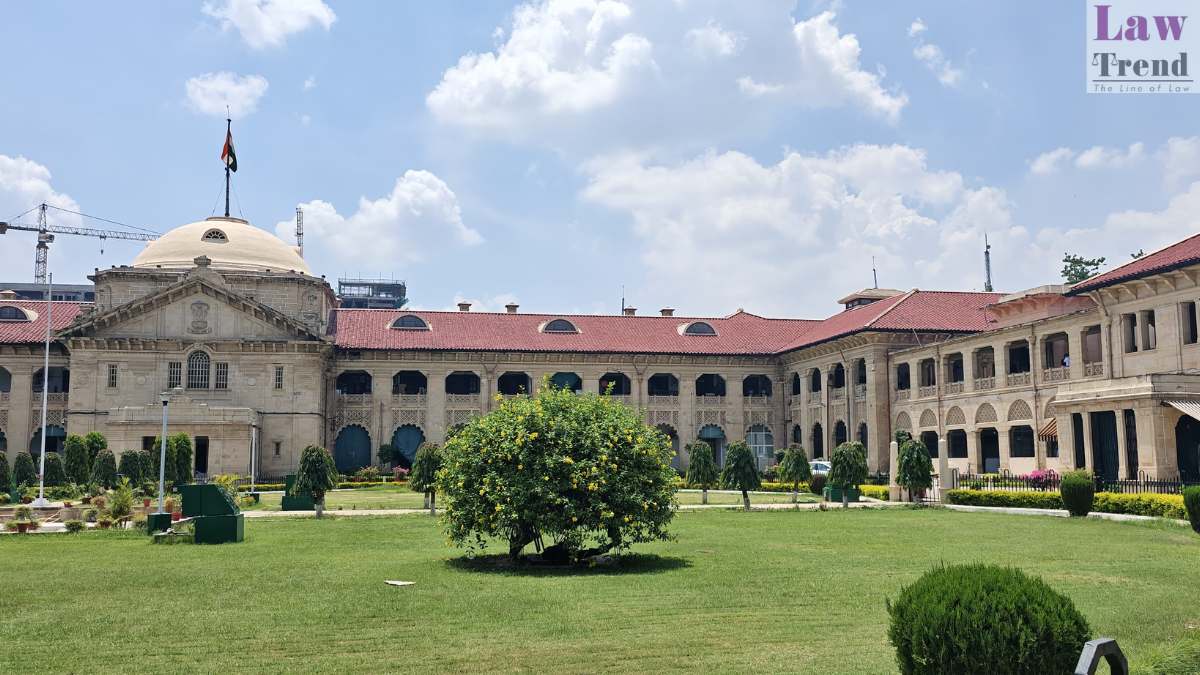
The Allahabad High Court has affirmed that public employment is a constitutional trust and ruled that state salaries drawn through interim judicial orders are fully recoverable if the underlying job appointment is ultimately found unlawful.
A division bench comprising Chief Justice Arun Bhansali and Justice Kshitij Shailendra delivered the judgment on August 7 while dismissing a special appeal filed by Subhash Chandra Tyagi. Tyagi had challenged his removal from his post as an assistant teacher at Shastri Smarak Inter College in Ahmad Shahpur, Padra, located in Uttar Pradesh’s Baghpat district. The bench also upheld a single judge order requiring Tyagi to pay Rs 2.16 lakh, which will be collected as arrears of land revenue if he fails to deposit the sum.
Constitutional Principles and Restitution
In its ruling, the court stated that judicial bodies cannot allow fraudulent or improper appointments to dilute the integrity of public hiring. The bench observed that appointments made in violation of legal norms directly breach constitutional provisions under Articles 14 and 16, which mandate equality, fairness, and transparency in public appointments.
Applying the doctrine of restitution, the division bench clarified that interim court orders do not confer permanent or independent rights upon a litigant. The judges noted that when an underlying writ petition is dismissed, any financial benefits received under temporary protection lose all legal basis and must be returned to the state exchequer. The court also rejected Tyagi’s attempt to claim protection under Section 33-F of the Uttar Pradesh Secondary Education Services Selection Board Act, 1982.
Origins of the Dispute
The controversy dates back to December 1992, when Tyagi was appointed against an alleged short-term vacancy created after another teacher, Ved Prakash Harit, reportedly took leave without pay. When Tyagi’s salary was subsequently withheld, he filed a writ petition in 1993 and obtained an interim court order allowing him to remain in service while the district inspector of schools reviewed the matter.
Following the interim order, the district inspector of schools approved Tyagi’s appointment on May 23, 1995, enabling him to draw a state-funded salary for years while the primary lawsuit remained pending.
Discovery of Fictitious Vacancy
The legal basis of the appointment collapsed when the original petition was finally taken up for hearing in 2010 and 2011. State authorities informed the high court that the educational institution had no documentation confirming Harit had ever taken unpaid leave, nor did his name appear on official salary registers or payroll records.
The division bench pointed out that the district inspector of schools at the time had approved Tyagi’s post without checking whether Harit actually existed or was merely an imaginary figure fabricated to create a fake vacancy. State submissions revealed that the official who granted the approval, S. S. Rawat, was later penalized in departmental proceedings for facilitating 96 fraudulent appointments. Rawat suffered a permanent 50 percent pension reduction and the forfeiture of his gratuity.
Final Dismissal and Termination
During the 2010 proceedings, Tyagi did not submit a response to the state government’s supplementary counter affidavit detailing the lack of records, and his legal counsel told the court that the original petition was no longer relevant. Consequently, the court dismissed the petition and vacated the interim order.
Following the dismissal, the district inspector of schools and the authorized controller issued formal termination orders on January 19 and 20, 2011. Tyagi subsequently challenged his removal, but a single judge dismissed his plea and ordered the recovery of Rs 2.16 lakh in costs, a decision now fully upheld by the division bench.




