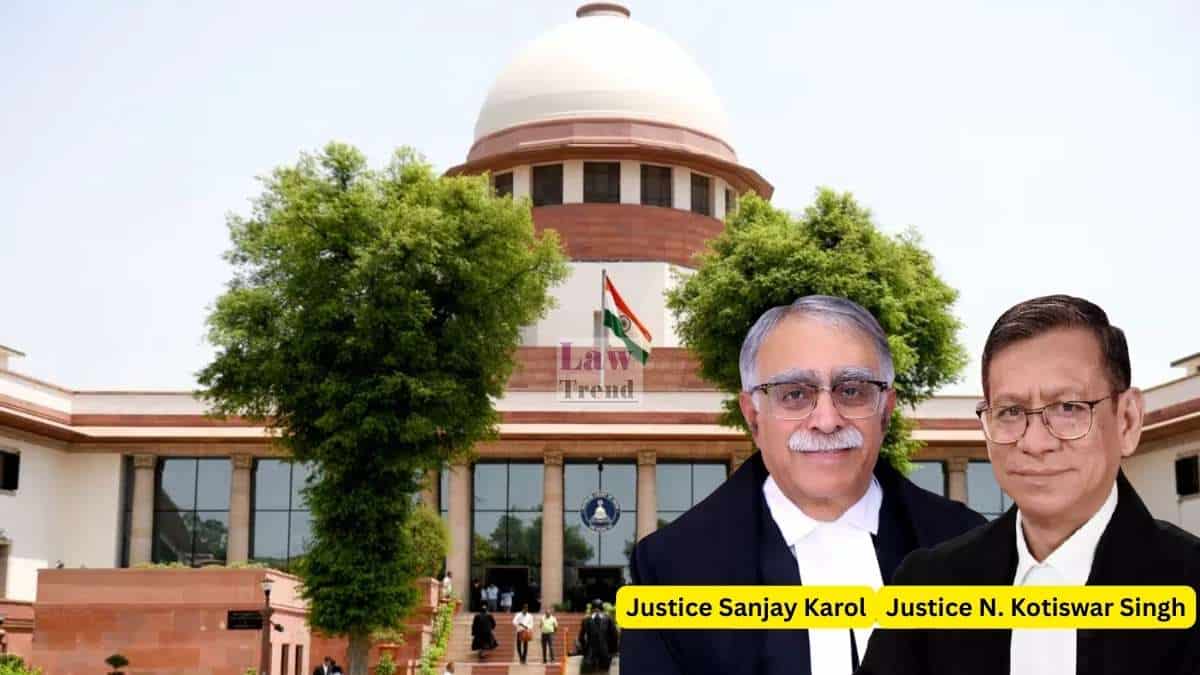
The Supreme Court of India, comprising a bench of Justice Sanjay Karol and Justice N. Kotiswar Singh, has held that an order of acquittal affirmed by a High Court cannot be overturned under Article 136 of the Constitution of India merely because another view on the evidence is possible. Dismissing an appeal challenging the concurrent acquittal of an accused in a 1998 murder case, the Court ruled that an acquittal reinforces the presumption of innocence and cannot be interfered with unless it suffers from manifest illegality, perversity, or gross misappreciation of evidence.
Factual Background
The case stems from an incident on October 11, 1998, at approximately 4:00 p.m. near a paddy field in Soharpur Village, Bihar. According to the prosecution, the informant Raju Kumar, his elder brother Vinod Prasad (the deceased), the appellant Sanjay Kumar (son of the deceased), and other villagers were returning from Yogipur market after purchasing household items. They were allegedly intercepted and surrounded by Respondent No. 2 (Nakul Prasad @ Nakul Yadav) and other co-accused persons.
It was alleged that the accused Anugrah Prasad fired a bullet striking the deceased on the forehead, Bablu Prasad fired hitting him on the left temple, Rajdev Prasad fired hitting him at the back of the head, and Nakul Prasad fired a rifle shot striking the deceased on the right side of his chin/beard. Vinod Prasad died on the spot.
The fardbeyan was recorded the same night, leading to the registration of Hilsa P.S. Case No. 373 of 1998 under Sections 302/34 of the Indian Penal Code and Section 27 of the Arms Act. The case of Respondent No. 2 was later split up into Sessions Trial No. 596 of 2003.
On December 24, 2024, the Additional Sessions Judge-III, Hilsa, District Nalanda, acquitted Respondent No. 2. The appellant challenged the verdict before the High Court of Judicature at Patna, which dismissed the appeal on September 11, 2025. The appellant then approached the Supreme Court.
Arguments of the Parties
The appellant argued that eyewitnesses PW-1, PW-2, and PW-4 consistently attributed the fatal gunshot to Respondent No. 2, specifically alleging that he fired at the chin/beard of the deceased. It was contended that Dr. Awadesh Kumar Singh (PW-6) corroborated this account by recording a firearm entry wound on the right side of the chin with inverted margins and blackening. The appellant further argued that related witnesses are natural witnesses whose testimony cannot be discarded merely due to their relationship with the deceased, and that the High Court erred in mechanically affirming the acquittal.
The State supported the appellant, highlighting Respondent No. 2’s alleged criminal antecedents and contending that the non-examination of independent witnesses was not fatal given the consistent ocular accounts of PW-1, PW-2, and PW-4.
Conversely, counsel for Respondent No. 2 argued that the Supreme Court’s scope of interference against concurrent acquittals under Article 136 is extremely narrow. It was submitted that the FIR alleged four distinct gunshot injuries, whereas the post-mortem report established only three firearm entry wounds. Respondent No. 2 further pointed out that out of five independent chargesheet witnesses, two turned hostile and three were withheld by the prosecution, leaving the case supported solely by interested and related witnesses.
The Court’s Analysis
Addressing the scope of interference with an acquittal, the Supreme Court reiterated the settled principles laid down in Kali Ram v. State of Himachal Pradesh, Ghurey Lal v. State of Uttar Pradesh, Chandrappa v. State of Karnataka, and Mrinal Das v. State of Tripura. The Court stressed that an order of acquittal strengthens the presumption of innocence.
Quoting Kali Ram v. State of Himachal Pradesh, the Court observed:
“if two views are possible on the evidence adduced in the case, one pointing to the guilt of the accused and the other to his innocence, the view which is favourable to the accused should be adopted.”
Examining the evidence of related witnesses, the Court referenced Dalip Singh v. State of Punjab, noting that while testimony cannot be rejected solely due to family relationship, it mandates careful scrutiny. Where ocular accounts conflict with medical findings and independent witnesses fail to corroborate the narrative, courts must exercise caution.
On the discrepancy between the ocular version and medical evidence, the Court evaluated the High Court’s findings. The High Court had observed:
“This clear mismatch between the medical evidence and the version in the F.I.R. weakens the prosecution case.”
The Supreme Court rejected the appellant’s argument that matching one specific injury (the chin wound) was sufficient to convict Respondent No. 2. The Court reasoned that criminal convictions cannot be founded on an isolated matching circumstance separated from remaining inconsistencies in the prosecution’s story. While the eyewitnesses alleged four separate gunshots by four named accused persons, the post-mortem report revealed only three firearm entry tracks. Specifically, the temporal injury assigned to co-accused Bablu was medically determined to be an exit wound corresponding to the forehead shot, directly contradicting the detailed ocular claims.
Regarding witness testimony, the Supreme Court highlighted that the prosecution examined only two independent witnesses (PW-3 and PW-5), both of whom turned hostile, while remaining independent witnesses were withheld without explanation. The Court noted that while non-examination of independent witnesses is not always fatal, it becomes significant when ocular and medical evidence conflict.
Addressing the plea of alibi and alleged criminal antecedents of Respondent No. 2, the Court held that the prosecution must stand on its own feet regardless of the strength or weakness of the defence. Extraneous subsequent cases or antecedents cannot be utilized to fill gaps in prosecution evidence or reverse a concurrent acquittal.
The Decision
The Supreme Court concluded that the findings of the Trial Court and Patna High Court were based on a plausible appreciation of evidence and did not suffer from perversity or manifest illegality. Finding no ground to interfere under Article 136 of the Constitution, the Supreme Court dismissed the appeal and affirmed the judgment of acquittal.
Case Details
Case Title: Sanjay Kumar v. The State of Bihar & Anr.
Case No.: Criminal Appeal No. 3316 of 2026
Bench: Justice Sanjay Karol, Justice N. Kotiswar Singh
Date: July 21, 2026