

Magistrate Cannot Reassess Surrogacy Eligibility Certificate While Deciding Parentage Application: Madras High Court
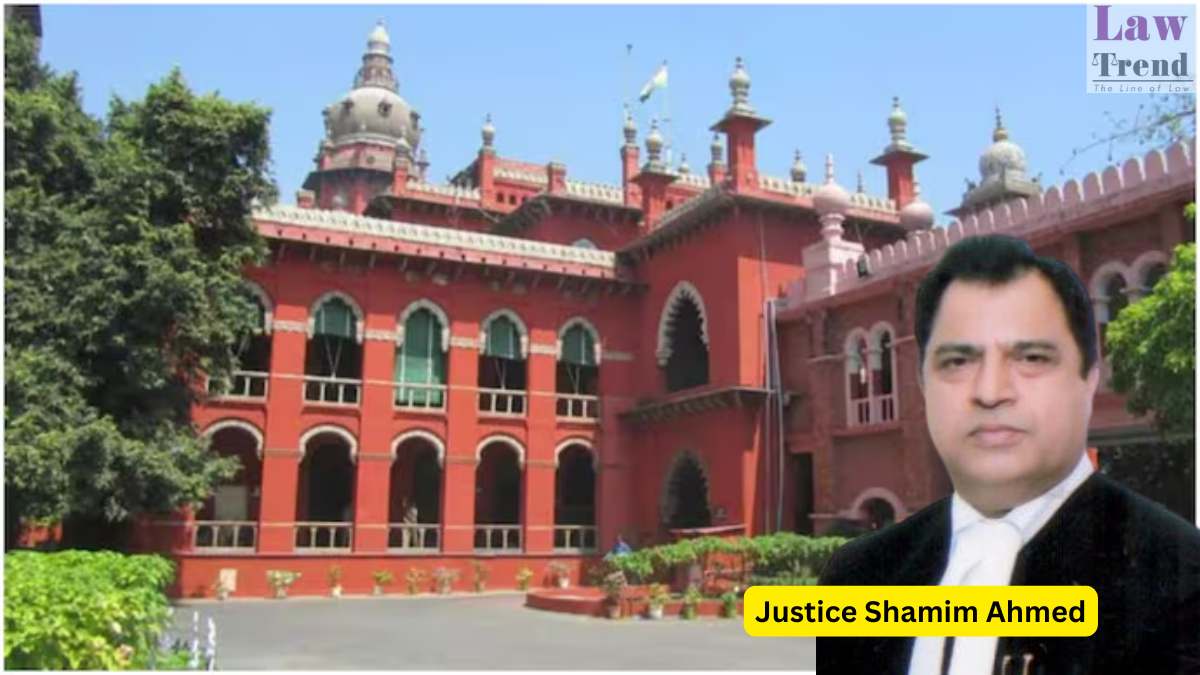

In a landmark ruling clarifying the division of duties under the Surrogacy (Regulation) Act, 2021, the Madras High Court, presided over by Justice Shamim Ahmed, has held that a Judicial Magistrate cannot act as an appellate authority to reassess or invalidate an eligibility certificate issued by an appropriate executive authority while deciding an application for parentage and custody of a surrogate child. Setting aside a lower court order that rejected a childless couple’s surrogacy application on grounds of the mother’s age and the non-examination of the surrogate mother’s husband, the High Court has remanded the matter for an expedited, sensitive re-determination, emphasizing that the beneficial legislation must be interpreted with compassion rather than hyper-technicality.

Background of the Case

The first and second petitioners were married on February 21, 2005, and had a son born on September 21, 2008. Tragically, their only child passed away due to a cardiac arrest on November 6, 2024. Desiring to have another child, the couple faced a medical impediment as the first petitioner suffered from the absence of a uterus, having undergone a total abdominal hysterectomy on October 29, 2024, which rendered her medically incapable of carrying a pregnancy. Consequently, they decided to have a child through altruistic gestational surrogacy.

The couple initiated the procedure at Dharan Hospital in Salem. After scrutinizing their medical records and age-related documents, the Joint Director of Medical and Rural Health Services at Namakkal (the Appropriate Authority) issued them an Eligibility Certificate on May 23, 2025. The third petitioner, a relative of the couple, volunteered to act as the surrogate mother. Along with the consent of her husband, she applied to the Appropriate Authority at Karur, which issued her an Eligibility Certificate on December 22, 2025.

Equipped with these certificates, the petitioners filed an application (Crl.MP.No.258 of 2026) before the Judicial Magistrate No. I, Namakkal, under Section 4(iii)(a)(II) of the Surrogacy (Regulation) Act, 2021, seeking a pre-birth order concerning the parentage and custody of the child to be born.

However, by an order dated March 18, 2026, the Magistrate dismissed the petition on two primary grounds:

  1. Age Ineligibility: The Magistrate calculated that the first petitioner was 50 years, 9 months, and 3 days old at the time of making the application, thereby violating the statutory upper limit of 50 years.
  2. Non-examination of the Husband: The Magistrate held that the failure to examine the husband of the surrogate mother as a party to the proceedings was fatal to the application.

The petitioners subsequently filed a Criminal Revision Case before the Madras High Court to challenge this dismissal.

Arguments of the Parties

The learned counsel representing the petitioners argued that a woman remains aged 50 years until she actually attains her 51st birthday, meaning she continues to stay within the statutory age bracket of “between 23 to 50 years.” They further submitted that the eligibility certificates issued by the Appropriate Authority carry a presumption of validity, and the trial court lacked the jurisdiction to sit as an appellate authority and reassess these executive documents. Additionally, they contended that since the written consent of the surrogate mother’s husband had already been secured and verified by the Appropriate Authority, his physical examination before the Magistrate was completely unnecessary.

READ ALSO  MP HC Directs DGP to Consider the creation of WhatsApp groups for each criminal case for summoning witnesses

The State of Tamil Nadu, represented by its Senior Advocate, supported the validity of the eligibility certificates. The State submitted that the Appropriate Authority had issued the certificates after completing all statutory formalities and that the Surrogacy Act contains no provision requiring the physical examination or deposition of the surrogate mother’s husband before the Magistrate.

The learned Amicus Curiae, Senior Advocate Mr. Hasan Mohamed Jinnah, assisted the court by analyzing the legislative intent behind the Surrogacy (Regulation) Act, 2021. He submitted that the Indian framework seeks to protect surrogate mothers from exploitation, prevent commercialization, and safeguard the welfare of children. He argued that the trial court had exceeded its jurisdiction by acting as an appellate forum and had wrongly decided the case on “surmises and conjectures” rather than adhering to the beneficial and facilitative nature of the legislation.

The Court’s Analysis

To resolve the dispute, the Madras High Court framed and analyzed four key legal questions.

First, the Court examined whether a Magistrate can re-examine the correctness of an eligibility certificate already issued by the Appropriate Authority. Defining the practice of surrogacy, the Court referred to the Supreme Court’s ruling in Baby Manji Yamada vs Union of India, quoting:

“The word “surrogate”, from Latin “subrogare”, means “appointed to act in the place of”. The intended parent(s) is the individual or couple who intends to rear the child after its birth.”

The Court observed that the statutory framework divides duties between specialized executive authorities and the judiciary. The Magistrate’s power under Section 4(iii)(a)(II) is strictly confined to passing an order concerning the parentage and custody of the child to protect its interests. The Court held that certificates issued by the Appropriate Authority carry a presumption of validity. Unless shown to be ex-facie illegal, fraudulent, or lacking jurisdiction, the Magistrate has no authority to reassess their merits.

READ ALSO  नौकरी हासिल करने के मकसद से लिया गया पैसा कर्ज नहीं है- मद्रास हाईकोर्ट ने कोर्ट ऑफिसर को रिश्वत लेने का दोषी ठहराया

Second, the Court evaluated whether the non-examination of the surrogate mother’s husband was fatal to the proceedings. It noted that the statutory text of Section 4(iii)(a)(II) only requires the intending couple (or intending woman) and the surrogate mother to initiate parentage proceedings. The husband of the surrogate mother is not required to be a party or to depose. The Court held:

“the Eligibility certificate issued by the Appropriate Authority takes into account the consent of the surrogate mother’s husband and the same is not a factor for re-examination by the Magistrate when he/she is passing an order of parentage and the Act does not mandate examination of surrogate mother’s husband.”

Consequently, the Court deemed the Magistrate’s dismissal on this ground to be perverse and legally unsustainable.

Third, the Court addressed the crucial interpretation of the expression “between 23 to 50 years” under Section 4(iii)(c)(I) of the Act. Relying on the Kerala High Court Division Bench judgment in Rajitha P.V. Vs. Union of India, the Court cited the following observation:

“under Section 4(iii)(c)(l) of the Act of 2021, the eligibility of intending woman to avail of surrogacy services extends throughout the 50th year, ceasing on the day the intending woman turns 51”

Furthermore, the Court referred to the Supreme Court judgments in Prabhu Dayal Sesma Vs. State of Rajasthan and Eerati Laxman Vs. State of AP regarding the legal computation of age, noting:

“In calculating a person’s age, the day of his birth must be counted as a whole day and he attains the specified age on the day preceding, the anniversary of his birthday.”

The Court held that the first petitioner was legally 50 years old and would remain so until her 51st birthday. Additionally, the Court pointed out that alternative medical and astrological records placed on record (including an ossification test, affidavit, and horoscope) showed her age to be 49 years, 11 months, and 24 days at the relevant time. Therefore, the Magistrate’s finding that she exceeded the age limit was completely misconceived.

Fourth, the Court highlighted that the right to reproduction is an essential facet of the Right to Life under Article 21 of the Constitution of India. Pointing to S.Prasanna Vs. M.Jothika, the Court reiterated:

“A petition filed under this Act must not be dealt with as though it is a routine application and Courts must keep in mind that these are matters touching upon one of the deepest aspirations of human life, the desire of childless couples to have a child.”

To guide judicial officers across the state, the High Court established detailed guidelines for Magistrates. It stated that the role under Section 4(iii)(a)(II) is facilitative and child-centric rather than adversarial:

“The role of the Magistrate under Section 4(iii)(a)(II) is confined to ensuring voluntariness, statutory compliance, welfare of the child and legal certainty regarding parentage and custody. The Magistrate is not expected to sit in appeal over findings recorded by the District Medical Board or the Appropriate Authority except where fraud, lack of jurisdiction or patent illegality is apparent on the face of the record.”

The guidelines direct Magistrates to verify basic identity documents, secure mutual undertakings against abandonment and commercial surrogacy, interact briefly with the parties to ensure voluntariness without converting it into a full trial, and decide such applications within a preferred time limit of four weeks.

The Decision

Applying the legal maxim actus curiae neminem gravabit (an act of the court shall prejudice no one), the High Court observed that the trial court’s erroneous rejection and the subsequent delay had caused the petitioners’ legally obtained eligibility certificate to expire on May 22, 2026, before the revision case could be decided.

READ ALSO  Consumer Court Fines Wedding Photographer For Not delivering Wedding Video Within Promised Time

Accordingly, the Madras High Court allowed the Criminal Revision Case and issued the following directives:

  1. The impugned order of the Judicial Magistrate No. I, Namakkal, dated March 18, 2026, was set aside and reversed.
  2. The matter was remanded back to the Judicial Magistrate No. I, Namakkal, for fresh, expeditious consideration in line with the High Court’s guidelines.
  3. The petitioners are directed to apply to the Appropriate Authority within two weeks for an extension of their Eligibility Certificate for the period from May 23, 2026, to May 22, 2027.
  4. The Appropriate Authority is directed to issue the extended certificate within two weeks of receiving the application.
  5. Upon the petitioners filing the extended certificate, the trial court must pass final orders within a strict timeline of four weeks.
  6. The Registrar General of the Madras High Court was requested to circulate a copy of this order to all Principal District Judges across the state for strict compliance.

Case Title: Sri Nandhini Devi @ Srinandhini Devi Saravanan & Ors. Vs. The State of Tamilnadu & Ors.

Case No.: CRL RC No. 950 of 2026
Bench: Justice Shamim Ahmed
Date: 25.06.2026

Law Trend
Law Trendhttps://lawtrend.in/
Legal News Website Providing Latest Judgments of Supreme Court and High Court

Related Articles

Latest Articles

