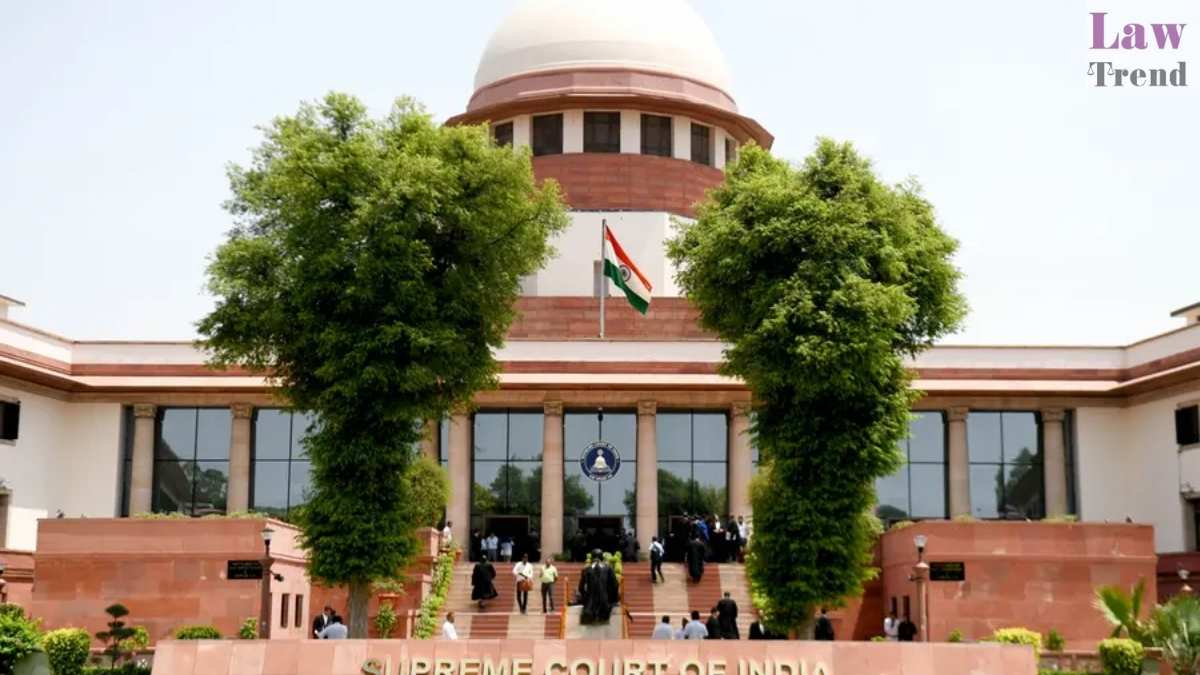
The Supreme Court of India, comprising a Bench of Justice S.V.N. Bhatti and Justice Atul S. Chandurkar, has ruled that a High Court cannot set aside a concurrent decree for a mandatory injunction and compel a plaintiff to accept monetary compensation in the absence of any such prayer or consent. Finding the Punjab and Haryana High Court’s approach of substituting lower court decrees directing the removal of illegal constructions with monetary compensation to be unsustainable, the Supreme Court allowed the appeals and remanded the matter back for fresh adjudication on its merits.
Background of the Case
The dispute originated from two separate civil suits filed by the original plaintiff, Om Parkash, whose legal heirs (Rajat Kumar and others) are the appellants before the Supreme Court.
The first suit, Civil Suit No. 426 of 1996, was filed against S D Adarsh Jain Kanya Mahavidyalaya Sadhaura and others (the respondents). The plaintiff sought a mandatory injunction for the removal of an illegal encroachment in the form of a wall constructed by the respondents on a common open space beyond the plaintiff’s house, along with a permanent injunction to restrain them from raising further construction. The plaintiff contended that this construction interfered with his right to enjoy air and light through ventilators and obstructed water flow through the common path. On February 6, 2006, the Trial Court decreed the suit, directing the defendants to remove the encroachment and restraining them from raising further construction. This decree was upheld by the first Appellate Court on September 5, 2007.
The defendants preferred Regular Second Appeal No. 364 of 2008 before the High Court. On November 25, 2011, the High Court disposed of the appeal by directing the defendants to pay an amount of Rs 10,000 with interest at 12% per annum, being half the construction cost, declaring that the walls would then be treated as “common.”
The second suit, Civil Suit No. 148 of 2000, was filed by the same plaintiff against the same defendants, seeking a mandatory injunction to remove the lintel of a school building erected by the defendants on the wall of the plaintiff’s house. On November 8, 2004, the Trial Court decreed this suit and directed the removal of the lintel. The first Appellate Court upheld this decision on September 5, 2007. Aggrieved, the defendants preferred Regular Second Appeal No. 363 of 2008 before the High Court, which was decided on November 25, 2011, with a similar decree directing the defendants to pay Rs 7,000 with 12% interest for the wall to be treated as “common.”
The legal heirs of the plaintiff challenged these orders. On September 13, 2013, the Supreme Court set aside the High Court’s judgments, holding that modifying decrees without entering into the merits and without framing substantial questions of law was impermissible, and remanded the proceedings.
On remand, the High Court took the view that the construction was raised long ago, no valuation report was on record, and the plaintiff’s claim had not been proved. Observing that the party could be compensated in money, the High Court set aside the decrees of the lower courts and directed the Executing Court to assess the value of the construction, ordering the defendants to deposit this amount for the legal heirs of the plaintiff. Aggrieved by this second reversal, the legal heirs appealed to the Supreme Court once again.
Arguments of the Parties
The appellants, represented by advocate Ms. Sangeeta Kumar, argued that the High Court committed a grave error by reversing the concurrent decrees of the Trial Court and the first Appellate Court on irrelevant considerations.
Despite being served, there was no appearance on behalf of the respondents before the Supreme Court since April 23, 2019.
The Court’s Analysis and Key Observations
The Supreme Court observed that the High Court erred significantly in reversing the well-considered concurrent decrees of the lower courts.
The Court highlighted that the original plaintiff’s suits were filed strictly for mandatory and permanent injunctions. The Trial Court had found that the defendants failed to prove any right, title, or interest over the land where the wall was built, and that they had illegally placed a lintel on the plaintiff’s wall. Crucially, the plaintiff had never prayed for damages or monetary compensation, and his legal heirs did not consent to such an arrangement.
Addressing this substitution of relief, the Supreme Court observed: “In absence of any such relief sought by the original plaintiff, the decree passed in his favour could not have been set aside by the High Court by compelling his legal heirs to accept compensation that was directed to be assessed by a valuer.”
The Bench further added: “The High Court, therefore, could not have undertaken such exercise of seeking to compensate one party at the cost of the other without any prayer being made in that regard.”
The Supreme Court also pointed out the procedural absurdity of the High Court’s directions. By setting aside the decrees of the Trial Court, the High Court had left nothing for the Executing Court to execute. On this point, the Supreme Court noted: “Once the decrees passed by the Trial Court in favour of the plaintiff were set aside, there would be no occasion for the Executing Court to proceed with the execution proceedings since there would be no decree holding the field for being executed.”
The Court explicitly remarked that: “Indeed, the course adopted by the High Court does not find support under Order XXI of the Code of Civil Procedure, 1908.”
Furthermore, the Supreme Court admonished the High Court for repeating the exact same error that had led to its previous 2011 orders being set aside in 2013. The Bench also noted that the High Court’s judgment proceeded on a “factually wrong premise” that the Trial Court had recorded a finding that the wall was a common wall, when in fact no such finding existed.
Finally, the Court observed that while the High Court listed questions that the defendants urged to be framed as substantial questions of law, the impugned order failed to indicate that these questions were actually treated as such. The Supreme Court concluded: “It is, thus, clear that without an available question of law for consideration and also by making out a new prayer, the decrees passed in favour of the original plaintiff have been set aside. The legal heirs of the plaintiff have been required to accept monetary relief for which a prayer was never made. Such course has resulted in miscarriage of justice.”
Decision of the Court
Finding the High Court’s common judgment dated May 2, 2016, unsustainable, the Supreme Court set it aside. Because the Second Appeals had not been adjudicated on their actual merits, the Supreme Court remanded both appeals (RSA Nos. 363 and 364 of 2008) back to the High Court for fresh consideration in accordance with Section 100 of the Code of Civil Procedure, 1908.
Given that the Second Appeals date back to the year 2008, the Supreme Court requested the High Court to consider and decide them expeditiously. The Civil Appeals were allowed with no order as to costs.
Case Details
Case Title: Rajat Kumar and Others v. S D Adarsh Jain Kanya Mahavidyalaya Sadhaura and Others
Case No.: Civil Appeal Nos. 19552-19553 of 2017
Bench: Justice S.V.N. Bhatti and Justice Atul S. Chandurkar
Date: June 19, 2026