

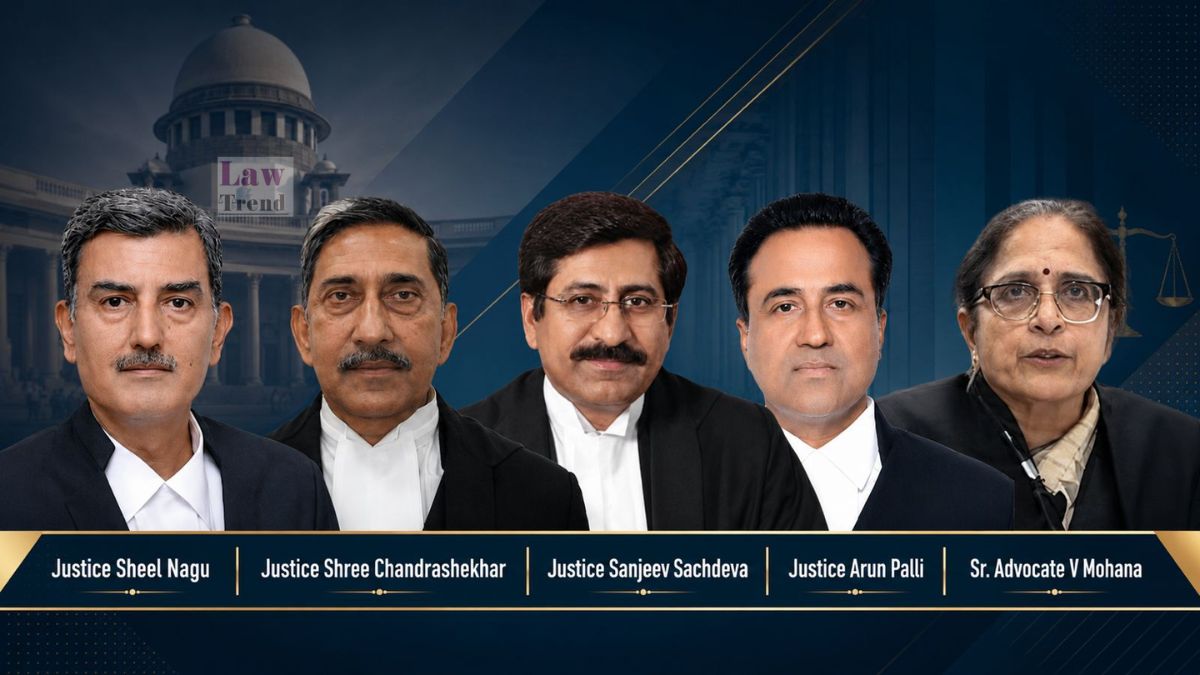
The Supreme Court Collegium’s latest recommendation of five names for appointment as judges of the Supreme Court is significant for filling vacancies in the country’s top court, but it is unlikely to disturb the projected line of succession to the office of the Chief Justice of India.
The Collegium has recommended the elevation of Justice Sheel Nagu, Chief Justice of the Punjab and Haryana High Court; Justice Shree Chandrashekhar, Chief Justice of the Bombay High Court; Justice Sanjeev Sachdeva, Chief Justice of the Madhya Pradesh High Court; Justice Arun Palli, Chief Justice of the Jammu & Kashmir and Ladakh High Court; and Senior Advocate V. Mohana of the Supreme Court Bar. The recommendations, if accepted by the Central Government, would fill five positions in the Supreme Court. Reports on the recommendations also note that V. Mohana would become one of the few lawyers to be directly elevated from the Bar to the Supreme Court.
The development comes shortly after the sanctioned strength of the Supreme Court was increased. The President approved the increase of the Supreme Court’s sanctioned strength to 38 judges, including the Chief Justice of India, after the Union Cabinet decision to raise the number of puisne judges from 33 to 37.
However, the appointments, though important institutionally, are not expected to change the future CJI line. The reason lies in the settled seniority-based convention for appointment of the Chief Justice of India. Under the Memorandum of Procedure, appointment to the office of CJI is ordinarily of the senior-most judge of the Supreme Court considered fit to hold the office.
As per the present Supreme Court roster, the likely CJI line after incumbent CJI Surya Kant, who is due to retire on 9 February 2027, runs through judges who are already members of the Supreme Court and whose retirement dates extend well beyond the likely retirement dates of the newly recommended names. The Supreme Court’s official roster records the dates of appointment and retirement of sitting judges.
On present seniority and retirement calculations, the projected line is likely to move from CJI Surya Kant to Justice Vikram Nath, followed by Justice B.V. Nagarathna, Justice P.S. Narasimha, Justice J.B. Pardiwala, Justice K.V. Viswanathan, Justice Joymalya Bagchi, and Justice Vipul M. Pancholi, subject of course to the usual caveat that the seniority convention continues and no unforeseen vacancy, resignation or departure occurs.
This is where the latest recommendations become important from a succession-analysis perspective. Even if all five recommended names are appointed to the Supreme Court, they would enter the Court below all existing sitting judges in seniority. Therefore, for any of them to become CJI, they would have to remain in office after all judges senior to them have either retired or otherwise demitted office.
That appears practically impossible for the four recommended High Court Chief Justices. Justice Arun Palli, born on 18 September 1964, would retire as a Supreme Court judge on 17 September 2029. Justice Sanjeev Sachdeva, born on 26 December 1964, would retire on 25 December 2029. Justice Sheel Nagu, born on 1 January 1965, would retire on 31 December 2029. Justice Shree Chandrashekhar, born on 25 May 1965, would retire on 24 May 2030.
By contrast, several sitting Supreme Court judges who would be senior to them are due to remain in office beyond those dates. Most crucially, Justice J.B. Pardiwala is due to retire on 11 August 2030, Justice K.V. Viswanathan on 25 May 2031, Justice Joymalya Bagchi on 2 October 2031, and Justice Vipul M. Pancholi on 27 May 2033. Since the newly recommended High Court Chief Justices would retire before these senior sitting judges, they would not reach the top of the seniority list.
The same conclusion applies to Senior Advocate V. Mohana, assuming her date of birth as 27 June 1966. On that basis, if appointed to the Supreme Court, she would retire on 26 June 2031. While she would outlast some current judges, she would still retire before Justice Joymalya Bagchi, who is due to retire in October 2031, and well before Justice Vipul M. Pancholi, who is due to retire in May 2033. Since both would be senior to her in the Supreme Court, her elevation would also not alter the projected CJI line.
In other words, the Collegium’s recommendations may strengthen the working strength of the Supreme Court and fill immediate vacancies, but they do not appear to create a new future CJI candidate among the five recommended names. The appointments would add senior judicial and Bar experience to the Court, but the succession path to the office of CJI remains largely unaffected.
The key reason is structural: Supreme Court seniority is determined from the date of appointment to the Supreme Court, and the retirement age is 65. All five recommended names, if appointed now, would join after the existing judges. Their respective retirement dates do not allow them to overtake the present seniority line.
Therefore, the latest Collegium recommendation, despite being a major appointment development, is unlikely to change the future CJI sequence. On current calculations, none of the five recommended names — Justice Sheel Nagu, Justice Shree Chandrashekhar, Justice Sanjeev Sachdeva, Justice Arun Palli or Senior Advocate V. Mohana — is likely to become Chief Justice of India.




