

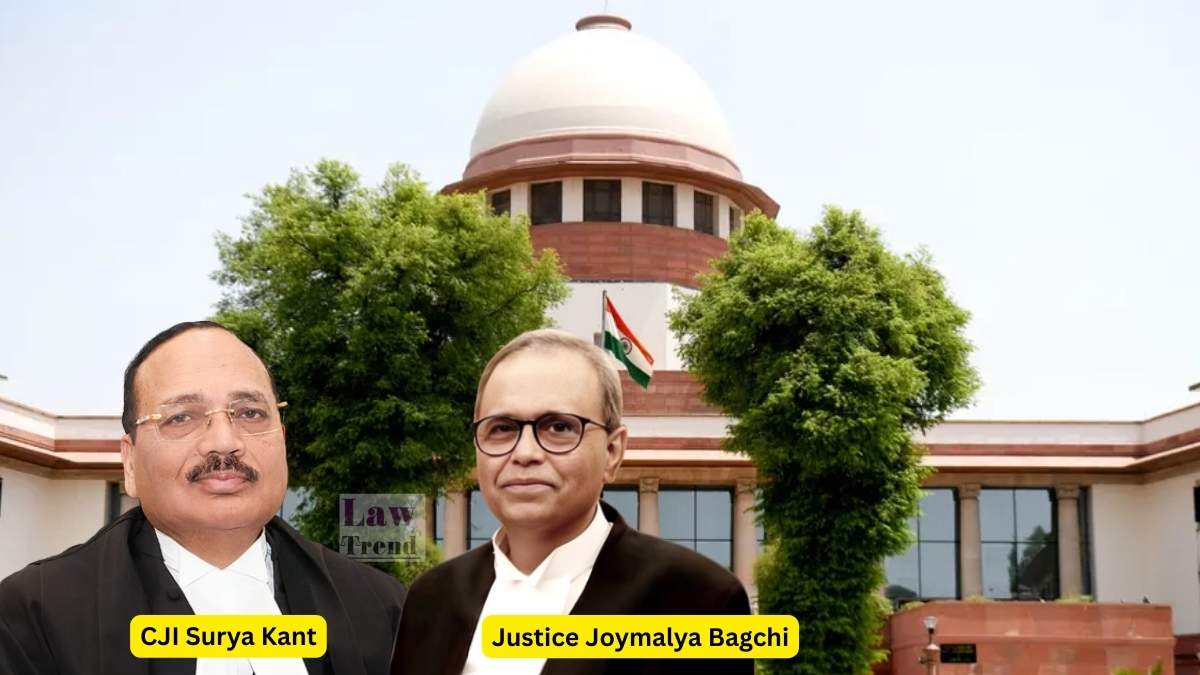
The Supreme Court of India on Wednesday delivered a landmark verdict on electoral integrity, ruling that the Election Commission of India (ECI) acted within its statutory powers during its controversial Special Intensive Revision (SIR) of voter lists, but drawing a firm constitutional line: the poll body has no authority to make final decisions on a voter’s citizenship.
The Division Bench, led by Chief Justice Surya Kant and Justice Joymalya Bagchi, declared the intensive cleanup legally valid, but ordered that all cases of individuals deleted from the rolls due to “doubtful citizenship” be handed over to the Union Home Ministry within four weeks for a rigorous, independent review.
The ‘SIR’ Cleanup Deemed Proportionate and Legal
Pronouncing a highly anticipated judgment that had been reserved since January 29 following extensive hearings, the top court rejected several petitions challenging the legality of the Special Intensive Revision.
The petitioners had argued that the SIR exercise exceeded the ECI’s statutory powers under Article 326 of the Constitution, the Representation of the People Act (RPA), 1950, and its associated rules. Defending the cleanup, the ECI maintained that the intensive revision was vital to eliminate duplicate names, weed out ineligible voters, and preserve the purity of the electoral system.
The Supreme Court sided with the poll body on its authority to conduct the exercise, writing:
“SIR fulfils proportionality and are not manifestely excessive. It was founded by constitutional purpose of restoration of accuracy of electoral rolls. The measures adopted by the ECI can’t be held to be disproportionate.”
The Bench ruled that the ECI did not violate the RPA by initiating the revision in Bihar, declaring that such exercises are “legally tenable” because they ensure the purity of the rolls and aid in the conduct of free and fair elections. Furthermore, the Court clarified that the SIR cannot be deemed invalid or ultra vires simply because it departs from the routine, ordinary revision processes usually deployed by the Commission.
A Hard Boundary on Citizenship Determinations
While the Supreme Court validated the ECI’s administrative authority to clean up its databases, it stripped the poll body of any final say on who is—and is not—a citizen of India.
The Court ruled that any decision regarding citizenship made by the ECI for the purpose of voter registration is purely temporary and must be subjected to thorough administrative oversight by the Central government.
“The determination of citizenship by the election commission for inclusion in voter list is not final as it has to be examined thoroughly by Union government after giving adequate opportunity to the doubtful voter who is deleted from electoral roll,” the Bench observed.
To protect vulnerable voters from administrative disenfranchisement, the Court ordered the ECI to forward the details of all individuals deleted from the electoral rolls due to “doubtful citizenship” to the Union Home Ministry within a strict four-week deadline. The Home Ministry will then conduct a detailed, independent exercise to formally determine their citizenship status, ensuring that every affected individual is given a fair opportunity to prove their case.
Roots of the Dispute and the Voter Burden
The legal battle trace back to June last year, when the ECI launched the SIR exercise in Bihar. The initiative was subsequently expanded to other major states and union territories, including West Bengal, Kerala, and Tamil Nadu, following a preliminary pre-SIR pilot in Punjab that uncovered logical discrepancies among 20% of mapped voters.
The core of the controversy centered on a stringent ECI requirement: any voter whose name did not appear in the 2002 electoral rolls (or the 2003 rolls in certain states) was required to show proof of ancestral linkage to an individual registered on those decades-old records.
Petitioners rushed to the apex court, arguing that this rigid linkage policy threatened to disenfranchise millions of genuine citizens. They pointed out that marginalized and migrant communities, who often lack the administrative documents required to trace their ancestry back over twenty years, were disproportionately vulnerable to being summarily struck off the rolls.
During the course of the hearings, the Supreme Court stepped in with interim directions designed to inject transparency into the process and reduce the burden on voters. While the ECI had initially approved a rigid list of only 11 acceptable documents for verification, the Supreme Court ordered that Aadhaar cards must also be accepted as a valid, additional document to prevent widespread administrative hardship.




