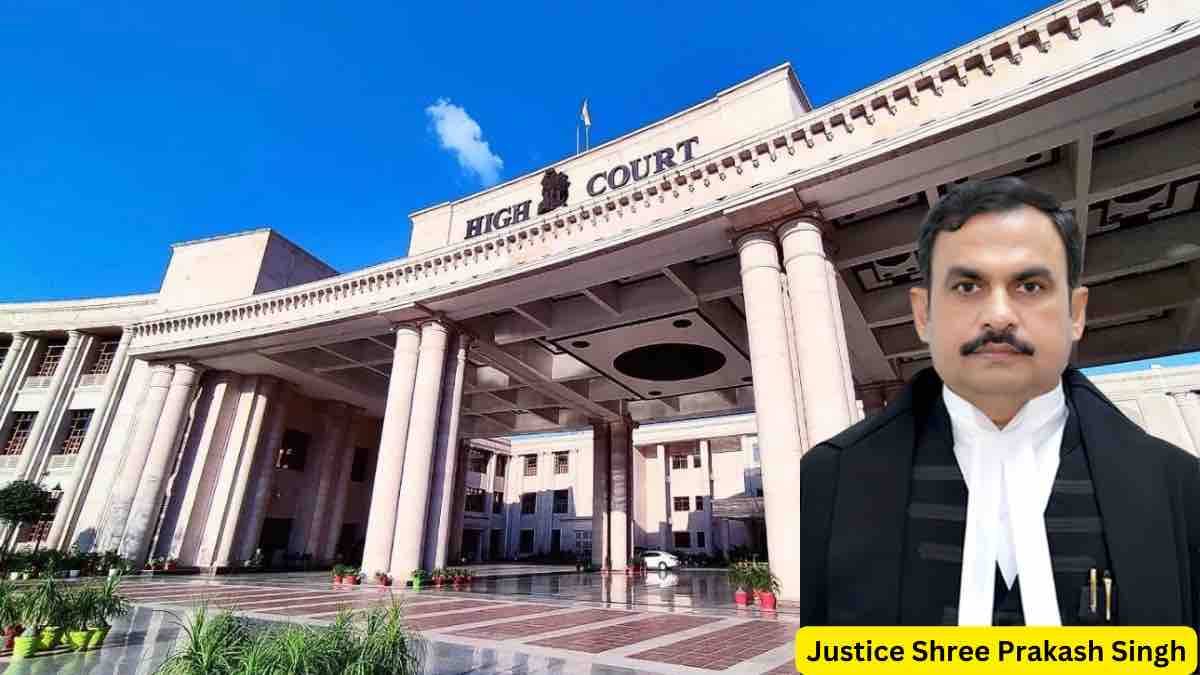
The High Court of Judicature at Allahabad, Lucknow Bench, has quashed an order passed by the District Inspector of Schools (DIOS) approving the suspension of a school Principal, holding that the order stood vitiated as it was passed beyond the 51-day timeframe stipulated by the court without the authority seeking an extension of time.
Delivering the judgment on May 8, 2026, Justice Shree Prakash Singh reconciled two key Supreme Court rulings—Union of India v. Sharvan Kumar (2022) and State of U.P. v. Ram Prakash Singh (2025)—and ruled that while there is no ultimate bar to extending court-mandated time limits, passing an order after the expiry of such a period without making a bona fide attempt to seek an extension from the court renders the proceeding unsustainable.
Background of the Case
The petitioner, Dr. Gyanvati Dixit, was appointed as a Lecturer in Hindi at L.R.N.S. Inter College, Naimisharan, on January 23, 1993. On August 22, 2011, she was appointed as the Principal of Shri Dayanand Rameshwar Prasad Hansrani Arya Kanya Inter College, Sitapur, following the recommendation of the U.P. Secondary Education Service Selection Board.
The dispute began after January 4, 2019, when the DIOS ordered a single-hand operation of the college’s accounts due to rival claims between management groups. Mr. J.P. Mishra was initially appointed as the Authorized Controller, and upon his retirement, Mr. Anil Kumar (Opposite Party No. 5) took over.
Opposite Party No. 5 recommended multiple transfers of teaching staff, reducing the staff strength from a sanctioned 58 posts to 33. Concerned by the depletion of staff, the petitioner wrote letters on July 3, July 25, and August 16, 2024, seeking intervention from senior educational authorities. Allegedly annoyed by these letters, Opposite Party No. 5 recommended the petitioner’s suspension under Section 16(G) of the Uttar Pradesh Intermediate Education Act, 1921. The immediate reason cited for her suspension was her failure to reinstate one Smt. Rajrani, although the petitioner contended that Smt. Rajrani had failed to produce required verification documents despite multiple communications.
This recommendation led to a series of legal battles:
- Writ A No. 9746 of 2024: The High Court quashed the initial suspension order of October 4, 2024, on November 5, 2024, granting liberty to pass a fresh order.
- Writ A No. 11061 of 2024: A subsequent suspension order under Section 16(G) of the Act, 1921, was challenged, but the petition was dismissed on November 27, 2024.
- Writ-A No. 1059 of 2025: After the DIOS confirmed the suspension on December 20, 2024, a coordinate Bench of the High Court quashed the order on April 11, 2025.
In its April 11, 2025 judgment, the coordinate Bench directed the Committee of Management to provide all necessary documents and the charge sheet dated January 8, 2025, to the DIOS, Sitapur, within three weeks. The DIOS was then directed to provide a hearing to both parties within 15 days and pass a fresh order within another 15 days—cumulatively establishing a strict timeline of 51 days.
The DIOS eventually passed the impugned order approving the suspension on June 23, 2025, which was 71 days after the court’s direction, without applying for an extension of time.
Arguments of the Parties
Petitioner’s Submissions
Counsel for the petitioner argued that the DIOS’s order was arbitrary, unlawful, and passed in violation of the court-mandated 51-day timeline.
- They contended that the order was based on mere conjectures and surmises, noting that the order observed that the petitioner “seems to be guilty” (“दोष सिद्ध होना प्रतीत होता है”), rather than arriving at an exact determination of guilt.
- They argued that the charges were prima facie vague, making the suspension unsustainable.
- They further submitted that the action was retaliatory, stemming from the Authorized Controller’s annoyance at the petitioner’s letters highlighting staff shortages.
- Finally, they relied on the Supreme Court’s judgment in State of U.P. v. Ram Prakash Singh (2025) and pointed out that the non-payment of subsistence allowance to the petitioner further vitiated the suspension.
Respondent’s Submissions
Counsel representing the opposite party no. 5 opposed the petition.
- He argued that while the proceedings exceeded the court-mandated timeframe without an extension application, this delay did not automatically render the disciplinary proceedings a nullity.
- He relied on the Supreme Court’s ruling in Union of India v. Sharvan Kumar (2022) to argue that conditional orders directing acts within a specified period do not lead to automatic abatement of proceedings upon expiry, unless default consequences are explicitly provided.
- He also cited the Allahabad High Court Full Bench judgment in Abhishek Prabhakar Awasthi v. New India Assurance Company Limited & Others (2014), emphasizing that an employer’s failure to conclude an inquiry within a court-mandated timeframe does not automatically strip the authority of jurisdiction or nullify the proceedings.
Amicus Curiae’s Submissions
Mr. Apoorva Tewari, serving as Amicus Curiae, assisted the court in resolving the apparent tension between the two Supreme Court rulings. He submitted that Sharvan Kumar held that time limits set in the absence of statutory periods represent “expectations and not the mandate” unless default consequences are specified. He argued that Ram Prakash Singh did not contradict Sharvan Kumar but advanced the jurisprudence by detailing how extension applications must be handled, noting that “no strait-jacket formula can be laid down for each case” and that courts retain the discretion to address the gravity of delay based on facts.
The Court’s Analysis and Reconciliation of Precedents
The Court framed two primary legal issues:
- Whether there is any conflict between the Supreme Court judgments in Union of India v. Sharvan Kumar (2022) and State of U.P. v. Ram Prakash Singh (2025) regarding the impact of violating a court-prescribed timeline?
- If a conflict exists, which judgment serves as the binding precedent?
To address these questions, the Court referenced A.P. Electrical Equipment Corporation v. Tehsildar and Others (2025 SCC OnLine SC 447), which provides that when two Supreme Court decisions appear inconsistent, High Courts must attempt to reconcile them, reading each judgment in the context of its specific facts:
“… every judgment must be read as applicable to the particular facts proved or assumed to be proved, since the generality of the expressions, which may be found there, are not intended to be expositions of the whole law, but governed or qualified by the particular facts of the case in which such expressions are to be found.”
Analyzing Union of India v. Sharvan Kumar (2022)
The Court noted that in Sharvan Kumar, a tribunal had set a two-month limit for de-novo disciplinary proceedings. The department’s extension application was dismissed on a technicality, and the final order was passed after the deadline. The Supreme Court held that the expiry of the period did not cause the proceedings to automatically abate because the timeline was procedural, intended to ensure expeditious resolution, and lacked “mandatory statutory character.”
Analyzing Abhishek Prabhakar Awasthi (2014 FB) & Ram Prakash Singh (2025)
The Court highlighted that the Full Bench in Abhishek Prabhakar Awasthi ruled that the court setting a timeline always retains the inherent jurisdiction to extend it, either on an independent application by the employer or during a challenge by the employee, balancing the need for speed against the public interest of ensuring serious misconduct is punished.
This Full Bench position was expressly approved by the Supreme Court in Ram Prakash Singh (2025), which went on to articulate several additional principles:
- Disciplinary authorities should ideally obtain an extension of time before the expiry of the stipulated timeframe.
- If a delinquent employee objects to the continuation of proceedings beyond the stipulated time, the authority must halt the proceedings and apply for an extension to avoid apprehensions of bias.
- Even if the employee does not object, the disciplinary authority is legally bound to seek and obtain an extension before passing a final order.
- The Supreme Court emphasized the necessity of this rule to preserve judicial dignity:
“This is for the simple reason that the sanctity of the orders of tribunals/courts cannot be disrespected by errant parties. The dignity of the judicial process would be seriously eroded and there would be nothing left of the rule of law if orders of tribunals/courts, validly made, are disobeyed and the disobedience is encouraged by being indulgent.” - A failure to make a bona fide attempt to seek an extension can invite judicial interdiction, though courts retain the discretion to overlook laxity in exceptional cases.
Finding of the Court on Reconciliation
The Court concluded that there is no inconsistency between the two Supreme Court rulings. Sharvan Kumar was decided on its peculiar facts where an extension had been sought but technically rejected, whereas Ram Prakash Singh comprehensively elaborated on the procedures and consequences of failing to apply for extensions of time.
Applying these settled principles to the present case, the Court observed:
“In the instant matter, admittedly, the time period has become over than that of fixed by this court and no effort has been made to place any application before the court concerned for extension of the time limit prescribed.”
The Court ruled that the complete lack of a bona fide attempt by the DIOS to apply for an extension of the 51-day timeline prior to passing the order on June 23, 2025, was fatal to its validity.
The Court’s Decision
The High Court held that in the absence of an application for an extension of time prior to the passing of the impugned order, the order stood vitiated.
The Court declared:
“I am of the considered opinion that so far as the factual matrix of the present case are concerned, in absence of any application for extension of time period, prior passing the order impugned, the said order stands vitiated. Consequently, the order impugned dated 23-06-2025 is unsustainable in the eyes of law, resultantly, the same is hereby quashed.”
The Court allowed the writ petition and quashed the DIOS’s order dated June 23, 2025. However, acknowledging that there is no absolute bar to extending court-mandated timelines, the Court granted the concerned authority the liberty to proceed with the inquiry from the stage of the petitioner filing a fresh reply.
The Court directed that the entire proceeding must be concluded within a period of two months from the date a certified copy of the judgment is produced before the authority.
Legal Representation
The following counsels represented the respective parties, as recorded in the judgment:
- For the Petitioner(s): Mr. Shreshth Srivastava, Mr. Ashutosh Kumar Shukla, Mr. Avdhesh Kumar Pandey, Ms. Radhika Varma, and Mr. Siddhartha Kumar.
- For the Respondent State of U.P. / DIOS: Mr. Brijendra Singh and Mr. Pradeep Kumar Singh (learned Additional Chief Standing Counsel) along with Chief Standing Counsel (C.S.C.).
- For the Opposite Party No. 5 (Authorized Controller): Mr. Ashutosh Singh.
- Amicus Curiae: Mr. Apoorva Tewari.
Case Details
- Case Title: Dr. Gyanvati Dixit v. State Of U.P. Thru. Prin. Secy. Deptt. Of Secondary Education Lko. And 4 Others
- Case No.: WRIT-A No. 12286 of 2025
- Bench: Justice Shree Prakash Singh
- Date: May 8, 2026