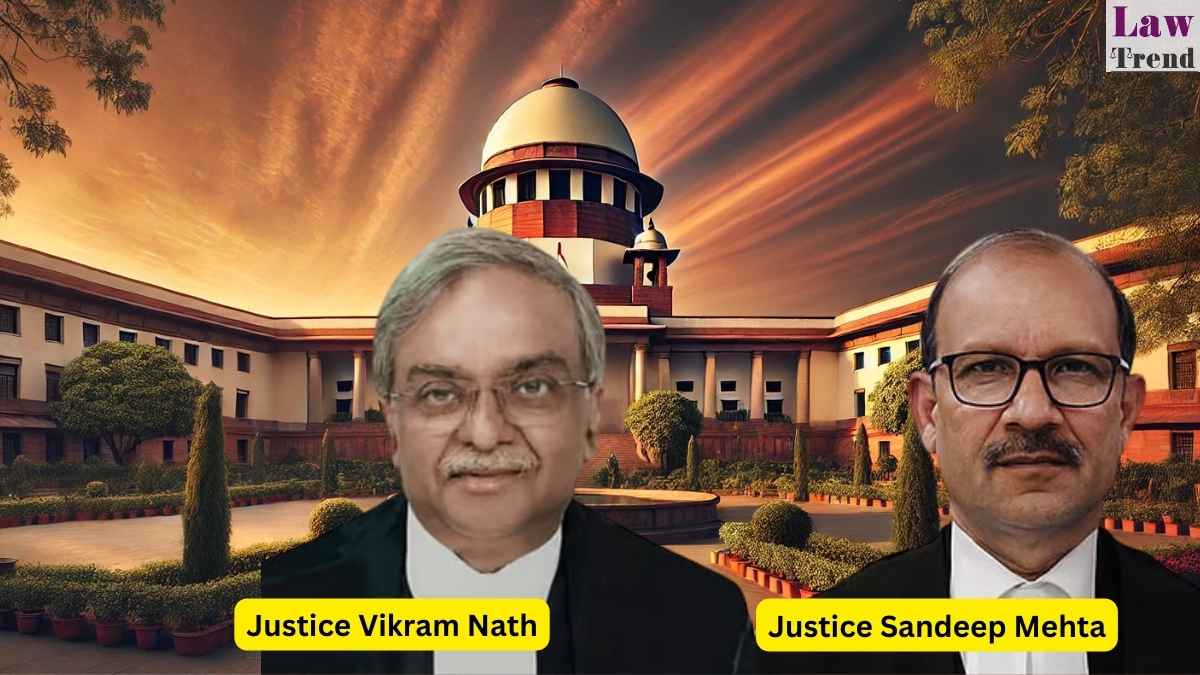
The Supreme Court of India has set aside an order of the High Court of Punjab and Haryana that denied a property owner the right to be impleaded in a writ petition challenging state building rules. A Bench comprising Justice Vikram Nath and Justice Sandeep Mehta held that a party who is “directly and demonstrably affected” by an interim order cannot be shut out from the proceedings, even if they were not an original party to the challenge.
The Court emphasized that the principles of Order I Rule 10 of the Code of Civil Procedure (CPC) serve as a guide for writ proceedings under Article 226 of the Constitution to ensure that the presence of necessary and proper parties enables a complete adjudication.
Background of the Dispute
The Appellant, M/s Chopra Hotels Private Limited, owns a commercial property in Jalandhar. While applying for a completion certificate in 2024, a discrepancy in the front setback was noted. The Appellant claimed the building became compliant under the Punjab Unified Building Rules, 2025, which reduced the minimum front setback requirement to 10 per cent.
However, the 2025 Rules were challenged in a separate writ petition (CWP No. 38742 of 2025). On December 24, 2025, the High Court passed an interim order directing that provisions of the 2025 Rules inconsistent with earlier regulations be kept in abeyance and that violations under previous rules not be regularized.
Relying on this interim order, municipal authorities sealed the Appellant’s building on February 5, 2026, and issued a demolition order. When the Appellant sought to regularize the building under the 2025 Rules, the authorities and later a Single Judge of the High Court rejected the request, citing the Division Bench’s interim stay on the rules.
The Appellant then moved applications for impleadment and clarification of the interim order in the main writ petition. The High Court dismissed these on February 26, 2026, stating the Appellant had “no lis” before the Court and was not a necessary party.
Court’s Analysis and Observations
The Supreme Court disagreed with the High Court’s view that the Appellant was a stranger to the controversy. The Bench noted that the interim order was being actively invoked by authorities to the Appellant’s detriment.
Principles of Impleadment
Referring to the distinction between a ‘necessary party’ and a ‘proper party’ as explained in Mumbai International Airport Private Limited v. Regency Convention Centre and Hotels Private Limited (2010), the Court observed:
“In writ proceedings, where the Court is called upon to interpret the scope and operation of an interim order already passed by it, a person who is shown to be directly and demonstrably affected by that order cannot be shut out merely because such person was not an original party to the principal challenge.”
Direct Impact of the Interim Order
The Court found that the subsequent proceedings placed the matter “beyond doubt” that the stay on the 2025 Rules had immediate consequences for the Appellant. The Bench remarked:
“At the very least, the Appellant was a proper party whose presence would enable the High Court to deal in a fuller and fairer manner with the consequences of its own interim order.”
Interconnection of Remedies
The Court also addressed the procedural complexity involving multiple pending matters: the main writ petition, a Letters Patent Appeal (LPA), and a Civil Revision (CR) against the demolition. The Bench observed that while these matters are interlinked, they should not be rendered “dormant for an indefinite period” just because the parent writ is pending.
The Decision
The Supreme Court allowed the appeals and set aside the High Court’s order dated February 26, 2026. The Court directed:
- Impleadment Allowed: The Appellant’s application for impleadment in CWP No. 38742 of 2025 is allowed, and they shall be added as a respondent.
- Independent Adjudication: The High Court is at liberty to proceed with the main writ petition independently.
- Joint Hearing of Linked Matters: LPA No. 760 of 2026 and CR No. 2579 of 2026 shall be heard together and decided on their own merits, uninfluenced by the previous impugned order.
- Status Quo: The parties are directed to maintain status quo regarding the property until the High Court disposes of the LPA and the Civil Revision.
The Bench clarified that it expressed no opinion on the merits of the building’s compliance or the validity of the 2025 Rules, leaving all substantive questions open for the High Court.
Case Details:
- Case Title: M/S Chopra Hotels Private Limited v. Harbinder Singh Sekhon & Ors.
- Case Number: Civil Appeal Nos. 4880-4881 of 2026 (Arising out of SLP (C) Nos. 9321-9322 of 2026)
- Bench: Justice Vikram Nath and Justice Sandeep Mehta
- Date: April 08, 2026