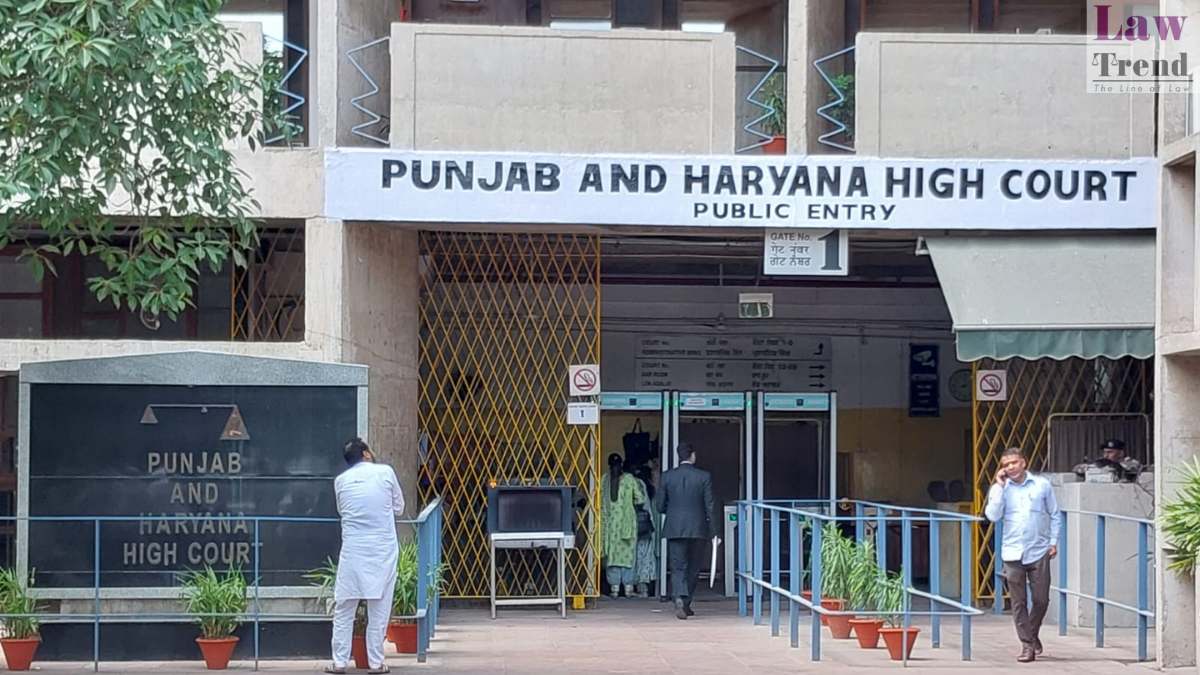
The High Court of Punjab and Haryana has dismissed an application seeking the recall of a previous order in an anticipatory bail matter, terming the attempt to disown a counsel’s statement as “procedural heresy.” Justice Sumeet Goel, while rejecting the plea filed by one Ankit Rawal, imposed exemplary costs of ₹20,000, observing that a litigant cannot be permitted to treat the Court as a “laboratory for experimental litigation.”
The primary legal issue was whether a judicial order, whereby an anticipatory bail petition was dismissed as withdrawn based on a counsel’s statement, could be recalled under Section 528 of the Bharatiya Nagarik Suraksha Sanhita (BNSS), 2023. The petitioner claimed the statement was made without proper instructions. The Court held the application was not maintainable under Section 403 of the BNSS and also lacked merit, as the sanctity of statements made by advocates at the Bar must be upheld.
Background of the Case
The matter arises from FIR No. 166 dated September 30, 2023, registered at Police Station Bapoli, District Panipat. The allegations involve Sections 302 (murder), 341, 323, 148, and 149 of the Indian Penal Code (IPC). According to the prosecution, on the night of September 29, 2023, the deceased (Tasavar) and an injured witness (Azad) were intercepted and attacked by a group of assailants armed with sticks, knives, and sharp-edged weapons. Tasavar succumbed to his injuries at a government hospital.
During the investigation, CCTV footage and weapons were recovered, and multiple accused persons were identified. The petitioner, Ankit Rawal, sought anticipatory bail. On January 28, 2026, his then-counsel withdrew the petition with liberty to appear before the trial court within seven days and seek regular bail. Rawal subsequently moved the present application to recall that order.
Arguments of the Parties
Petitioner’s Contentions: Represented by Mr. Gaurav Grover, the petitioner argued that the earlier counsel made the statement regarding surrender and regular bail without “proper instructions.” He contended that he had only authorized the withdrawal of the petition if the Court was not inclined to grant relief, but never authorized an undertaking to appear before the lower court. On merits, he argued that his name was not in the FIR, he was implicated solely on a co-accused’s disclosure statement, and no recovery was to be made from him.
State’s Contentions: The State, represented by Ms. Mahima Yashpal Singla, Senior DAG Haryana, opposed the recall, stating the order was passed after a categorical and voluntary statement by the counsel. On merits, the State emphasized the gravity of the murder charge, the brutal nature of the attack, and the necessity of custodial interrogation to ascertain the complete chain of events and the role of each participant.
Court’s Analysis
Justice Sumeet Goel noted that the application was barred by Section 403 of the BNSS (corresponding to Section 362 of the Cr.P.C.), which restricts the power of a criminal court to alter or review its judgment or final order.
The Court further addressed the advocate-client relationship, observing:
“The judicial process operates on the foundational presumption that statements made by a counsel at the Bar are made with full authority and reflect the true intent of the litigant concerned.”
The Court remarked that by executing a Vaqalatnama, a litigant clothes the counsel with express and implied authority. To allow a litigant to resile from such statements would render judicial orders “vulnerable to being reopened, simply because the litigant has had a change of heart or has engaged a new counsel.”
Regarding the petitioner’s specific claim of “lack of instructions,” the Court stated:
“The attempt by the applicant-petitioner to disavow the withdrawal of petition under the guise of ‘lack of instructions’, amounts to a procedural heresy striking at the very root of the advocate-client relationship… The petitioner having put his signature on the Vaqalatnama, cannot be permitted to act as a stranger to the actions taken by his earlier counsel in open court.”
On the merits of the anticipatory bail, the Court cited the Supreme Court decision in State v. Anil Sharma (1997), reiterating that custodial interrogation is “qualitatively more elicitation-oriented” and that effective interrogation is vital in such serious offences.
Decision
The Court dismissed the application (CRM-8361-2026) and imposed costs of ₹20,000 to be deposited with the CJM, Panipat, for remittance to the Haryana State Legal Services Authority. The Court concluded:
“To accept this plea would virtually allow the applicant-petitioner to abuse the process of law by turning this Court into a laboratory for experimental litigation… The sanctity of the judicial process will be seriously eroded if such attempt(s) is not responded with necessary firmness.”
The Court clarified that its observations would not affect the merits of the ongoing investigation or trial.
Case Details:
- Case Title: Ankit Rawal v. State of Haryana
- Case Number: CRM-8361-2026 and CRM-9472-2026 in CRM-M-4433-2026
- Judge: Justice Sumeet Goel
- Date of Judgment: March 16, 2026