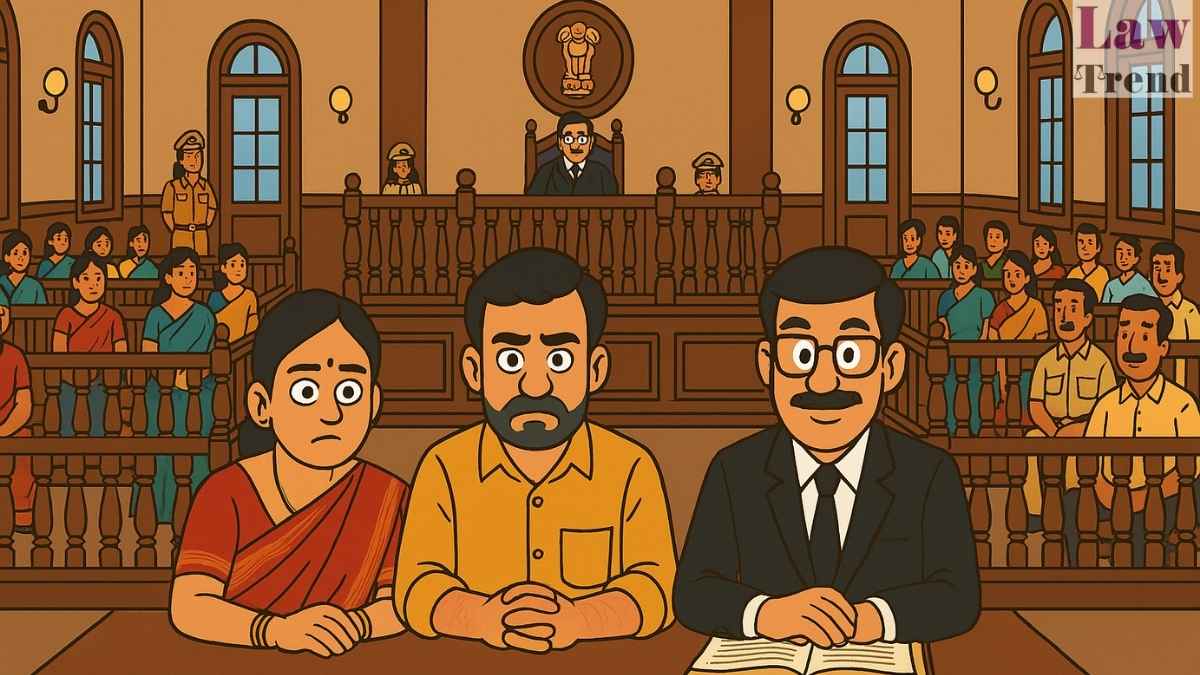
The High Court of Jammu & Kashmir and Ladakh has held that a wife residing separately from her husband by mutual consent is statutorily barred from claiming monthly maintenance under Section 488(5) of the Criminal Procedure Code (Cr.P.C.). However, exercising its inherent jurisdiction to ensure substantial justice and prevent vagrancy, the Court directed the respondent-husband to pay a one-time settlement of ₹2.50 lakhs to the petitioner-wife.
The judgment was pronounced by Justice Sanjay Parihar in a case involving complex questions of customary divorce and the statutory right to maintenance.
Background of the Case
The parties were married in 1990 and had a son from the wedlock. In 1995, the petitioner-wife filed proceedings under Sections 494/109 of the RPC and Section 488 of the Cr.P.C., alleging that her husband had contracted a second marriage. On August 28, 1995, the parties entered into a compromise, executing a customary divorce (farakhtnama). The wife withdrew her legal complaints upon receiving ₹10,000 as a full and final settlement, and the parties began living separately.
In subsequent proceedings in 2003 and 2007, where she sought maintenance solely for her minor son, the petitioner described herself as a divorcee. However, in March 2008, she filed a fresh petition under Section 488 Cr.P.C. seeking maintenance for herself, without disclosing the 1995 settlement.
After multiple rounds of litigation and a failed Lok Adalat settlement in 2013 (where the husband had agreed to pay ₹2.50 lakhs as permanent alimony), the Chief Judicial Magistrate (CJM), Ramban, allowed her petition on June 29, 2020, granting ₹2,000 per month as maintenance. The respondent-husband challenged this before the Principal Sessions Judge, Ramban (Revisional Court), which set aside the CJM’s order on November 3, 2020. The Revisional Court concluded that since the parties were living separately by mutual consent, the wife was disentitled to maintenance under Section 488(5) Cr.P.C. The petitioner subsequently moved the High Court to challenge this revisional order.
Arguments of the Parties
Counsel for the petitioner-wife argued that there was no proof of a lawful dissolution of marriage, as a customary divorce was never strictly proved in accordance with the law. Relying on the Supreme Court judgment in Shail Kumari Devi v. Krishan Bhagwan Pathak and the Division Bench judgment of the J&K High Court in Vijay Kumari v. Ashwani Kumar, the petitioner contended that the statutory right of maintenance is founded on public policy and cannot be waived by a private agreement.
Conversely, counsel for the respondent-husband argued that the petitioner had unequivocally admitted to the separation via customary divorce. Pointing out that she had lived separately since 1995 and only revived the claim after the respondent secured a government job, the defense relied on judgments including Popat Kashinath Bodke v. Kamalabai Popat Bodke and Vitthal Hiraji Jadhav v. Harnabai Vitthal Jadhav to argue that maintenance cannot be granted to parties living apart by mutual agreement.
The Court’s Analysis
Justice Sanjay Parihar concurred with the lower courts that the respondent failed to prove a valid custom permitting dissolution of marriage through a farakhtnama. Without a decree of divorce or proven custom, the marital tie could not be considered legally severed.
However, the Court emphasized the statutory bar under Section 488(5) Cr.P.C. The Court observed the petitioner’s prolonged conduct, noting that she withdrew her 1995 complaint after taking a monetary settlement, described herself as divorced in child-maintenance applications, and lived separately for over a decade without asserting marital rights.
The Court noted:
“It is a settled principle that an admission constitutes substantive evidence against its maker unless satisfactorily explained… In the present case, the petitioner had earlier withdrawn proceedings, accepted monetary settlement, described herself as divorced, and remained separate for a considerable period. These acts constitute clear admissions of consensual separation.”
Reiterating the scope of revisional jurisdiction, the Court referred to Supreme Court precedents such as Santosh (Smt.) v. Naresh Pal and Parvathy Rani Sahu v. Bishnu Sahu. The High Court stated that while an informal agreement might not dissolve a statutory marriage, it is highly relevant to determine the nature of separation.
The Court observed:
“Even assuming that the marriage legally subsisted for want of proof of custom, the petitioner cannot be permitted to approbate and reprobate by asserting divorce in earlier proceedings and later claiming desertion. The principle of estoppel by conduct would operate against her. Her consistent admissions in judicial proceedings that she was divorced and living separately disentitle her from now asserting that she was deserted without cause.”
“if spouses enter into an agreement to live separately on permanent basis and such agreement is acted upon, Section 488(5) Cr.P.C. disentitles the wife from claiming maintenance if she is living separately by mutual consent.”
The Decision
The High Court upheld the Revisional Court’s decision, confirming that the petitioner was not entitled to monthly maintenance under Section 488 Cr.P.C. due to the mutual separation. Accordingly, the wife’s petition [CRM(M) No. 444/2020] was dismissed.
However, taking note of the petitioner’s current dependency on her son, her lack of independent income, and the escalation in the cost of living since the initial ₹10,000 settlement in 1995, the Court invoked its inherent jurisdiction. Citing the husband’s prior unwithdrawn consent to pay ₹2.50 lakhs during the 2013 Lok Adalat proceedings, the Court intervened to prevent destitution.
The Court ordered:
“In order to advance the cause of justice and to prevent the petitioner from falling into a state of vagrancy, this Court, while exercising its inherent jurisdiction to achieve substantial justice, considers it appropriate to direct the respondent to pay a sum of ₹2.50 lakhs to the petitioner as a one-time settlement.”
The respondent was directed to pay the amount within six months, failing which a 6% per annum interest would be applicable. The Court also ordered the release of ₹1,40,091 currently lying in an FDR (from the respondent’s previous deposits) to the petitioner.
Case Details
- Case Title: Sarita Devi V/s Mohan Singh
- Case Number: CRM(M) No. 444/2020 c/w CRM(M) No. 279/2021
- Coram: Justice Sanjay Parihar
- Date: 06.03.2026